Luis Feliz Leon

In a watershed victory, workers at the Volkswagen factory in Chattanooga, Tennessee, voted tonight "UAW, yes!" The company's sole non-union plant will finally join the rest of the world.

“If Volkswagen workers at plants in Germany and Mexico have unions, why not us?” said equipment operator Briam Calderon in Spanish, ahead of the vote.

"Just like Martin Luther King had a dream, we have a dream at Volkswagen that we will be UAW one day," said Renee Berry, a logistic worker on the organizing committee who's worked at the plant for 14 years.

Main Image: 
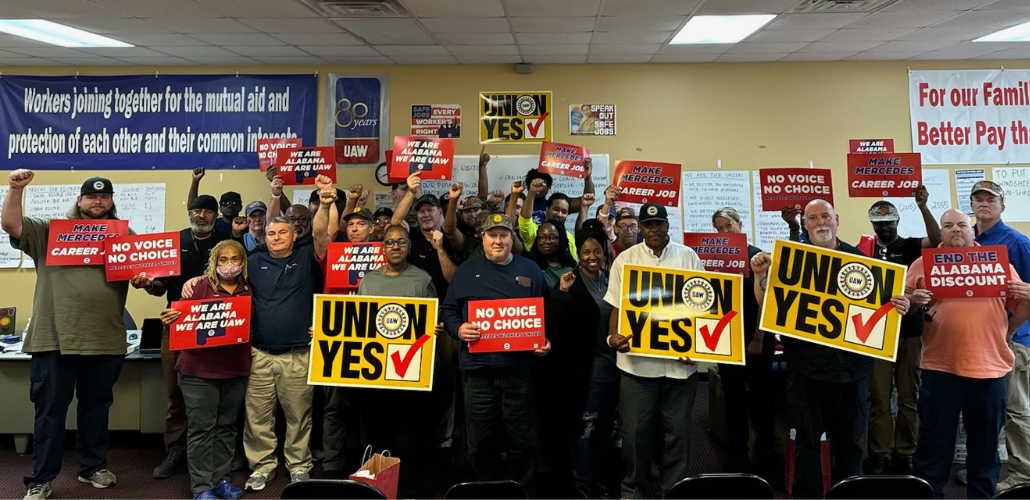
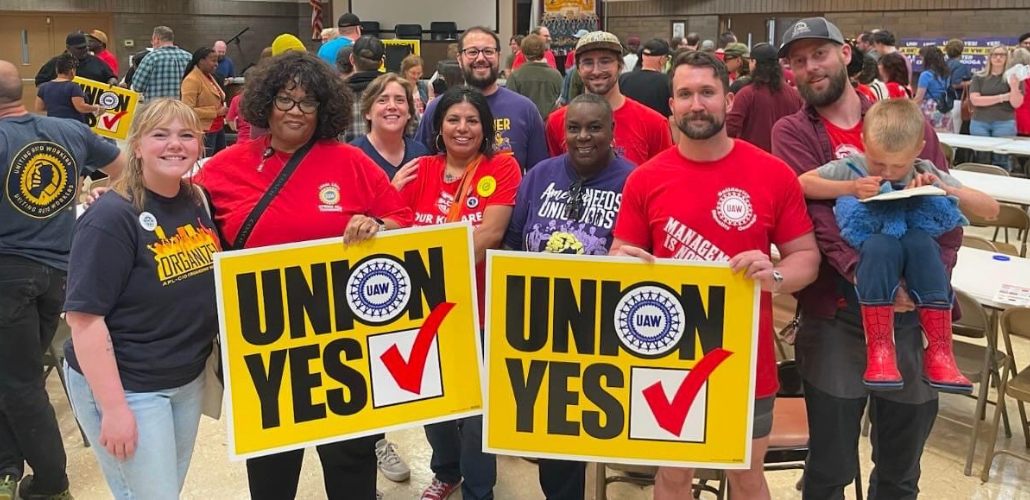
Ten smiling people pose together in a crowded meeting room. Two are holding huge yellow "Union Yes" signs with the UAW logo. Most are wearing red, blue, or purple T-shirts with UAW logo or organizing-themed slogans. The man on the far right holds a small child in his arms.

With a Velvet Glove, Mercedes Tries to Punch Down Alabama Union Momentum
Blog: 
Author(s): 

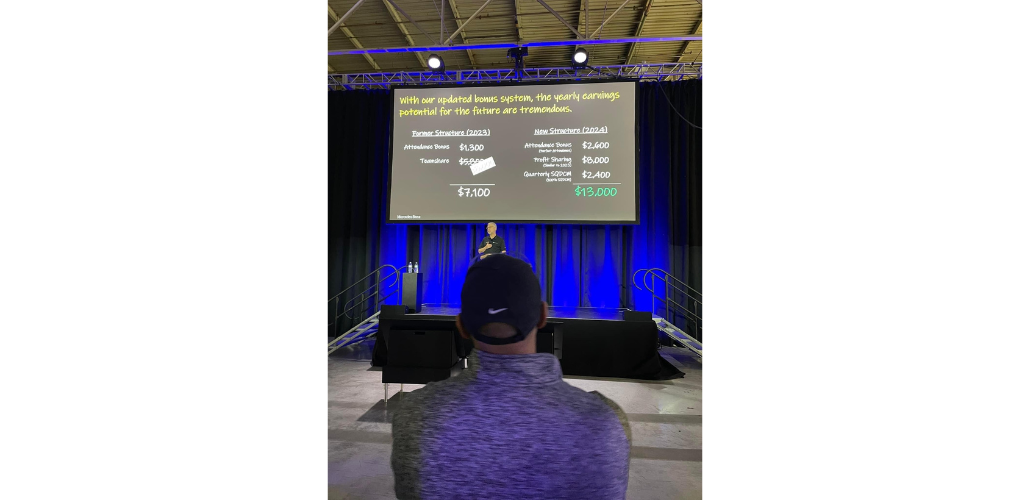
Workers at Mercedes-Benz in Alabama were forced to attend 20-minute anti-union meetings with the company’s top management today.

Recordings obtained by Labor Notes show top management dangled carrots and put on a contrite-boss act, promising to do better.

Workers filed with the National Labor Relations Board on April 5 for the first-ever election to unionize the 5,200 people who work at the plant.
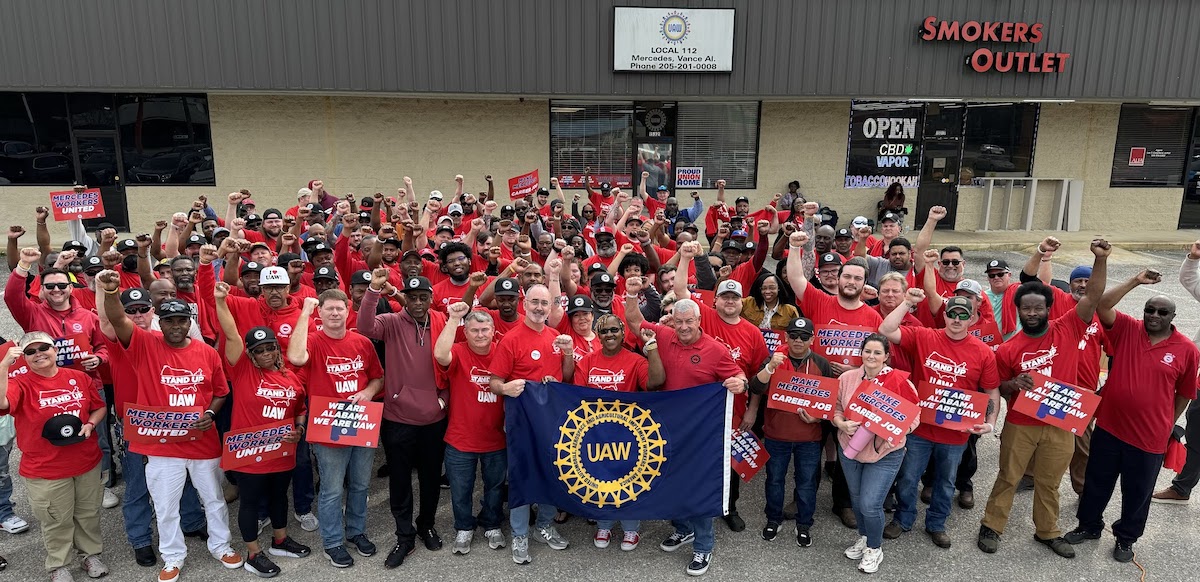
Auto workers are gearing up to smash through anti-union bulwarks in Alabama and Tennessee.

In Chattanooga, Tennessee, at the only Volkswagen factory in the world without a union, votes will be counted April 19 as 4,300 workers who make the Atlas SUV and the ID.4 electric vehicle decide whether to join the United Auto Workers.

“We didn’t think things would happen so fast,” said VW worker Victor Vaughn.

Main Image: 
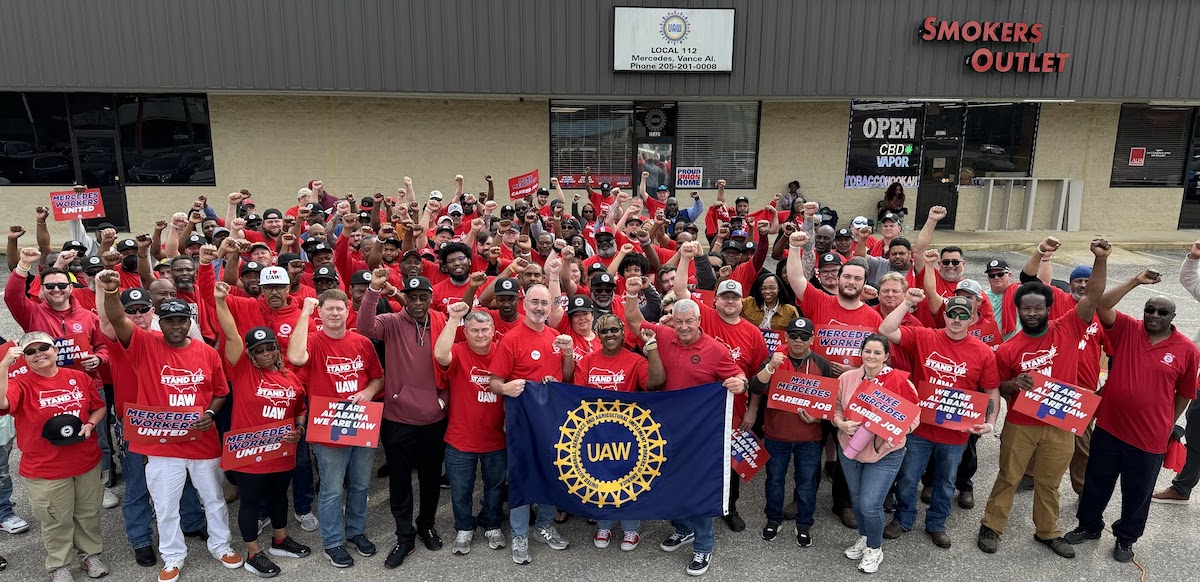
A group of a hundreds autoworkers gather outside with red shirts and fists raised.

Auto workers at a Toyota engine plant in Troy, Missouri, have signed up 30 percent of their 1,000 co-workers to join the United Auto Workers (UAW)—a first at Toyota, the world’s largest automaker, on the heels of the union’s announcements of organizing campaigns at Volkswagen, Hyundai, and Mercedes-Benz.

Main Image: 
Thirty people, many with fists raised stand behind a banner that says “Stand Up, for safe jobs, for fair pay”

Fifteen hundred auto workers in Indianapolis made their New Year’s resolution public: unless Allison Transmission agreed to eliminate tiers in wages, benefits, shift premiums, and holidays, they would hit the bricks.

“The fight plan throughout negotiations was ending tiers,” said Phil Shupe, a 10-year assembler on tier two and bargaining committee member. “We weren't going to accept anything from the company that had any more division. We stood firm that we all needed to be equal.”

Main Image: 
Forty workers in red t-shirts pose together outside a building with a blue awning.

In 1978, Volkswagen became the first foreign-owned company to manufacture cars in the United States since Rolls-Royce in the 1930s, setting up shop in Westmoreland, Pennsylvania.

“This is one of the most important organized victories in years for the UAW,” said United Auto Workers President Doug Fraser after VW workers voted 865 to 17 to join the union. “We believe that there will be other foreign automakers deciding to open plants in the U.S. and we intend to organize those workers as well.”

Main Image: 
A blue box shows with the notation: “Photo license expired”

Auto workers at Hyundai in Montgomery, Alabama, have signed up more than 30 percent of their nearly 4,000 co-workers in an ambitious drive to unionize.

The Auto Workers (UAW) announced the organizing breakthrough with a new video, “Montgomery Can’t Wait,” where workers link the labor and civil rights movements: “Montgomery, the city where Rosa Parks sat down, and where thousands of Hyundai workers are ready to Stand Up.”

Main Image: 
Three smiling men, two African American, one European American, face the camera

Sometimes workers just want to listen to music to escape the drudgery of repetitive work. But until recently, Amazon prohibited workers in all its facilities to use earbuds while stuffing boxes—and handed out write-ups to workers who defied the ban.

Sure, managers would blast music on the loudspeakers—but then workers couldn’t hear each other talking across the conveyor belt. And what if workers wanted to hear their own music, or an audiobook on organizing?

Main Image: 
About 25 people walk along a sidewalk, some carrying signs.

Today workers at Volkswagen's Chattanooga, Tennessee, assembly plant announced their third bid to unionize plant-wide with the Auto Workers (UAW).

Riding the momentum of its strike of the Big 3 automakers, the UAW now wants to double its numbers in the auto industry by adding 150,000 workers at companies that have long avoided unionization. Thirteen non-union automakers are on notice: Honda, Toyota, Hyundai, Nissan, Subaru, Mazda, Mercedes, Volvo, BMW, Volkswagen, and electric vehicle producers Rivian, Tesla, and Lucid.

Main Image: 
A masked worker in overalls place a seat into a car on an assembly line.

“The company knows that Toyota workers are watching,” said Auto Workers President Shawn Fain on November 3. “And when the time comes, Toyota workers and all non-union auto workers are going to be ready to stand up.”

That time has come—yesterday the UAW announced its plan, already in motion, to organize the whole auto sector. “Workers across the country, from the West to the Midwest and especially in the South, are reaching out to join our movement and to join the UAW,” said Fain in a new video.

Main Image: 
A determined-looking woman with a crowd behind her wears a red shirt saying UAW, Back in the Fight

Pages