ICE Raids Turn Schools into Battlegrounds to Defend Students
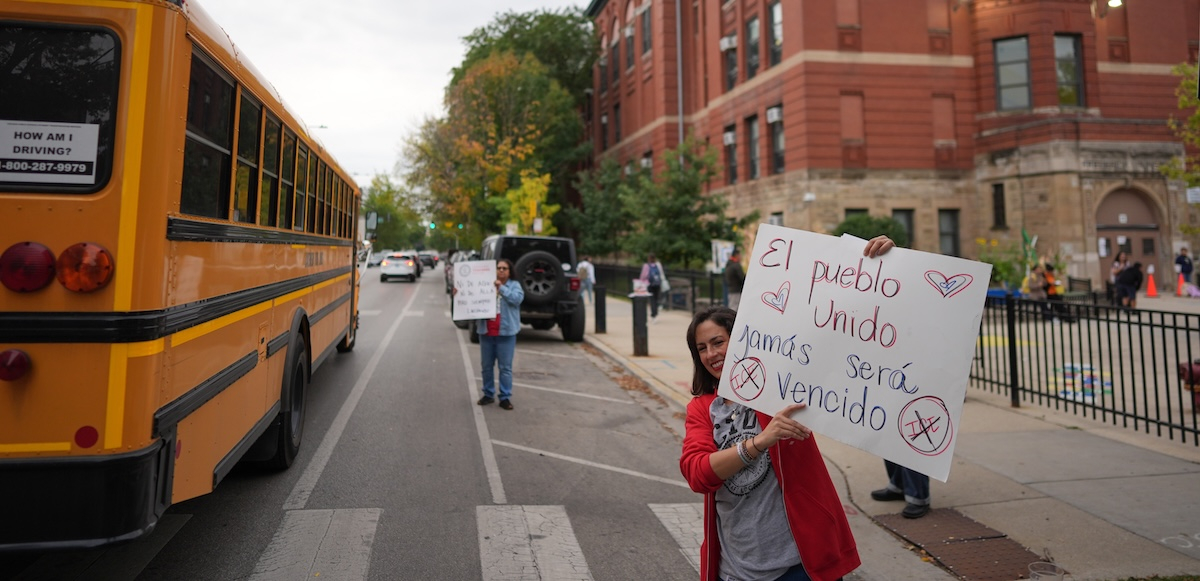
First grade teacher Maria Heavener held a sign saying “The people, united, will never be defeated,” in Spanish as she participated in Sidewalk Solidarity, a show of support by Chicago Teachers Union members for the school’s immigrant community in Chicago’s Logan Square neighborhood in October. Photo: AP/Rebecca Blackwell
Educator Carolyn Brown was meeting with school counselors when she got the call: ICE agents were out front. By the time she got out of the building, ICE had abducted a woman and her 17-year-old daughter, an American citizen.
Brown, a coordinator of the International Baccalaureate program at Thomas Kelly College Prep, is also part of the rapid-response team for the school, in a Mexican enclave in Chicago’s Little Village neighborhood.
The ICE agents were gone, for the moment. But in the stores across the street, people were too frightened to venture out. Brown and her co-workers talked with shopkeepers and shoppers, and started arranging rides for people to return home.
Meanwhile a helicopter thumped overhead. Down the street, ICE had caused a car crash. Parents and older siblings were showing up to pull their students out of school early and head home for safety. The teachers lined up and held welcoming signs, telling students and their families, “We will keep you safe here.”
Defending schools as places of safety and joy is a growing challenge for rattled educators in Chicago, Los Angeles, and Washington, D.C., where heavily armed men strapped with tactical vests are swarming neighborhoods, snatching people from the arms of loved ones and from the streets that lead to school.
These deportation roundups are designed as spectacles of terror. Masked federal agents detain people without showing badges; they appear faceless, wearing neck gaiters, not even the whites of their eyes visible behind sunglasses.
Nationwide at least 60,000 immigrants are detained in privately contracted prisons. In this expanding dragnet, schools have become battlegrounds, and teachers and communities are staging a bulwark against federal assaults on their students and families.
IT HELPS TO BE PREPARED
During the first Trump administration, United Teachers Los Angeles organized to make the L.A. schools “sanctuary schools,” which means school staff and teachers won’t cooperate with immigration officials on school grounds.
Last spring, as attacks on immigrants escalated and schools became potential sites of terror, physical education teacher Denisha Jordan said, the union decided “it was time to bring those policies back to life.” UTLA led trainings on immigrant rights and protections.
When school started back and ICE was intensifying its attacks, activists were able to get do’s and don’ts out quickly, because the union has a strong communication network within schools and across regions: area representatives communicate with school-based representatives, who communicate with members.
Chicago had also prepared—educators and neighbors had held trainings, formed rapid-response teams, and distributed red cards with know-your-rights information. When the attacks came in earnest, the training expanded to include information about how to film ICE, how to report ICE, how to warn of a raid.
Besides strong union structures, UTLA and the Chicago Teachers Union both had longstanding community relationships, which helped teachers respond, often following the lead of community organizations.
WAKING UP A SLEEPY UNION
In Washington, D.C., Laura Fuchs, the newly elected president of the Washington Teachers Union, is acutely aware that her union doesn’t have those structures in place to activate.
“Our union has been sleepy for a long time,” she said. “We have to build up basic systems so that we are prepared for when we face an even more direct attack. So that the union will be seen as the place to do this work.”
The National Guard arrived in D.C. just weeks after Fuchs took office. Soldiers took up positions around Metro stations where students gather; D.C. students do not get school bus service, and rely on Metro trains to get to school.
The soldiers harassed and intimidated students, many of whom had not yet received their district-issued Metro passes. It is customary that, if passes have not gone out yet, students still use the Metro.The soldiers stopped the students from accessing the Metro if they did not have a pass.
The National Guard was only one branch of federal forces in D.C.; there were also men wearing uniforms with an alphabet soup of acronyms in a coordinated onslaught of repression: ICE, ATF, FBI, DEA.
The D.C. community—anchored by groups like Empower Ed and Free DC—responded by organizing “walking school buses” for younger children, where adults walk along a bus route and pick up children along the way. For older children, they organized an adult presence at the Metro stations and posted lookouts on street corners. They formed text-message groups to educate people about what was needed, how to support families, and how to track and respond to federal agents.
MEETING IMMEDIATE NEEDS
In Waltham, Massachusetts, outside Boston, community organizations anchored a groundswell of support, including lawyers, mutual aid, a pro-immigrant rally, and funding for families struggling economically after a provider was abducted.
Kelly Henderson, a Newton teacher who lives in Waltham, said she got involved when she saw someone being abducted from the courthouse down the street from her home. “I texted two people I knew,” she said, “and it just so happened one of them knew how to connect me. Now we have hundreds of people in a Signal chat.”

These hundreds of people call their organization FUERZA, Spanish for “force,” and they are providing street watchers, food delivery, and kits for kids that include toys and coloring books. They have a case management team to support families when a member has been abducted, and a fundraising team to support $500 grants to families that have lost breadwinners to ICE raids.
All of these teacher unions are taking the lead from well-established community organizations. But there is also story after story of people who are not connected to an organization or the union or the school, reaching out or showing up at schools, demonstrations, and workshops to offer their support. Which is essential, said history teacher Chloe Asselin in D.C., “because there is so much to put in place in order to have a response. We need all of the volunteers.”
KIDS MISSING SCHOOL
Anywhere raids are happening, students are traumatized and afraid. Brown, the Chicago educator, said that attendance has dropped off—teachers guess that it’s usually due to fear, but there’s no way to know if it’s because the student’s family moved, or if the student moved in with a relative after adults in the family were abducted. Just tracking students has become more complicated.
In D.C., schools are evaluated based on attendance. But students who were being harassed at Metro stations, or whose parents didn’t feel safe sending them out, were missing school.
For teenagers, says Asselin, a curfew and the National Guard “had a profound effect on kids who were already being scrutinized, and took this scrutiny to a whole different level.” Wilson said enrollment got so low in Los Angeles schools that there were 100 more teachers than positions for them, leaving teachers unassigned.
THREE LAYERS OF PREPARED
Oakland elementary teacher Jessie Papalia realized last spring that, when it came to ICE, her school district was thinking through the lens of liability, not resistance. She gathered a group of friends and educators to build out a plan and team to prepare resistance.
From a handful of educators, they grew to more than 100 strong, including parents and others from the community, enacting a three-tiered plan to protect students and families.
The first tier is that every school has a proactive plan that includes trainings for families and educators, response teams, and posted signs explicitly indicating that ICE is not allowed on campus.
A smaller number of schools, those with higher numbers of students who are immigrants, are part of the second tier of school defense. These schools add foot patrols during arrival and dismissal times to form a protective presence during the highest-risk parts of the school day.
The third tier is a citywide first-response network of people from the schools and the community, ready to mobilize within minutes if ICE appears at any school.
MAKING SPACES OF SAFETY AND JOY
Teachers are committed to keeping students safe and making classrooms spaces of joy, but don’t want to deny what is happening.
In L.A., at the beginning of the school year, teachers held big parties with music and cheerleaders to extend a warm welcome to students and families.
As the attacks escalated in Chicago, where a child care teacher was recently abducted from the day care center in front of children, finding joy got more and more difficult.
“We want to give the children an experience everyday that is normal,” said Brown. “They don’t want to talk about ICE all day. They want to be kids, to have friends, to learn. We are spending lots of time learning how to strike the balance: normalcy, but not pretending that the world is not insane.”
TEACHERS TRAUMATIZED TOO
Striking this balance is tough on teachers themselves, who are experiencing their own trauma.
“That is where the dissonance comes in,” said one Chicago teacher, who preferred to not be named. “Things that are so big and out of the norm are happening, and then you have to submit your grades.
“We are responsible to create a space that is structured and safe, where they know what is going to happen—to bring in joy—but our own cups are being drained.”
In Los Angeles, the union is also in the middle of a contract campaign. “It is a huge challenge, in the middle of everything that is going on, to ask teachers to do more,” Wilson said. Still she said, the day after we spoke they would be leafleting schools about their contract demands.