Bring Member Power to the Table By Opening Up Bargaining
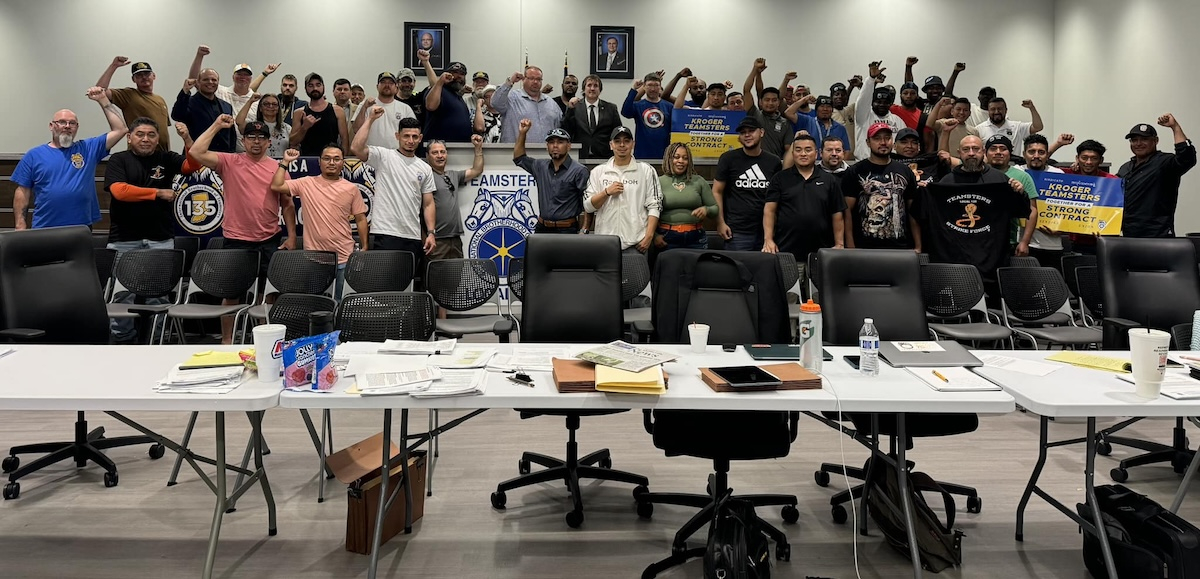
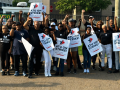
Teamsters Local 135 bargained with Kroger with a big group of members attending to observe, and later tell others what they heard and saw. Photo: Teamsters Local 135
Since electing new leadership in 2022, Teamsters Local 135 in Indiana has completely changed the way it conducts negotiations. It’s using open bargaining to revitalize the local.
Under the previous leadership, a small bargaining team negotiated behind closed doors. Gag orders ensured that members would know nothing about negotiations until an agreement was presented for a vote.
“It would be the business agent and a couple of stewards,” says business agent Robert Doolin, who started out in 1998 at a warehouse that supplies Kroger. “I always hated this. The company would always try to put a gag order on negotiations.”
Now Local 135, which is one of the biggest locals in the Teamsters with 12,000 members, pushes to make negotiations open to all members. “Not only do we tell management we’re going to tell the members what’s going on,” says Doolin, “we tell them we’re going to invite members to watch what you’re going to say.”
Pepsi, Coke, and Kroger negotiations no longer take place in a little conference room. Instead the local offers its union hall for bargaining sessions. If companies don’t want that, management can pay for a larger space. The message to employers, says Local 135 President Dustin Roach, is: “We don’t tell you who you can or can’t have on your team, and you don’t tell us.”
At Zenith Logistics, the local mobilized 150 of the site’s 190 members to join negotiations. “We were in a caucus,” Doolin says. “The general manager walked back in and everybody was there. He wasn’t expecting that. The first words out of his mouth were, ‘Oh shit.’”
From then on, 50-plus members were in the room regularly. “We ask everybody to come before shift, come after shift, come on your days off,” says Doolin. “If you can only be there for an hour, great.”
By opening up the bargaining process and organizing member-driven contract campaigns, Local 135 has been winning major raises, stronger strike language, and additional vacation time.
PREPARATION IS KEY
Opening up bargaining requires preparation—and it’s not just about what happens in the room at negotiations. “It really goes a lot further than just opening up some seats and saying it’s open bargaining,” says Doolin. “We’ve been trying to include the membership all the way through the negotiating process, to get them involved, get them working for their contract as well.”
At Kroger, Local 135 began passing out flyers to members nine months before negotiations started. They handed out windshield signs and badges with the word “union” in the warehouse’s top four languages (Spanish, English, Chin, and Haitian Creole). They also surveyed members about their top priorities, and asked whether members would help by passing out flyers or phone banking. In the process they collected members’ current contact information.
At Pepsi, Coke, and Bimbo, the union started with member meetings to review what they already had. “Most of the workforce doesn’t open up the contract,” says business agent Jesse Mikesell, who worked at Pepsi for 18 years. “It’s hard to make proposals if you don’t know what’s in your contract.” These kinds of meetings really helped get people engaged in the campaign, he said, “even if it’s a quick meeting between shifts.”
Mikesell looks for ways members can take ownership of their own campaigns, including choosing campaign slogans. Bimbo bread delivery drivers and loaders landed on “Bimbo needs more dough.” The local also expanded the size of the bargaining committee beyond just stewards, and made sure all the key work groups were represented.
‘A MORE SERIOUS MESSAGE’
Even if management agrees to allow any member to observe bargaining, only a fraction of members will attend most of the time. Choose strategic times to push for a big turnout, like when deeply felt issues are on the agenda. Sessions focused on wages or other economic issues can be particularly good targets for mobilization.
Local 135’s open bargaining push has helped turn up the pressure on employers, says Mikesell: “It delivers a more serious message to the company—that members are involved, and that these members are ready to take you guys on if they need to.”
The union has also begun taking contract deadlines more seriously, backed up by enhanced strike pay of $1,000 a week from the Teamsters international.
Open bargaining has helped win over some skeptical members even in right-to-work Indiana, says Mikesell: “There were a half-dozen long-tenured members at Kroger who said, ‘The union only protects the troublemakers, and I don’t need the union because I don’t get in trouble.’
“At the end of negotiations, these guys come up and say, ‘I’ve got a new respect for the union. I didn’t know this stuff was going on behind the scenes. I can see who’s trying to hold me down now—it’s not the union, it’s the company.’”
GROUND RULES FIGHT
Open bargaining gained steam first in the public sector, especially in K-12 and higher education. Trailblazers like Teamsters Local 135 and the national NewsGuild, where reformer Jon Schleuss won the presidency in 2019, are proving it can work in the private sector too.
The NewsGuild, representing 26,000 journalists and media workers, has been using open bargaining with many newsroom employers. “Open bargaining is about transparency, from the union’s perspective,” says Nick Bedell, a NewsGuild organizer. “We are talking to the employer in a way that is representative of the way you want us to talk to them—and we’re so confident that you can come watch. And if you’ve got issues with it, you can let us know.”
But management often pushes back against allowing observers, especially after seeing how it can strengthen the union’s hand. To press for open bargaining, the Guild has mobilized a lot of observers for the first session, when negotiators discuss ground rules. “The employer often gets pissed and leaves,” says Bedell, “so we file a bad faith bargaining charge and put lots of pressure on them to allow observers.” The union has often won out.

Why does the Guild fight so hard to open up bargaining? “It tends to tip the scales, in terms of who has the power, toward the union,” says Bedell. In standard bargaining, he says, the bargaining team often “experiences the employers’ bad behavior and relays it to the membership. And then the membership just starts bargaining with the union: ‘Why didn’t you say this?’ ‘Why didn’t you say that?’”
That dynamic changes when members observe bargaining themselves. “Management is the best organizer ever,” says Bedell. “Let them tell you that you’re not worth any money. Let them tell you you don’t deserve just cause. Let them tell you you’re going to get disciplined if you’re five minutes late because the subway was broken down.”
PHASE IT IN
Some officers and longtime stewards may be used to the way things have always been. So it’s important to help the negotiating committee warm up to the idea, and understand that they don’t have to agree to the old ground rules, like limits on what they can tell members or the press.
“Step number one is not agreeing to blackouts,” says Sandy Pope, bargaining director for the Office and Professional Employees (OPEIU). "What to say to the members and whether to put information in the public sphere is a strategic decision that the union should control."
Officers and others may also worry that members who attend bargaining won’t stay on message. Pope suggests that skeptical locals can limit the number of observers at first. Get observers to show up to negotiations 15 minutes early for a short training on what will happen at the bargaining table. Emphasize that only bargaining committee members should speak, but observers can share thoughts afterwards.
Observers can be recruited to the union’s outreach or contract action teams, Pope says. “People think that because they open up bargaining that’s everybody—but that’s just a fraction of the members [who show up].” Observers can bring key takeaways from bargaining back to their work groups, and gauge members’ reactions.
In Local 135’s negotiations with Pepsi and Coke, Doolin says, contract action team members divided up the task of texting out updates to the rest of the members after each session, to avoid rumors and confusion that could foment division.
“People who see for themselves firsthand can be better communicators,” says Pope. “It also relieves the bargaining committee from having to do everything—you can split up jobs.
“Having more members observe the bargaining process actually helps you,” she says. “Otherwise you’re carrying management’s water. You’re telling members why they’re not getting the $3 an hour you asked for, instead of them witnessing that management offered 5 cents at the beginning, and you’ve been in a fight from there.
“I don’t understand why some union leaders don’t figure out how much they lose by hiding things.”
NOT THE ONLY APPROACH
Unions should be wary of making a fetish of open bargaining, however. If employers fight hard to keep observers out, do you want to spend months fighting over this? Could you instead expand the bargaining team?
Also consider whether your union is prepared to mobilize a lot of members to the table. If few people turn out, that shows weakness to the employer. Better to focus on building up the union before you move to open bargaining.
Opening up bargaining doesn’t automatically make things more democratic or transparent. Will sessions be scheduled when members can meaningfully participate? Who is most likely to actually attend? How can you make sure information gets to all members?
In some situations, open bargaining may not make sense. Maybe the employer is too big or spread out. Or they’re looking for excuses to drag out a tough contract fight, and this issue becomes one of them.
“You need to talk about what the goal is,” says Gay Semel, retired general counsel for Communications Workers District 1. “The goal is member involvement and democracy. Are there other or better ways to do it in your specific situation?”
Says Bedell: “The question in bargaining is always: ‘Is this strategic?’ That goes for opening up bargaining, too.”