Mexico Volkswagen Workers Could Soon Strike
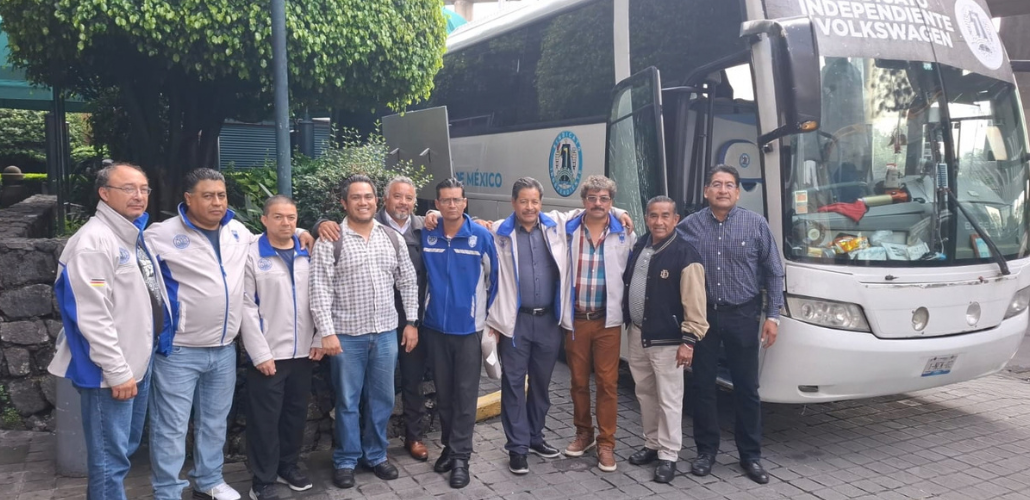
SITIAVW's negotiating committee gathers ahead of negotiations. Photo: SITIAVW
In Mexico, at the world’s largest Volkswagen facility outside of Germany, workers are weighing the risks of a possible strike.
The 6,500 workers build the Jetta, Tiguan, and Taos at the company’s Puebla plant. Their union, SITIAVW, is one of Mexico’s most storied independent unions, and is in the midst of the plant’s annual wage reopener negotiations.
Days before the strike deadline of October 22, the company presented two proposals—offering raises of 7.98 percent and 7.95 percent for a one-year duration—which were rejected by the union. Soon afterwards, the company presented another offer: an 8.24 percent increase, of which 3.59 percent is a one-time payment of 12,000 pesos, equivalent to about $641 USD. The deal would maintain the yearly salary reopener, a cycle the company had tried to lengthen in previous offers. Workers will vote on the offer on October 28th, and could strike the next day if a deal is not reached.
On October 15, workers voted down an offer that would have provided a 13 percent combined increase to wages and benefits over the next two years. The vote was 3,135 against and 2,452 for.
A month earlier, workers had overwhelmingly voted down the previous offer of a 10 percent combined increase. (The union had been pushing for a 17 percent increase earlier in negotiations.) Days before that first agreement was put to a vote, Volkswagen cut one of three shifts in a segment of the plant that produces the Jetta and the Tiguan. About 800 workers lost their jobs, El Financiero reported.
Although the union announced that 611 of the workers—those who did not sign voluntary separation agreements—would be eligible for reinstatement when Volkswagen begins production of its Golf compact car at the Puebla facility next April, the damage was done. 5,925 of the company’s 6,440 eligible voters participated in the ratification vote: of them, 73 percent voted to reject the offer, in what SITIAVW advisor Willebaldo Gómez Zuppa characterized as an expression of anger at the firings. The deal would have also pushed the next wage reopener to 18 months out instead of the yearly cycle, angering workers.
‘NOT AT OUR EXPENSE’
Workers were also frustrated with the company’s efforts to put off their next wage reopener for 18 months rather than a year. The second offer would have pushed the wage reopener out even further, to two years.
“We are not blind to the delicate crisis facing the German automotive industry, nor are we ignoring the global financial challenges Volkswagen cites,” the union said in a statement in September after workers voted down the first offer. “But let it be heard loud and clear, all the way to Wolfsburg: corporate crises will not be resolved at the expense of the sweat, the rights, and the future of the Mexican working class.”
Volkswagen did not respond to requests for comment. In a statement sent to La Jornada de Oriente, VW said, "We respect the result of the vote... and at the same time, express our deep worry and disappointment. This agreement represents the greatest viable offer from the company, given current conditions.”
GLOBAL LAYOFFS
In September, VW announced plans to eliminate 50,000 jobs globally by 2030, alongside another 50,000 already anticipated cuts—together representing the largest culling of jobs ever by a single automaker.
The company noted in September that its European factories have the capacity to produce 500,000 more vehicles per year than it can sell. The industry faces “enormous pressure” due to low cost electric vehicles produced in China, Volkswagen's CEO Oliver Blume said at the Paris Motor Show in October. Its restructuring plan calls for eliminating half the models it produces (the less profitable half).
IG Metall, which represents 120,000 Volkswagen workers in Germany and sits on the company’s supervisory board, agreed to accept the closure of four German plants between 2031 and 2034, telling the Guardian that both labor and management had made concessions to stave off “a dangerous escalation of the conflict.”
Workers at VW's only U.S. assembly plant, in Chattanooga, Tennessee, joined the United Auto Workers in 2024 after years of trying, and ratified their first contract earlier this year. So far the cuts have not affected them.

It remains unclear how many more cuts are expected in Puebla. Since 2012, the plant has cut its workforce by 36 percent, Milenio reported, but it remains one of the largest employers in the state of Puebla today.
About 6,500 production workers are directly employed at the plant, which produces vehicles largely for export to the United States. Some 39,000 more work in the auto supply chain across the state, including 3,500 at the local Audi plant, and thousands more in the parts sector, producing seats, motor components, and electronics.
The offer that workers voted down in October included a guarantee that the 611 members laid off in September would be rehired in the future, and guaranteed jobs for the current workforce.
AUTO STRIKES RARE
Unlike in the U.S., where companies can try to continue operations during a strike by using managers and hiring replacement workers, under Mexican labor law, companies must cease all production at a struck plant. That gives Mexican unions tremendous potential power.
Yet strikes in the country’s auto industry, the world’s seventh-largest, have been exceedingly rare in recent decades, with most of the industry’s contracts held by employer-friendly “protection unions” who have been a key partner in Mexico’s low-wage development model. SITIAVW, one of the few independent unions, has won the highest wages in the industry.
In this case, however, some analysts have speculated that the company may welcome a strike.
In Mexico, employers must provide a justification to the government for laying off workers. Among those justifications can be losses incurred due to a strike, said SITIAVW adviser Willebaldo Gomez Zuppa: “It opens the door before the government to say, ‘That’s why I have to fire so many people.’”
“It’s not hard to go out on strike,” said Hugo Tlalpan, SITIAVW’s General Secretary. “The hard thing is ending it.”
ONE MINUTE LATE
The Puebla plant has been in operation since 1967. In the plant’s early days, workers were affiliated with the Confederation of Mexican Workers, or CTM, a labor confederation known for imposing pro-employer “protection contracts” on workers. But in 1972, workers split off from the CTM and formed the independent SITIAVW. Since then, the plant has seen a number of strikes and workplace actions—and nearly as many efforts from Mexico’s halls of power to subvert them.
In 1992, 14,500 workers at the Puebla facility struck to expel their union leadership that some workers felt was complicit in negotiating an employer-friendly contract. With the blessing of the Secretary of Labor, the company locked them out, then fired them. About 10,000 were rehired a day later, but under an agreement that imposed higher productivity targets, flexible scheduling, and a reduction in benefits.
In 2000, workers struck again, and once more their strike was quashed with support of Mexico’s labor authorities. Because workers went out on strike at 11:01 a.m. instead of exactly at 11, their stated strike deadline, the Federal Arbitration Board deemed their strike invalid. (They struck a year later and clinched 14.7 percent raises.)
The union is carefully weighing its options in this round of negotiations; so far, SITIAVW has extended its strike deadline four times. Most recently, just two days before the September 17 strike deadline, the union extended the deadline to Friday, October 2.
“This is an attack on one of the most robust collective bargaining agreements [in the country],” Gomez Zuppa said. What happens next will have repercussions for autoworkers throughout Mexico and Volkswagen workers across the world.