Mexico's Gig Workers Fight Efforts to Hollow Out Their Employee Status Win

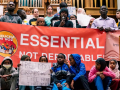
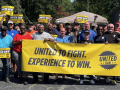
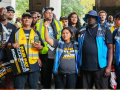
UNTA members participated in a global work stoppage on May 15. Photo: UNTA
Chanting, “We are not partners, we are workers,” hundreds of workers across Mexico who provide rides and deliveries through apps held a two-hour work stoppage on May 15 demanding fair rates, an end to unjustified deactivations, and ultimately, a collective labor agreement with app giants like Uber, DiDi, and Rappi (two Uber Eats-style delivery platforms).
The National App Workers Union (la Union Nacional de Trabajadores por Aplicación, UNTA) said the work stoppage included workers in five states and Mexico City. They were joined by app workers in at least 15 countries who held similar stoppages during peak hours.
President Claudia Sheinbaum advanced a landmark federal labor law reform in 2024 recognizing Mexico’s 1.2 million app-based workers as employees—granting them access to social security, profit-sharing, and federal housing credits. But the bar to access these benefits remains too high, workers say: only 10 percent of app workers earn enough to be eligible.
Luis Fernando Mora Reyes, an app worker for seven years and the union’s Secretary of Training and Culture, said he took inspiration from the Flint Sit-Down Strike at General Motors in 1936-7, a landmark in the organizing of auto workers in the U.S.
“Getting off your motorcycle or [out of your] car, and sitting on the sidewalk with a group of workers while you’re discussing, talking, exchanging ideas about the union,” he said, “it reminded me a lot about these images of strikers within the plants at Flint.”
Mora Reyes shuttles pizzas, groceries, and meal orders on his trusty bike. In an average week, he bikes between 15 and 40 miles: “It depends on my knees,” he said. Even then, Mora Reyes said, he’s one of the lucky ones who can do this work part time as his second source of income. He thinks of his older colleagues who work full time, “who can’t afford a motorcycle, let alone a car, and I see how they suffer.”
IMPOSSIBLE BAR
In order to qualify for benefits under the new labor law, workers who make deliveries using a car must make about 19,000 pesos per month (approximately $1,105 USD), which is double Mexico’s minimum wage. What’s more, not all of their earnings are counted towards this salary floor: 48 percent are excluded to account for costs like gasoline and maintenance.
This carveout “is a mutilation of our rights,” said Shaira Garduño Tovar, Secretary of Gender Equity for the union. Motorcycle drivers like her need to make approximately 14,000 pesos per month to qualify; currently, she makes between 7,000 and 8,000 per month. “I’d need to work from 8 a.m. to 8 p.m. Imagine spending 12 hours [straight] on a motorcycle—the strain on the body that that entails.”
The app giants and pro-employer groups lobbied for the carveout to minimize the contributions they would be required to make into the Mexican Social Security Institute system, said Sergio Guerrero, General Secretary of the UNTA, in 2025. “We at UNTA have always opposed these percentages. The position of these companies was the one that was taken into account.”
WATER, TACOS, AND OIL
Since the union’s founding in November 2020, UNTA members have worked to build relationships with other app drivers across the country.
Their efforts are complicated by the extensive reach of company unions. An estimated 90 percent of collective bargaining agreements in the nation are pro-employer “protection” contracts that lock in low wages and stave off actual union representation.

Building relationships with these workers—and making the case for a very different sort of unionism—can’t be rushed. At the heart of it is “letting them see that we’re not sent by the government, we’re not delinquents, just everyday workers,” said Mora Reyes. “They see we’re not offering money, but instead promising our loyalty, our work, and our commitment. Those who stay, stay for the right reasons.”
One approach that has helped: the union puts on “solidarity stands” in areas where app workers tend to congregate: “We offer them a bit of water; if possible, a bit of food, maybe a taco or a slice of pizza,” said Pedro Guerra, who has worked on the apps for eight years. “Where we can afford it, we’ve been able to give them oil for their motorcycles, perform minor maintenance like lubricating their chains, things we know represent an extra cost out of drivers’ pockets.”
ORANGE ZONES
The union has also established a handful of “orange zones” where drivers can go if they’re experiencing a safety issue, or just need a place to use the restroom. The zones have no formal government backing or financial support; UNTA simply works to get local business on board. “It’s a web of solidarity that we’re building,” said Mora Reyes.
There are also group chats where drivers can check in if they feel unsafe, said Luis Fernando Higuera Rivera, head of the union’s organizing committee in Mexicali. “If a client [is harassing] a driver, she can place an alert in our group.” Any drivers who are in the area then approach to de-escalate the situation if needed.
But despite every effort to mitigate the risks, the work remains grueling. “Day after day, we face accidents,” said Garduño Tovar. “We face the risk of being assaulted.” That fear is especially present for workers who deliver on a bike or motorcycle: “If you have an accident, your car covers you. But for us on the bikes, the first thing that goes flying is our bodies.”
Weather conditions raise the stakes. “Even when the roads are dry it’s risky, because any tiny thing on the pavement, a bit of oil or sand can cause you to skid when you brake,” she said. “Just imagine when it’s raining.”
Many workers, particularly those on bikes and motorcycles, try to avoid driving in the rain, despite the financial hit: “It’s not worth risking my life for 30 pesos,” Guerra said.
‘I HAVE THREE BOSSES’
The apps offer the promise of being your own boss. But for Mora Reyes, that couldn’t be further from the truth. “I have three bosses,” he said. “The government, the app, and the client. I’m accountable to all three. If I do something the app doesn’t like, they deactivate me. If I do something the customer doesn’t like, they deactivate me. If I do something the government [doesn’t like], I’m detained. We’re everything but our own bosses.”
While app workers may not be their own bosses, they can still run their own unions. One tactic to foster member leadership: UNTA’s digital courses on organizing tactics, economics, and writing skills. The classes are open not just to UNTA members, Guerra said, but to any app worker who’s interested, and to members of other unions: “We’ve had electricians and people from the water department attend too.”
Guerra has led the writing courses himself. The first two sessions focus on writing fundamentals like sentence structure and tenses. The last two address logical fallacies and how to structure arguments. He gives students assignments to make sure the material is landing, he said, “but the real impact is felt in the daily life of the organization. One of the aims is to decentralize skills, in order to decentralize power. The more skills our members have, the more prepared they are when they hold union office.”
The app giants won’t stand by idly as Mexican workers enforce their labor rights. But there is plenty of fertile ground for organizing. “I was always sure there would be a reform. I never doubted it,” said Garduño Tovar. “The platforms arrived in Mexico nearly 13 years ago. It took nearly 10 years to win that reform. Maybe it will take us another 10 years, but we’re going to eliminate that [carveout]. We can win this.”