Portland Community College Workers Defeat Budget Cuts in Wall-to-Wall Strike
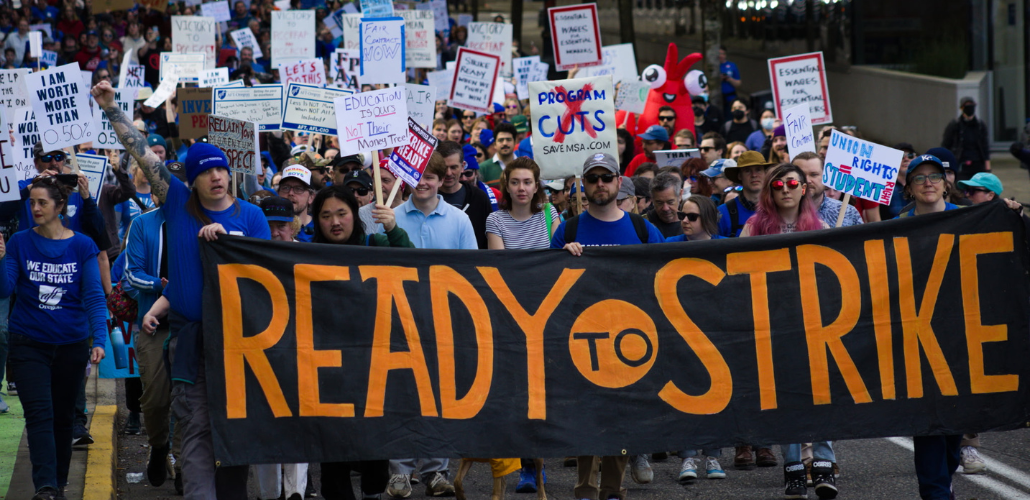
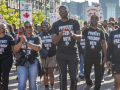
Educators and support staff struck together for three weeks, bringing the whole college to a standstill. Photo: Christian Martinez-Guzman
Two unions representing 2,300 workers at Portland Community College went on strike for three weeks in March. It was the first-ever community college strike in Oregon, and a rare wall-to-wall strike where both educators and support staff walked out together.
The strike ended in resounding victory. We won wage increases and protection against cuts to course offerings, and defeated the administration’s attempt to impose budget cuts on the backs of workers and students. Six weeks after we reached a tentative agreement, PCC President Dr. Adrien Bennings resigned.
A joint strike committee, made up of members from the PCC Federation of Faculty and Academic Professionals (FFAP) and the PCC Federation of Classified Employees (FCE), fostered solidarity, support, and friendships that transcended job classifications.
STRIKING IN THE RAIN
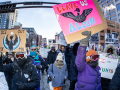
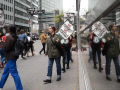
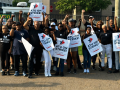
The first few days of picketing, the forecast called for (and delivered) an “atmospheric river,” a storm that dumps heavy rain. Members, students, and community supporters showed up by the hundreds at each campus, clutching umbrellas and wearing ponchos over union T-shirts. There was karaoke, drums, dancing, laughter, hugs. Local businesses donated warm food and coffee. Hundreds of drivers honked in support.
“It feels like the old PCC,” one long-time faculty member said in a member meeting held on Zoom later that week, and the screen exploded in heart emojis. Newer members were learning that the college had once been a place where workers felt appreciated and empowered—before a 30 percent increase in management jobs and a series of reorganizations caused morale to crater.
The bargaining teams were under enormous pressure to cave to an unyielding administration who spent months insisting on cost-of-living adjustments of less than 1 percent. Some members warned of colleagues planning to quietly cross the picket lines; some staffers at our national and state affiliate pointed to metrics they claimed showed flagging support on the picket lines.
But these rumors and warnings didn’t track with on-the-ground assessments from strike captains—who were working out kinks in the picket sign-in process, from glitchy software to physical sign-in sheets that got soaked by the rain. They insisted that members were holding strong.
At the table, each moment of potential leverage seemed to melt away. Finals week ended, spring break began, and the deadline to submit winter term grades passed. The college delayed the start of spring term by one week and seemed willing to accept a prolonged disruption to our students’ education.
As spring break ended, the stakes sharpened. Further delay threatened international students’ visas, student veterans’ financial aid, and students in Career and Technical Education programs (such as nursing and welding) whose schedules could not be compressed.
Eventually our colleagues in the classified staff union reached a tentative agreement, and the college ceded ground on most of our priorities. But management refused to budge on one issue, “a hill to die on” according to one vice president: back pay for striking workers.
The college expected faculty and academic professionals returning to work to catch up on winter term, submit grades, and prepare for a compressed spring term, all without compensation. Running the numbers, we estimated the college was saving $620,000 per day by not paying striking workers. If we agreed to these terms, the college would break even on our economic settlement. Our members were incensed.
Our strike victory depended on a strong, constant connection between organizers and the bargaining team—a connection that could withstand doubt, misinformation, and intense pressure.
Organizing leaders told the bargaining team, “Hold the line; we are winning.” At the table, it did not feel that way. But a member survey in which 68 percent participated, and 94 percent of respondents pledged to stay out on strike to win a fair deal, reassured us that support was strong. Students, the media, and the public were on our side. We knew our colleagues in higher ed across the state were watching. If we settled a deal without back pay, it could have a chilling effect on other unions fighting their own contract battles.
HOW WE ESCALATED
Our strike succeeded because organizers had planned ahead for a long strike that would include a series of escalating actions to increase the pressure on management. The sustained energy enabled the bargaining team to stand up to pressure from the management team who insisted, falsely, that they had no money.
Here are a few of the escalating steps we took:
We reached out to state and local elected officials, many of whom contacted administrators and joined us on the picket lines.
Our union presidents wrote an op-ed published in the Oregonian, highlighting how hypocritical it was for the college to deny us fair cost-of-living increases while increasing management bloat and administrative compensation.
The student government showed support for us by taking a Vote of No Confidence in the college administration. The unions followed up with Votes of No Confidence of their own, which passed by overwhelming majorities.

We held a “People’s Board meeting,” a satellite viewing party of the PCC Board of Directors meeting. A large crowd watched as college administrators were directly confronted by students, workers, and elected officials about their austerity budget. The testimony was devastating and widely covered by local media.
Strike captains kept up the positive energy and morale on the picket lines with theme days, marches, banner drops, and a strong social media presence.
Faculty members pledged to withhold grades until a fair deal was reached.
We issued a press release exposing that the college president had trademarked the school slogan and was using it to promote her personal consulting business. This has led to an investigation by the Oregon Government Ethics Commission.
FOUND $6 MILLION
Our union won the night the college finally buckled under the pressure, which included direct intervention by Oregon Governor Tina Kotek.
After 10 months of stonewalling, the college came up with an additional $6 million, enough to secure a 5 percent cost-of-living increase over two years, back pay for striking members, and an agreement to end arbitrary caps on course offerings that prevented faculty department chairs from adding sections even when waitlists were full.
The work is not done. Programs remain at risk, and though the college leadership is using a softer tone, they remain committed to their austerity narrative, which says we must cut budgets now to prepare for imagined, future funding shortfalls.
Our campaign slogan #WeFixPCC is both a call to action and a reminder that we don’t have to accept the neoliberal vision of higher education that disempowers workers and treats students as commodities. Our strike has inspired a fresh crop of worker and student leaders, and we are just getting started.
Michelle DuBarry is a grants officer for the college and executive vice president of the PCC Federation of Faculty and Academic Professionals.
Myths Threatened Our Strike Power
by Laura Wadlin and Meryl DePasquale
While it was clear to members how powerful our strike was, we repeatedly faced warnings of weakness—especially from union staff—that didn’t track with our own assessments. Here are some misconceptions that other unions should be alert to, and the rebuttals we wish we’d known:
“Management might offer even less if you strike.”
This is exceedingly rare for a reason: strikes are painful for employers, and they’ll sacrifice a lot to stop them. PCC’s “last best final offer” to PCCFFAP before the strike was an economic package totaling $3.9 million. After three weeks on strike, PCCFFAP settled at $16.2 million.
“We could get in legal trouble if we talk publicly about permissive subjects.”
State law allowed us to strike only over mandatory subjects of bargaining (proposals the employer is required to respond to, such as compensation or safety) rather than permissive subjects (proposals the employer is not required to respond to, such as decisions about program closures). Our bargaining teams worried that even mentioning “common good” demands publicly could put our strike at legal risk. But the solution was simple: keep mandatory proposals higher than you expect to win (for us this meant a beefy economic package) and use that as a bargaining chip to trade for permissive subjects. In statements to the media, we made clear that we were “striking over wages and benefits” and also “fighting to protect education.”
“We should be picketing at all working hours at all locations.”
We didn’t need to turn away students or scabs because our campuses were already mostly closed. The College was forced to operate online the entire time. Our greatest asset was the social crisis of a strike, bolstered by community support. So we usually picketed for three hours a day at only two of four campuses, and we skipped some days when we had other actions planned. This allowed every picket to be well-attended, well-resourced, and high-energy. During non-picketing time, we scheduled other events like planning meetings, phone banks, member forums with the bargaining team, educational events and trainings, online events for remote workers, and rallies, marches, and other demonstrations that directly targeted decision-makers. These were all essential to our victory.
“We have no way of knowing how shut down the facilities are. They could reopen tomorrow with scabs.”
We knew it would be virtually impossible for PCC to replace 2,300 strikers in time to go forward with spring term, especially the more than 1,000 credentialed instructors. Astonishingly, management admitted this to us at the table, told the media that 85 percent of workers were striking, and later told students that only 30 percent of final grades had been submitted.
“Politicians won’t want to help us if we are too critical or demanding of them.”
We knew that Oregon Governor Tina Kotek could be pressured to play a role in getting our employer to settle. She’s a Democrat who depends on support from unions but recently failed to secure endorsements from the Oregon Education Association and the Oregon Working Families Party. In short, she had something to prove. When we’d already been on strike for two weeks and the governor had been silent throughout, PCCFFAP wrote a press release that called on her to intervene. The next day, the governor made her first public statement of support for our union. After we held a press conference to call further attention to her inaction, she spent the entire weekend communicating directly with the PCCFFAP bargaining team and the PCC Board of Directors. On Monday we reached an agreement.
Laura Wadlin and Meryl DePasquale were co-chairs of the joint union strike committee. This box is excerpted from a much longer piece, “12 Myths that Threatened the Power of Our Strike.” Read it here.