AutoZone Workers Are Trying to Form the Company’s First-Ever Union
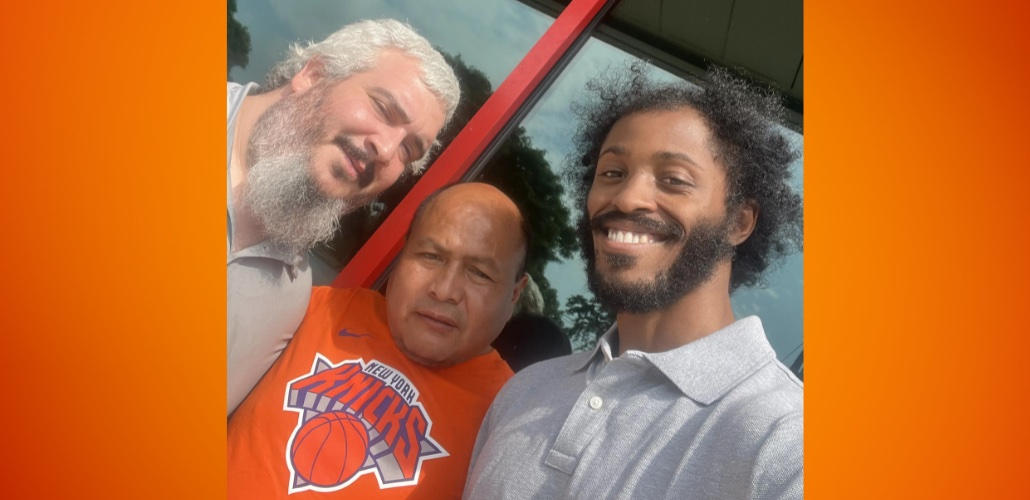
AutoZone workers (from left, David Valencia, Juan Accostupa, and Nathan DuCongé) pose for a photo in front of the store in White Plains, New York. Credit: Nathan DuCongé.
UPDATE, September 26: AutoZone workers won their union election on Friday—the first ever union election win at the company.
When workers file for a union election, it’s like a Bat-Signal goes off: a column of light cuts through the night sky, summoning not Bruce Wayne but a swarm of anti-union managers and consultants who reap tens of thousands of dollars from sowing fear and doubt.
A new calculator from workers’ rights watchdog LaborLab estimates that the parts retailer AutoZone has paid $210,696 to managers and lawyers to crush a union drive by 11 workers in one store in White Plains, New York. The workers went public in July with their drive to join United Auto Workers Local 259.
“It’s like hitting a fly with a mallet,” said Michael DiGuiseppe, vice president of Local 259. “At the first whiff of a union, they had their corporate executives in the store the next day. They’ve been camped out at a hotel around the corner since, and it’s been going on for two months.”
Managers have been pulling workers into meetings for antiunion propaganda and closely surveilling them to assess union support and chill the organizing. “They’ve had more corporate executive union-busters in the store than workers,” said DiGiuseppe.
The Economic Policy Institute estimates that U.S. employers spend $1.7 billion annually on union-busting consultants and law firms.
“If you understand the corporate structure in America, then you understand they’re spending the money with expectations to make more money,” said AutoZone worker David Valencia. “And where is that money going to come from? It’s going to come from us!”
INVITATION TO FIRE YOU
The election is on September 25. Workers are seeking to become the first of the company’s 111,000 U.S. employees across 6,863 stores to form a union.
AutoZone management is pulling out all the stops to ensure this effort ends in defeat just like in 1992, when the Teamsters tried to organize a distribution center employing 200 workers. No workers have filed for an election at an AutoZone store or warehouse since.
The company has also pushed hard to exclude one of the key worker-organizers, Nathan DuCongé, from the bargaining unit, claiming he is a supervisor.
“If you don’t stop, we will accept your invitation to fire you,” Tammy Hamilton, a regional manager, told DuCongé on an August 28 recording shared with Labor Notes. DuCongé and his co-workers presented management with a demand letter in July calling for fair wages, regular raises, reliable scheduling, and affordable health insurance.
Hamilton admitted to monitoring his social media and organizing activities.
AutoZone CEO Phil Daniele III has also been skulking around DuCongé’s Instagram posts, screenshots shared with Labor Notes indicate. Daniele’s total compensation last year was $9.64 million, 331 times the median salary of an AutoZone worker, which is just $29,017.
Federal labor law protects workers’ right to organize a union and talk with co-workers about it, and prohibits employers from surveilling this activity, as well as from threatening to discipline or fire workers for exercising their rights. Supervisors, however, do not have these protections.
CARVED OUT FROM UNION
Workers and a UAW organizer said management succeeded in carving DuCongé out of the bargaining unit, claiming that he was a supervisor, even though he has no hiring or firing authority and other workers with the same title and responsibilities are eligible to vote.

“They wanted them to vote because these are people that already swung to the no side,” said DiGuiseppe. “It has nothing to do with who’s the supervisor and who’s not.”
But it could have delayed the election and cost Local 259 tens of thousands of dollars to challenge his exclusion in court. Instead, DuCongé and the union agreed to accept it.
“The guy fell on his sword,” DiGuiseppe said. “He’s like, ‘If this is what it takes to at least have a vote and let people know what’s going on here, then I’ll let them pull me out of it.’”
STUCK AT MINIMUM WAGE
Juan Accostupa, another White Plains worker, has worked for AutoZone for 10 years, earning $17 an hour. During that time, his wage has increased only to keep up with New York’s minimum wage.
“We don’t just cash people out,” said Accostupa. “We do extra work physically. We do the unloading of trucks. We do installations of wiper blades, headlights, and batteries.”
Workers say the company generates a lot of sales from these installation services, and it compels them to upsell washer fluid when customers purchase wiper blades, or grease when they purchase batteries.
“You’re changing batteries, wiper blades, in extreme weather conditions,” said DuCongé, who had to walk through a blizzard earlier this year to open the store.
Since 2021, retail workers at Chipotle, Home Depot, REI, and Trader Joe’s stores have filed for union elections. But even when they’ve won, these workers have yet to win first contracts, as the companies have been implacable in their opposition and have stonewalled in negotiations. Chipotle workers announced they were abandoning their efforts earlier this year.
Public support for unions hasn’t abated, however; it’s still at a record high of 71 percent. And unions are filing for elections at the same rate as in previous years.
GLORIFIED TITLE, NO AUTHORITY
As social inequality has deepened a cost-of-living crisis, workers have turned to alternatives in labor and politics. Zohran Mamdani’s campaign for mayor of New York City became a lightning rod for workers frustrated with low wages and high rents.
DuCongé was one of them. He and his wife moved to New York from Atlanta two years ago as he pursued a career in the film industry. But his big break never came, and he ended up at AutoZone.
When he became a parts manager, responsible for opening and closing the store and auditing the cash register, he got a pay bump to $18.50 an hour. He called it “a glorified title, but no authority.”
Seeing his own struggles reflected in Mamdani’s platform, DuCongé became a field lead for his mayoral campaign in the Bronx. Through canvassing, he met organizers with the Emergency Workplace Organizing Committee, which put him in touch with a UAW organizer.
DuCongé credits filmmaker Boots Riley as another inspiration. In Riley’s latest film "I Love Boosters," shoplifters help factory workers in China and retail workers in San Francisco to join together in a strike against the corporation that’s oppressing them. The ultimate takeaway is that it will take international worker solidarity and militant strikes to rein in corporate power.
And now, “here I am unionizing the workplace with my co-workers,” he said. The big break had finally arrived. “No matter what happens, we are always there for any other AutoZoner who would like to organize their workplace,” he said.