UAW President Shawn Fain Nears Re-election Victory
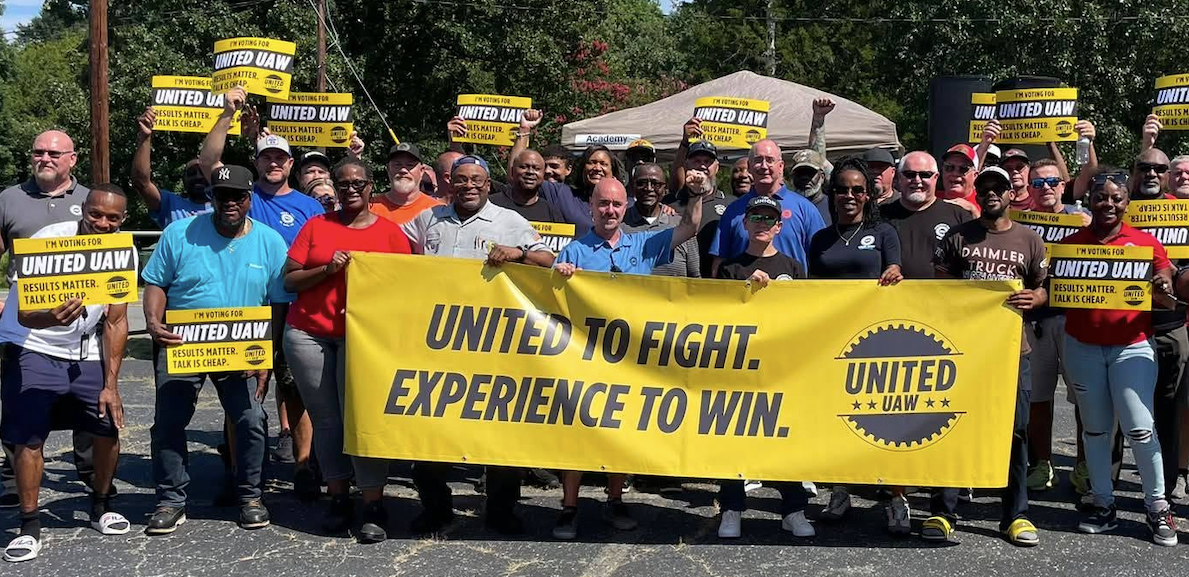
The United UAW slate, led by incumbent president Shawn Fain, looks set to win the Auto Workers leadership election. The vote reinforces the new direction the union has taken under Fain, with audacious contract fights and hard-fought new organizing. Photo: United UAW
United Auto Workers President Shawn Fain looks poised to win a second four-year term, with an overwhelming lead in member balloting for the union’s top officers.
The election was a referendum on the new fighting direction Fain has taken the union by leading 2023’s Stand-Up Strike against the Big 3 automakers, other bold contract fights, and new organizing campaigns.
It marks the second time members have voted for their top officers in the union’s 91 years. UAW members voted to switch to a one-member-one-vote system in December 2021.
With votes in eight of the union’s nine regions counted as of Friday morning, Fain had more than two-thirds of the vote, against five opponents. His nearest competitor, incumbent vice president Rich Boyer, had 14 percent.
Fain is running as part of the United UAW slate. His slate-mate for secretary-treasurer, Brandon Campbell, has also garnered two-thirds, against two rivals including incumbent Margaret Mock.
The slate’s candidates for the three vice president spots appeared on track to be elected with 19-25 percent each in a field of 11 candidates. (VP candidates need 16.7 percent to win.) The slate has also won all the regional director races counted thus far that it contested.
If the slate sweeps, as appears likely, it will hold all the seats on the union’s International Executive Board except for one regional director.
Fain has won a majority of the vote in most locals, from assembly plants to legal services, and a plurality in almost all the rest. Boyer, who heads the union’s Stellantis division, has won just two of the union’s dozens of big locals: Local 140, Warren Truck, his home local, and Local 1700 at Sterling Heights Assembly Plant, both near Detroit.
Turnout was low and similar to the 2022 election, with a little over 10 percent of the union's 400,000 active members and 600,000 retirees returning their mail ballots. (Retirees also vote on top officers in the UAW.)
While some expected Fain’s strongest support to come from the higher education and legal aid locals on the East Coast, turnout there was down by more than half from 2022, with fewer than 2,000 ballots counted. Turnout was up in Local 4811 at the University of California, which went 75 percent for Fain, but still only 2,500 of 60,000 members there voted. As in the last election, it was members in the big manufacturing locals that were key to Fain’s victory.
Perennially online candidate Brian Keller had 7 percent of the presidential vote. As the ballots were counted he took to Facebook Live to swear at members for 30 minutes and call them “morons” for not voting for him.
MOTIVATORS
In phone interviews with a dozen members, auto workers cited pensions and post-retirement health care as their key motivators for backing Fain. They also raised concerns about tackling automation and job security.
But the biggest issue was the better contracts the UAW has won since Fain took office.
Infighting between Fain and his opponents on the outgoing International Executive Board—Rich Boyer, Margaret Mock, and Mike Booth—came up, but people drew widely different conclusions, with many repeating the phrase Fain “isn’t perfect.” Jeep worker Megan Fagan in Toledo said some members have checked out due to the internal drama, reinforcing the cynical view that not much has changed.
For most, though, disagreements at headquarters were not of interest or on their radar. They looked at their pay stubs and voted accordingly.
Boyer, Mock, and Booth came together to form the Integrity Slate but failed to offer a counter to Fain’s focus on fighting the companies and launching new organizing drives. Boyer’s main pitches in his campaign statement in the UAW magazine were to lower union dues and reduce the staff at union headquarters.
“Fain and his slate are the only ones that have a real program for the future of the union,” said historian Nelson Lichtenstein, author of Walter Reuther: The Most Dangerous Man in Detroit. “You’d think the other people would have come up with something aside from they want to reduce dues, which means basically cripple the new organizing.”
“The members chose Fain, despite the Monitor’s best efforts to create turbulence, because we’re ready to fight for retirement health care and protection from A.I. layoffs in 2028,” said Gary Chynoweth, vice chair of the reform network UAW Member Action, in a statement. “Our work now is to keep helping members step up as leaders in a union that’s ready to fight.”
KEEP ON TRACK
UAW Local 551 member Candyla Brown is one of 5,000 workers at Ford’s assembly plant in Chicago. She said she backed the United UAW slate to keep the union on track in 2028, to win pensions, post-retirement health care, and pay bumps that keep up with inflation.
To win these demands, “we need strong leadership,” she said. “We had a good experience with the 2023 strike, and I’ve been watching the new organizing efforts,” she said. “I think the UAW has come a long way since Fain got into office.”
She pointed to her own local’s successful organizing of nurses at her plant and a narrowly lost election at Julian Electric, a parts plant that supplies Ford, as examples of how the union is devoting resources to organize, even if some campaigns have come up short. She said organizing in the South is another bright spot. Volkswagen workers in Tennessee voted to join the UAW in 2024 and won a first contract earlier this year, becoming the first unionized foreign-owned auto assembly plant in the South.
Jessica Acosta of Ford Local 249 outside of Kansas City said she voted for Fain and his slate because she's seen transparency at the top of the union and wants to see the same in her local, where there was a contested election recently. “I want to know what’s going on,” she said. “I don’t want to be left in the dark.” Her top priority is winning pensions, though she recognizes that’s a tough demand to win.
At Daimler Truck in North Carolina, Jon Greene, president of Local 3520, said workers are building about 80 trucks a day, after winning a new record contract in 2024 with 25 percent wage bumps and job security.
Their contract expires in March 2028. In the next one, Local 3520 wants to win more product for the plant to ensure job security, especially after Daimler shut down a Freightliner truck plant in Oregon. But the company is slated to open another plant on the East Coast in 2029. “So it's important that we put the right people in place, or keep them in place, who know what they're doing to get us to 2028,” he said.
He said Daimler has staffed up its labor relations personnel in preparation for another showdown, and corporate HR has been closely following the election. “We tripped them up with the last contract,” said Greene. “It wasn't any more of that friendly bargaining that had been happening over the years with International, so we caught them off guard.”
TEMP WORKERS CONVERTED
Kirk Hoddinott started as a temp line worker in 2020 at Toledo Jeep in Ohio, building Jeep Wranglers and Gladiators. Toledo Jeep was one of the plants that launched the Stand-Up Strike, which forced Stellantis to convert all temporary workers to permanent roles after nine months on the job. Hoddinott became one of 1,957 temps at Stellantis who were converted within three months of ratification.
In spite of the 2023 contract’s big gains, he said, the lingering effects of past corruption scandals contribute to cynicism among Local 12 members who blame reps for poor communication in grievance handling. “People still think that the union is in bed with the company because they feel that they're not being represented as strongly as they want to be,” said Hoddinott.

“I would like to see more communication through our union from top to bottom, and back from bottom to top,” he said, “because I think that the company is talking to each other, and they're making a game plan. I think we should be doing the same thing.”
Nonetheless, Hoddinott said he believes Fain has made “good progress” and “I want to see another term and see how much more progress that he can really make.”
Hoddinott’s top priorities are post-retirement health insurance and job security around automation. “Every person that works there for more than 10 years is going to have wear and tear in their body that you're going to have permanent health problems from,” he said. Before the massive concessions of 2007, Big 3 retirees had company-paid health insurance till they were eligible for Medicare. Those hired since then no longer do.
He worries when he reads news stories about humanoid robots at BMW plants. At the Jeep complex, “they have a robot that can go up and down the racks and look at inventory to try to find parts,” he said, “and they are telling me that so far it hasn't taken any jobs.”
RENEWED MANDATE
With a renewed mandate, the pressure is on Fain’s team to organize members to step up when contracts expire at the Big 3 automakers on May 1, 2028.
In 2023, the companies were caught off guard, accustomed to a sedate strike, if any, and modest union demands. When the union launched a spreading strike against all three companies at once, with more plants walking out week by week, company bargainers were blindsided. They gave up more in that one contract than they had in the previous four contracts combined.
They will likely be better prepared for May Day 2028. Unions may face another obstacle in 2028—in an election year, Democratic politicians traditionally bring heavy pressure not to rock the boat, fearing blame from voters. In 2023, though, a poll found 78 percent of Americans supported the UAW’s strike.
Some expensive union demands were left on the table last time: pensions and retiree health insurance for workers hired after the big concessions of 2007-2009, and protections against mandatory overtime and automation.
Flush with victory in fall 2023, Fain urged other unions to line up their contracts with the Big 3’s, for a united assault on corporate coffers.
Domanick Moss, a member of Local 1853 at General Motors’ Spring Hill, Tennessee, assembly plant, said he backed United UAW because it built a broad coalition and set a goal of preparing for a potential May Day 2028 general strike.
“I think that we have a solid ground laid in terms of how we've been connecting with other unions,” Moss said. “If enough of us go on strike, we could get more attention on universal health care. I would like to see Medicare for All and the PRO Act passed. I would like to see consequences for corporations doing rampant automation.” (The PRO Act would make it easier for workers to organize and secure contracts.)
Moss said his plant’s chassis department in general assembly lost 38 jobs as a direct result of automation over the last couple of years. “Cameras replaced quality gates,” he said. “All of the seat loading is done by robots now, and my team was previously loading seats.”
The Spring Hill assembly plant builds electric vehicles like the Cadillac Lyric, and they aren’t selling as well after Trump and congressional Republicans eliminated a $7,500 tax credit. “When the price of those electric cars went up about $8,000 overnight, we started selling less of them,” he said.
Ditching the tax credit also had an impact at the Chattanooga Volkswagen plant, where Zach Costello, who backed Fain, said “there have been massive cutbacks.” Volkswagen stopped producing the company's ID.4 SUV in April, instead ramping up production of the gas-powered Atlas SUV.
GOVERNMENT HANDS OFF UAW
The election results are a sharp rebuke to the government-appointed monitor, Neil Barofsky, whose original mandate was to oversee clean-up of the endemic corruption that sent 13 union officials to jail.
Barofsky developed a strong antagonism to Fain when the UAW Executive Board passed a resolution calling for a ceasefire in Gaza in late 2023, which the monitor said could be seen as “antisemitic.” Fain resisted Barofsky’s attempts to reverse that stance. Ever since, Barofsky has issued a series of reports criticizing Fain and siding with his opponents on the Board. Some UAW members who followed the drama drew cynical conclusions, but apparently most voters found Fain’s actions spoke louder than the monitor’s words.
Barofsky's mandate is set to end in early 2027, but the consent decree keeps open the possibility of extending the monitorship. If Barofsky's previous behavior is any indication, he may push to stay in place longer.
Fain’s opponents made much of the monitor’s reports, which accused Fain of misdeeds including retaliating against Boyer and Mock, after he relieved them of some of their major responsibilities. Opponents spent most of their energy attacking him personally and detailing their own grievances, rather than talking about the direction of the union. Their campaigns did not have much reach.
Fain, on the other hand, reminded members of the union’s achievements and tried to keep the disagreements from looking personal.
Despite encouraging leadership at the top, the UAW has a long way to go to become a member-driven union that consistently takes on the boss. While Fain has charted a new direction, much of the union bears the scars of decades of concessions, or is still stuck in the old, company-friendly ways of operating. That includes seeing the union structure as a career ladder, a way to get off the factory floor.
Years of one-party rule means that the bench of members able and willing to push the union in a new direction is still shallow. That has the potential to change in locals where the International has brought big resources for contract campaigns and strikes.
The UAW Member Action network is slowly working, through education and trainings, to build up the bench. After this election, it looks like the UAW will continue to be back in the fight.