How Unions Can Reverse Privatization of Medicaid and Why It Matters
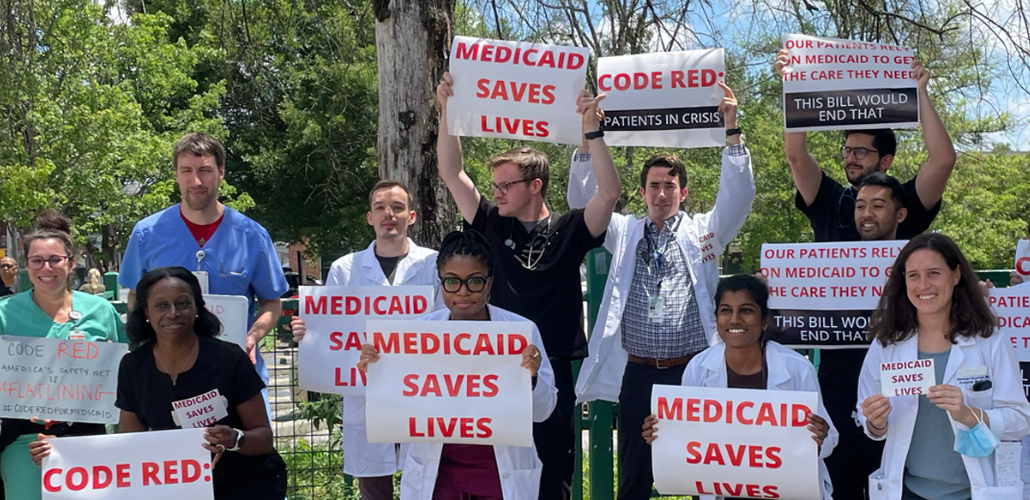
Federal Medicaid cuts could have a disastrous impact on people who lose coverage, and drive up the cost of care for everyone else too. But states could mitigate the damage, and even improve access to care, by eliminating the role of private insurers who are hoarding public dollars as "managed care organizations." Photo: Physicians for a National Health Program
The following was adapted from a March 2026 speech that Rose Roach, National Coordinator for the Labor Campaign for Single Payer, gave to the Minnesota AFL-CIO.
In July 2025, President Trump signed HR1 into law, inflicting a trillion dollars of federal cuts on our nation’s lifesaving state-based Medicaid programs. Meanwhile, Congress allowed the tax credits available for people enrolled in Affordable Care Act (ACA) insurance exchanges to expire.
These cuts impact all of us, even those with union-negotiated health care plans. That’s because when emergency rooms and hospitals have more uninsured patients, they provide more uncompensated care. To cover that loss, providers increase prices, and insurance companies in turn increase premiums and out-of-pocket costs for those who are still insured.
Union members who are insured through their employers are already seeing their exorbitant health insurance premiums rise to some of the highest levels we’ve seen in more than two decades. Meanwhile, Medicare Advantage plans (privatized, for-profit insurance) serving retirees are closing shop or increasing premiums while cutting benefits. Those on a Medicare supplemental or Medigap plan are seeing hefty premium increases as well.
States, which administer Medicaid, are being forced to respond to the federal funding cuts. Their options include cutting Medicaid eligibility, cutting benefits, or reducing Medicaid’s (already low) reimbursements to providers. Some states may also cut funding for public education, public transportation, or other necessary programs to compensate for the new health insurance costs.
Alternatively, states could raise taxes, perhaps only on billionaires and corporations that experienced a windfall under HR1 (a potential positive step).
A PROMISING OPTION
But there’s another option, a more strategic alternative that could keep Medicaid intact, and even improve access to care: States could eliminate the role of the health insurance companies that are providing “managed care” in their Medicaid programs. Instead of allowing these companies, often called “managed care organizations” (MCOs), to hoard public dollars so they can generate high profits or excessive reserves, states could use those dollars to cover direct patient care.
Eliminating the role of MCOs is a win-win because it uses money already earmarked for health care and allocates it to actual care instead of insurance company administration and profit. And this strategy has a track record: After Connecticut removed MCOs from its public Medicaid program in 2013, it saved 14 percent in administrative overhead.
Connecticut used the money it saved to improve its Medicaid program: It increased primary care provider reimbursement rates, upped the number of physicians and clinics who take Medicaid patients, and improved on quality measures, particularly for cancer patients.
MCOs claim that without them, patient care cannot be coordinated. But as Connecticut has demonstrated, a public state health program can absolutely oversee care coordination – by paying primary care providers a fee to do the coordinating. In truth, managed care organizations don’t manage care, they manage money — it is our health care professionals who manage our care.
Other states could use Connecticut as a model for eliminating private insurers in public Medicaid programs and creating a direct provider payment system. In fact, Minnesota, Illinois, Wisconsin, Indiana, Maryland, New York, West Virginia, Missouri, Ohio, Hawaii, Washington, and Iowa have already started campaigns to de-privatize their Medicaid programs.
Here’s how it works. States would:
- Pay primary care providers a fee for coordinating care.
- Pay providers (clinics, doctors, hospitals) directly for the care they deliver to patients, eliminating MCOs as a middleman.
- Seek collaboration with community clinics to reach people who are not currently receiving needed care.
- Ensure continuity of care by supporting enrollees or re-enrollees in meeting HR1’s new work and qualification requirements.
- Prevent fraud by eliminating the bureaucratic complexity of MCOs, which have long lacked accountability and transparency.
WHAT ARE THE BENEFITS?
Eliminating private insurers from public health programs takes health care decisions out of the hands of insurance companies and puts it into the hands of patients and their providers, where it belongs.

There are many benefits of this approach. For one thing, it saves money that can instead be used to deliver better care to patients. The scope of savings is significant: According to a national Medicaid report, private insurers within Medicaid programs waste 10-17 percent of the tax dollars they receive on unnecessary administrative overhead and bureaucracy.
Eliminating the MCO role prevents MCOs/private health plans from interfering with Medicaid patients’ care or denying them treatment.
It also means an end to the MCOs’ “in network” requirements, which can greatly limit peoples’ access to care, especially dental and mental health care. People in low income and rural communities will also especially benefit, since they often struggle to access care even when there are in-network providers in their area.
Once states realize savings from eliminating the MCO role, they can consider raising provider payment rates up to Medicare levels. Medicaid reimbursement rates are far too low, so increasing them will help shore up clinics and hospitals with many Medicaid patients. This, in turn, can ease tight budgets—particularly in rural and high-needs urban/suburban communities.
WORKERS HAVE A STAKE
Even though most unionized workers have health insurance through their employers, labor has a stake in this Medicaid anti-privatization fight. Corporatized health care is harming all of us, starting with our siblings in health care unions, who often work in grossly understaffed facilities, even as layoffs continue.
Unions are now constantly faced with choosing either higher wages or “affordable” health insurance. For decades this has contributed to wage stagnation and a loss of buying power for the working class. Removing profiteers from our public health programs and taking insurance middlemen out of our health care system may give workers more leverage at the bargaining table.
Of course, Medicaid recipients are workers too. Over 90 percent of Medicaid adults are either working or meet traditional work exemption criteria, including those not working due to caregiving, school, and/or a disability. Medicaid enrollees are most likely to work in health care, social assistance, retail, and hospitality. They are part of the working class.
Eliminating MCOs from public Medicaid programs will help keep our rural hospitals and clinics open so they can continue to keep workers employed. And removing private insurers (which are generally not unionized) and shifting funds instead to public health programs may well create more good union jobs.
Being strong stewards of our public tax dollars is good government: It increases oversight, accountability, and transparency. It’s in all our interest to build our public health infrastructure—because health is public.
The labor-community coalition “We Make Minnesota” makes the case against the continued privatization of health care and other sectors this way:
By shifting public services to the private sector, we introduce perverse incentives, creating opportunities for fraud and profiteering, as well as an increased need for auditing and oversight. Over time, privatization weakens the public sector’s ability to perform essential tasks. This loss of ‘public sector capacity’ cedes democratic processes to private actors, handing control of public data and decisions to unaccountable executives, turning public dollars into corporate profits, and enabling greater social and political control by powerful corporations and the rich.
De-privatizing our health care system can help turn the tide.
If you live in one of the states listed above that are now organizing to eliminate MCOs, please reach out to me at the Labor Campaign for Single Payer (rose.roachLCSP[at]outlook[dot]com) so I can connect you to your state’s campaign. If your state doesn’t yet have a campaign to eliminate privatizers from their Medicaid program, and you’re interested in starting one, please also contact me.