Deere Workers Reject Contract Extension: We’ll Meet You at the Table in 2027
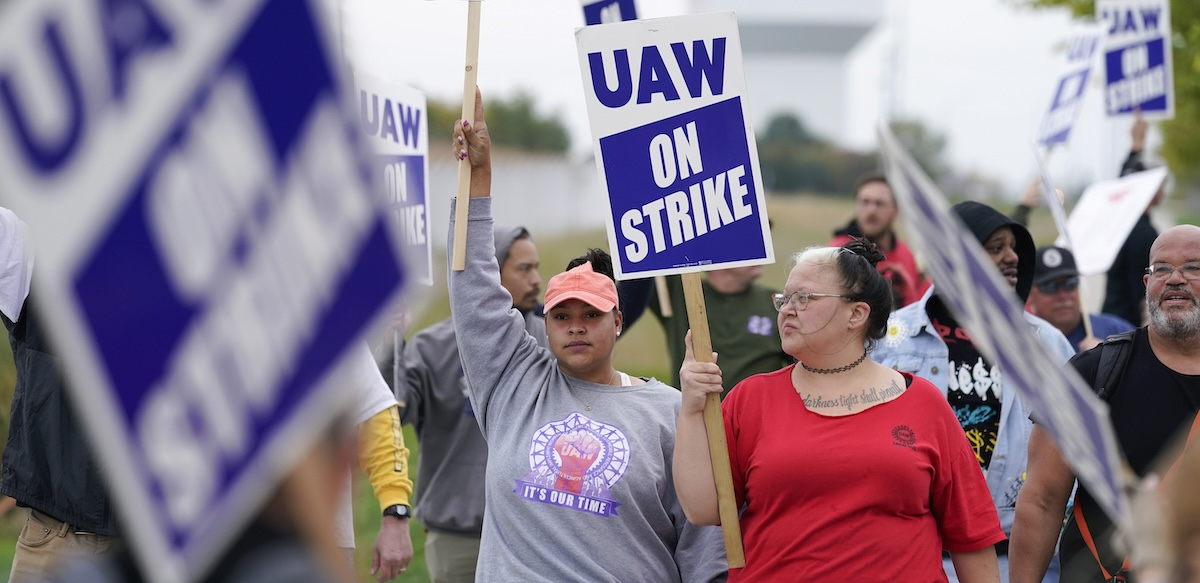
Members of the United Auto Workers struck a John Deere plant on October 2021 in Ankeny, Iowa. About 10,000 UAW workers were on strike against Deere at plants in Iowa, Illinois, and Kansas. (AP Photo/Charlie Neibergall)
This article has been updated from the version originally published August 11. –Editors
The agricultural machinery maker John Deere tested the mettle of the United Auto Workers this summer, probing for softness as the union heads into a leadership election. Voting ‘no’ on August 23, members essentially told Deere to stick it.
Deere had hoped to extend its six-year contract to eight years. The existing pact for 10,000 workers at nine Midwestern plants will expire October 31, 2027—six months before the union’s deals with the Big 3 automakers are up on May 1, 2028.
Jake Lane, education chair at UAW Local 450 in Des Moines, Iowa, told Labor Notes, "People are glad it was voted down. They see the quarterly profits. They see the promises to pay out shareholders through buyback."
In 2021, Deere workers struck for 34 days, gaining national press. They voted down two offers before winning a 20 percent pay boost over six years, COLA, and three lump sums. Lane said, “Everybody is still pretty proud of our strike.”
Another veteran of that winning battle said the company was “mad as f*ck about the 2021 strike still.”
“They’re trying to feel how unstable the union is when it comes to who wants what out of a contract,” said Pete Schaefer, from the Harvester Works in East Moline, Illinois. “They’re definitely up to something. The majority of us here understand that.”
Deere’s extension would have been largely status quo: continue the contract’s remaining annual 4 percent raises, pay a $3,000 signing bonus, and move a 3 percent lump sum scheduled for this fall to fall 2028. Health insurance would continue unchanged.
Deere builds tractors, combines, cotton pickers, and other high-ticket farm equipment. Its sales are tied to agricultural corporations’ ability to buy. With its proposal, the company claimed to have workers’ interests at heart. Citing “lower commodity prices, higher interest rates and market volatility” that are reducing demand, Deere argued that a contract extension would “protect what our employees already have.”
FLOORED AS THE NEXT GUY
After weeks of a lack of shared information that frustrated rank-and-file members, the UAW International and the Deere Council, made up of local union leaders, told Deere its unilateral offer was a nonstarter and demanded bargaining instead. Deere initially contacted the UAW Agricultural Implements Department on June 10, right before the union’s convention.
On July 6, local union officers met with the UAW VP in charge of the Agricultural Implements Department, Laura Dickerson, and heard the news. Local 838 President Tim Cummings in Waterloo, Iowa, publicized Deere’s proposal to his members online, writing, “I was just as floored as the next guy.”
On July 29 the union’s Deere Council resolved to make a counteroffer. Dickerson’s July 31 statement pointed out, “John Deere is asking to change a collective bargaining agreement that both sides already negotiated and signed. When a company comes back to rewrite the deal, it is asking for something. That is bargaining. Deere does not get to ask the union for a favor while acting like the rules of bargaining suddenly do not apply.”
The union’s counteroffer was substantially richer than Deere’s: 5 percent pay raises instead of 4 percent, two 3 percent lump sums instead of one, roll the cost-of-living adjustment into the base wage off of which everything else is calculated, a $2,000 contribution to retirement accounts for each year of service, and, perhaps most irksome to the company, “no more work or product will be outsourced.” Riffing off Deere’s purported concern for workers, Dickerson added, “This would provide the stability John Deere values for its customers and employees.”
Deere claimed the UAW’s proposal would cost an extra half-billion dollars and rejected it out of hand, reminding the union of the rule it had tried to lay down at the outset: its offer was the only thing on the table.
‘WE DON’T FORGET’
Schaefer remembered, “My first contract that I had with the company being 2008, they laid off a lot of us, knowing that they had a high volume of orders coming in. So it’s hard to trust them after we went through that.

“The company is gonna look out for the shareholders and people who invest in the company more than the workers,” he added. “It comes down to the worker is always the expendable asset. That’s why a lot of us just don’t think that they’re doing us a favor by offering this extension. That’s like where the mindset is at Harvester. We don’t forget.”
Josh Saunders, a steward at Harvester, said before the vote, “I would say it was initially very split between yes, no, and on the fence. And the more discussion has gone on and there’s been lots of great points for and against, I feel like more people are leaning towards no.”
Why no? “It would be a lot the same as why we voted no and ended up on strike in ’21,” Saunders said. “We want a bigger piece of the pie. Deere puts out billions of dollars in profits every year, and they balk at paying us a little bit more. They do billions of dollars of stock buybacks. We’re the ones that make the money for the company, and then they’re giving it to someone who doesn’t work here.”
Deere has stepped up its outsourcing, including to Mexico. Matt from the Davenport, Iowa, plant (who asked to use his first name only) pointed out that a longer contract would mean more time for the company to move work unhindered: “After signing our latest contract we have witnessed an increase in outsourcing work to countries with a vulnerable workforce that is taken advantage of,” he told Labor Notes. “Giving up the expiration date reduces our time line in securing language to protect our jobs.”
PAY FOR STABILITY
The union’s Region 4 director, Brandon Campbell, who covers the Deere locals, said the company’s proposal could have held advantages for members. “The market is in a downturn, and that will continue into next year,” he said, “especially with the uncertainty of the current presidential administration. Companies love stability; they’ll pay a few extra bucks to have stability, and they can certainly afford a few extra bucks.
“I don’t know if 2027 is going to be a great time to be at the table with them. Trump is going to be in office still. That’s not good for UAW working people, after our president [Shawn Fain] wore proudly a ‘Trump is a scab’ shirt. And I did the same. It’s not necessarily a good time to get into that fight with that company.” A two-year extension would have pushed expiration to fall 2029.
Former Deere worker Sara Yenzer dug into company finances and wrote on Facebook:
What pisses me off about it. Deere says they need this extension for “certainty” and “stability” because of economic volatility. Fine. Except in June, the same month this whole thing kicked off, Deere raised their full-year guidance [what they tell Wall Street about how they expect to do this year] and announced a new stock buyback program [link added]. Analysts read that as Deere signaling they’re confident enough in their cash generation to commit more capital to shareholders. That doesn’t sound like a company *bracing for volatility* to me.
Since our 2021 contract, they’ve paid out over $25 billion in shareholder distributions, and they just told Wall Street they’re ready to hand out more. The “volatility” argument only gets applied to us (labor costs) never to what goes out the door to shareholders. Now, with a downturn here they’re asking workers to be flexible. That’s the part that's bullshit.
Lucas DeSpain, assistant director of Region 4 and now running (with Fain, Campbell, and Dickerson) for director on the United UAW slate, replied approvingly, “Sara Yenzer is a hammer and this math is nails.” Deere forecast a fiscal 2026 net income of $4.5 to $5 billion.
On August 21, Fain called the offer “insulting” and urged members to vote ‘no,’ calling out Deere’s huge profits, its CEO’s salary, and the layoffs of 1,600 Deere workers. He accused Deere of whipsawing large locals against smaller ones whose work has been outsourced and urged solidarity as “our only path to security.”
WHOSE DOWNTURN?
Dickerson questioned Deere’s finances and its concern for workers, writing, “We see the same industry conditions Deere sees. We also see Deere’s corporate ledger. We see shareholders enjoying the ‘continuity’ of collecting the rewards of our members’ hard work. The people who build the products have earned just as much of a voice in deciding what comes next as the people collecting the dividends.”
Responding to the company’s argument about a current market downturn, Tim Cummings told Labor Notes, “The ag market is so unpredictable. Global markets, commodity prices, right now we’re in the middle of global uncertainty that has affected a lot of things. We might have a good year this year, a bad year next year, or multiple-year cycles, a decade of good, five years of bad.”
Jake Lane, recently elected to the union’s Agricultural Implement Council, pointed out that Deere is projected to make close to $17 million in profits in 2024-26. He had urged members to vote no, build a contract campaign for fall 2027, and brew momentum for May Day 2028.
Luis Feliz Leon contributed to this story.