Viewpoint: What Amazon Workers Can Learn from the Successes (and Failures) of the Fight for 15
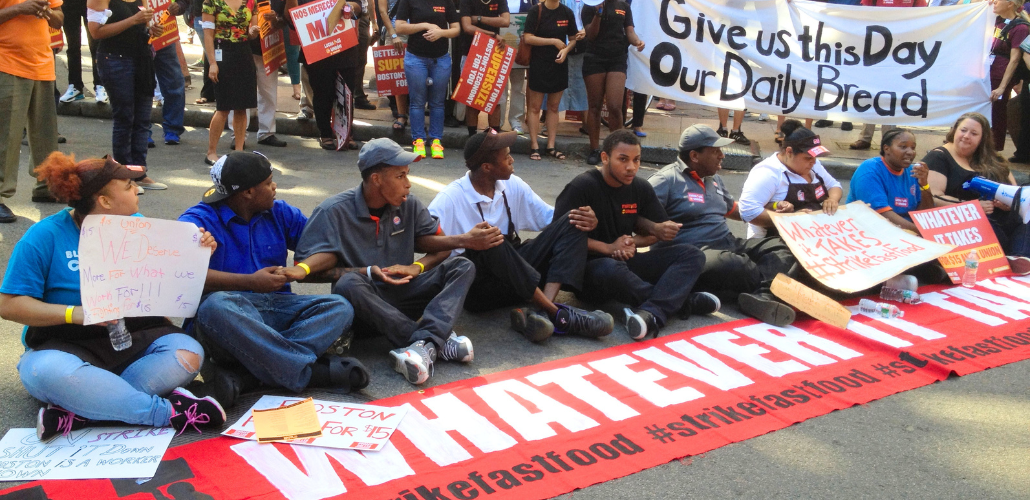
Fast food workers in Boston went on strike and committed civil disobedience in 2014 as part of the Fight for 15. Photo: Rand Wilson
If the labor movement is to maintain and raise standards, then we must organize Amazon—one of the largest employers and most powerful corporations in the U.S. today.
Already thousands of Amazon workers have engaged in organizing campaigns in dozens of delivery stations, fulfillment centers, and air hubs. Although Amazon has responded by raising its starting wage to around $21, so far workers have won only one big unionization election, at a Staten Island warehouse, and as yet, no union contracts.
Some of these campaigns began as independent union drives; today they’re supported mainly by the Teamsters. But now that Amazon’s aggressive expansion into groceries, health care, entertainment, and Internet web services are threatening labor standards in those sectors, the UFCW, SEIU, and other unions are considering making a serious commitment of resources to support a broader Amazon campaign.
The prospect of a better-resourced and more comprehensive campaign is an exciting development. While the efforts so far have made some inroads, winning against Amazon will require unions to spend tens of millions of dollars and sustain a multi-year campaign.
We believe there is much to be learned from the successes and shortcomings of another ambitious union campaign: SEIU’s Fight for 15.
Amazon organizers can learn from the Fight for 15’s success at building pressure through a broad public campaign—and from its failure to really build an organization of, by, and for workers. At Amazon, we need to succeed at both.
WHAT WAS IT?
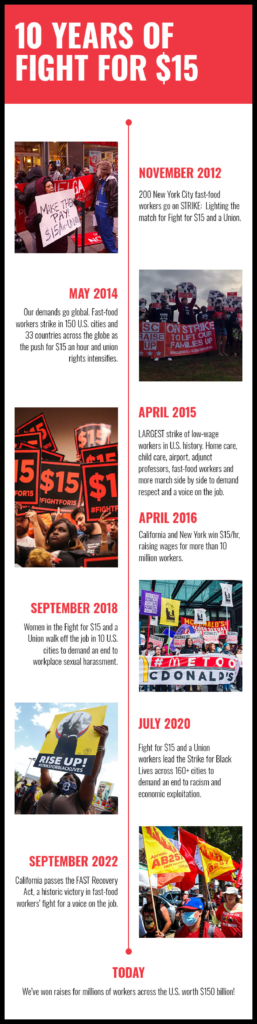
For a decade, SEIU waged a national campaign that raised wages for millions of low-wage workers, dramatically improved many states’ minimum wage laws, and led to innovative sectoral bargaining (with mixed results) in California and New York City.
SEIU locals in New York City began organizing fast food workers in 2012, and grabbed national attention with a one-day strike by 200 workers demanding “$15 [an hour] and a union.” This was more than double the federal and state minimum wage, $7.25.
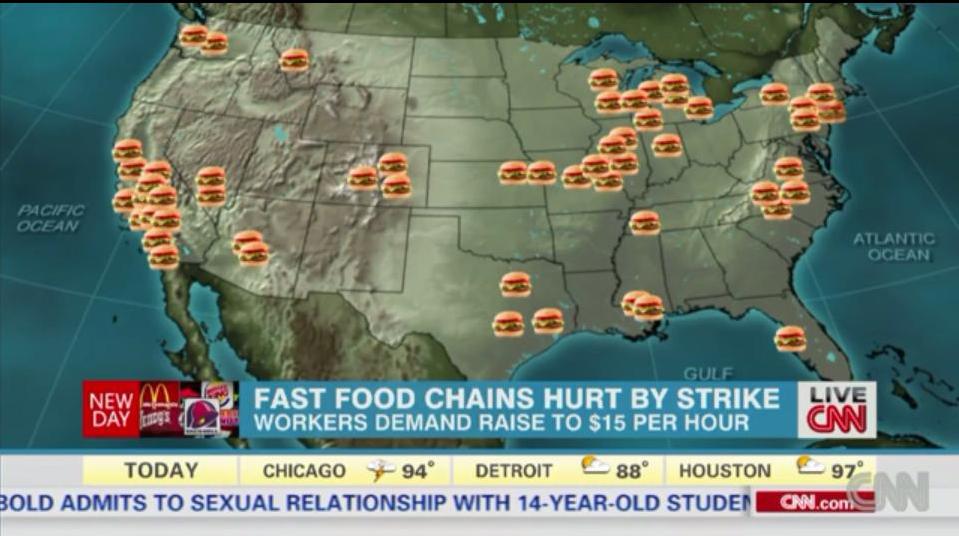
The bold demand and strike inspired a national Fight for 15, backed by SEIU and allied unions. It spread to 58 cities in 2013 and more than 500 cities by 2015, and gradually broadened its focus to include home care, airport, and retail workers.
Over the course of the campaign, thousands of low-waged workers, mostly women and mostly people of color, risked their livelihoods and went on strike. As at Amazon, these were usually non-majority strikes. Still, in April 2015 alone, organizers claimed, 60,000 workers took part in demonstrations across the U.S.
The objective wasn’t to organize store by store—there were 200,000 fast food outlets in the U.S., mostly owned by franchisees—but to raise the federal minimum wage to $15, improve working conditions, and build public and regulatory pressure on the major fast food employers that could eventually be leveraged to demand union recognition and collective bargaining.
WAS IT A SUCCESS?
The campaign won $70 billion in raises for 24 million workers across the country, plus other improvements like paid sick days. Seventeen states raised their minimum wages to at least $15.
SEIU pushed for joint-employer rules to force the big fast food companies, rather than just their franchisees, to bargain with workers and answer for violating their rights. And it won the utilization of a previously untapped regulatory body, the New York State Wage Board.
The movement helped link minimum wage demands with the civil rights issues of the Black Lives Matter movement, the call for immigration reform, and the insistence on equal pay for women, especially women of color. It trained a national spotlight on income inequality and inspired new worker-led organizing at Starbucks and Amazon.
Often overlooked is the campaign’s impact on union members. Hundreds of thousands of them were also making less than $15. SEIU’s campaign raised members’ expectations and put tremendous pressure on its local affiliates (and many other unions) to get their contracts above this floor. For instance, at SEIU Local 888 in Massachusetts, where one of the authors was on staff, several thousand members were below $15, and the Fight for 15 inspired many of them to demand more.
However, critics (including us) have pointed out that the campaign did not result in new members or a self-sustaining organization of fast food workers. While the slogan was “$15 and a union,” the union part often seemed secondary. The campaign focused almost entirely on directly pressuring employers and winning better legislation.
Our late friend Jane McAlevey argued that the campaign was too focused on mobilizing and advocacy, rather than deep organizing. It relied on finding a few worker representatives in each area to speak to the media and in front of legislators, instead of trying to organize majorities.
LESSONS FOR AMAZON
Amazon is a different type of target, more susceptible to disruptive worker action than the fast food industry. We have argued for a metro strategy, where unions work together in big cities like New York and Los Angeles, where there are sympathetic elected officials and huge markets to disrupt.
Amazon organizing is also starting in a different place than fast food organizing. There are dozens of serious, well-rooted organizing committees in its facilities across the country, and many have already taken collective action.
Nevertheless, the Fight for 15 gave a glimpse of what is possible when a union devotes significant resources and staff to a broad campaign.

For instance, labor needs to up its capacity to research Amazon’s chokepoints and vulnerabilities. It needs a coordinating hub that uses collaborative methods to distribute relevant data and reports to networks of university research and labor centers. It also needs a comprehensive digital capacity that spotlights worker actions and inspires broad support with sophisticated advertising and social media.
SEIU spent between $70 million and $180 million on the Fight for 15. The only other recent organizing campaign that came close to this scale was UFCW’s Our Walmart, which became a public relations irritant to the company, but never posed a strategic challenge to Walmart’s power or business model.
The size and scope of the Fight for 15 was impressive. It had:
- A strong field team, with 50 national organizers working in 30 states, supplemented by staff from the locals, with regular national and regional meetings
- Heavy engagement from leaders of SEIU local unions and state councils
- Significant staff research capacity
- A sophisticated approach to communications, using Twitter and a rapid-response website, and swamping reporters with strike news
- A multi-year budget commitment
- Deliberate engagement with community groups and elected officials as key allies
SEIU invited community coalitions to play meaningful roles—and in an unusual move for a national union, it did not brand the campaign with its signature purple. To fight Amazon, we will need a broad coalition of unions and other progressive forces at the national level, with metro labor tables to coordinate the campaign.
NEAR-TERM GOALS
The ultimate goal of collective bargaining remains far off for workers at Amazon Logistics, Whole Foods, and Amazon Web Services. The only collective bargaining that Amazon does in the U.S. is with the unions in Hollywood because of its purchase of MGM, an already unionized firm.
Labor needs to keep organizing at Amazon, figuring out how to disrupt its operations, and working toward winning unionization elections. A lesson we can draw from the Fight for 15 is the value of finding more ways to pressure the company at the same time—like local ordinances, state regulation, legislation, and boycotts.
It’s a fatal (and common) mistake to substitute these tactics for worker organizing. But it’s also a mistake to dismiss them as distractions. We need to hit this company from every angle.
An ordinance already under consideration in New York City would require Amazon to abandon the outsourced “Delivery Service Providers” model within the city and employ drivers directly. States could pass regulations targeting Amazon’s poor treatment of pregnant workers, or penalize it for its high level of reported injuries and workers comp.
Boycotts could target Amazon’s most vulnerable consumer sector: Whole Foods. Jobs with Justice could host Workers’ Rights Board hearings that “subpoena” CEO Andy Jassy and other executives to testify regarding Amazon’s corporate misconduct.
Within their own ranks, unions impacted by Amazon’s assault on labor standards must commit significant resources to educating members on the strategic importance of taking on Amazon.
And much like the Fight for 15 encouraged underpaid union members to demand $15, Amazon organizing can spotlight issues that union members may also be dealing with, like tech-driven speedup, and build momentum to raise standards in union workplaces that are actually behind Amazon in some way.
ON THE INSIDE
The Fight for 15 showed the impact of a broad, well-coordinated public campaign on the fast food companies. A similar effort is needed at Amazon—but it must be accompanied by building powerful workplace committees and identifying strategic pressure points.
During the recent national strike by Starbucks Workers United, union supporters blockaded a Starbucks warehouse in York, Pennsylvania. (Hopefully, their campaign will undertake organizing those strategic warehouse workers.) Similar experimentation is needed in the Amazon production system to determine where its greatest vulnerabilities are, and where organizing is advanced enough to effectively stop the flow of goods.
We will need an “outside in” strategy that engages the ethnic and religious connections of this diverse workforce. The best example so far is the Somali-based Awood Center in Shakopee, Minnesota, where community leaders have helped to legitimize the internal organization of Amazon workers.
Labor could establish Amazon Aid Centers in the metro areas where Amazon operates multiple facilities, as a point of entry for aggrieved Amazon workers and ethnic-based community organizations that want to assist the effort. The Missouri Workers Center is already trying something like this.
Supporting “salts” (workers who take a job with the intention of organizing) and pro-union cadre is another essential component of building workplace committees and carrying out shop floor actions. UNITE HERE and other unions have developed models for recruiting, training, and sustaining salts that should be replicated. A national salting program could include robust college campus recruitment, establishing affordable housing for salts, plus other indirect subsidies.
Worker protections under the Trump National Labor Relations Board are minimal. The situation may necessitate trying new tactics that use the law of the jungle to workers’ advantage—not illegal tactics, but venturing beyond the tactics that are legally protected, since those protections have become so minimal anyway. Could Amazon union supporters find ways around the legal restrictions on secondary picketing and sympathy strikes?
The present reality of our relative labor weakness and social media strength makes what some organizers call an “air war” compelling. It’s always the path of least resistance to quickly scale up a campaign. But if it’s not accompanied by significant resources for genuine worker organizing and leadership development, all the money in the world won’t produce enduring worker power.
Peter Olney is retired organizing director of the Longshore Workers (ILWU) and a co-editor of the book Labor Power and Strategy. Rand Wilson has worked as a union organizer and labor communicator for more than 40 years, and is currently an organizer for CHIPS Communities United.