
How We Organized a Union at Whole Foods
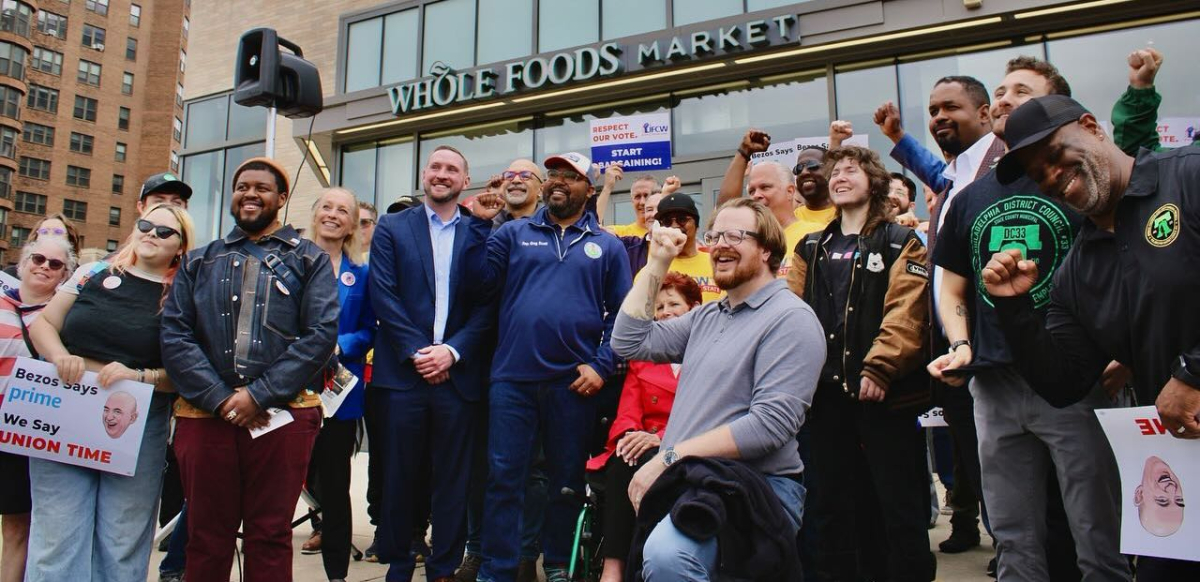
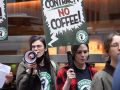
Workers at the Whole Foods store in Philadelphia's Center City voted to unionize over a year ago, becoming the only union store at the Amazon-owned chain. Now they're fighting for a first contract. Photo: Philadelphia AFL-CIO
There were six of us at the first meeting to form a union at Whole Foods in Philadelphia: too many to fit around the coffee shop table, a good sign, so we moved to a restaurant around the corner.
We talked about disrespectful managers, low pay, and the loss of paid breaks and health care for part-timers. “I’ve seen many wonderful people come and go” in a decade at the store, said produce worker Ed Dupree. “So many of them worked hard and weren’t always treated well, especially after the Amazon acquisition.”
To reach the 300 workers at our store, we brainstormed a list of people in each department we thought might be pro-union and willing to talk. We included all types: young and old, veterans and new hires, shy and outgoing, leftists, liberals, and conservatives, every race, gender, and ethnicity at our store. We needed an organizing committee that was representative of the workforce, or our co-workers wouldn’t put their trust in it.
Adapting what we’d learned from studying the Labor Notes’ book Secrets of a Successful Organizer, we made a plan to do “two-on-one” conversations with each person on this initial list. One member of our core group and one newer organizer would meet them at a bar, coffee shop, or park, or virtually. We would ask questions like: “How has work been for you recently? What’s your favorite part? Least favorite part?” Then we would tell them about our plan to form a union, and how a union would give us the power to fix the issues they cared about.
We found that having a second organizer at these talks not only helped train newer organizers, but also made the conversations feel more relaxed. We aimed to have the organizers speak just 30 percent of the time, letting the co-worker do most of the talking, since people tend to be moved most by the things they say themselves.
If the co-worker reacted positively, we would ask who they usually talked to at work, whether they thought those people would support a union and could be trusted to keep a secret, and whether they could talk with them to confirm their support. This was how our organizing committee began to grow.
We used a spreadsheet to track assessments of where each co-worker stood, updating it at least weekly, until we understood the web of social connections. The spreadsheet also helped us see who we still needed to talk to.
BUILDING GOOD VIBES
To build a sense of community and a feeling of joining something larger than ourselves, we organized group meetings, a group chat, and even a book club.
Meetings were held every three weeks at a bar or outdoor cafe, and became a way of constantly integrating new members into the union community. Any co-worker could be invited, so long as we believed that they wouldn’t run and tell management afterwards. We were systematic about inviting people a week in advance, confirming with them the day before, and sending a day-of reminder.
The agendas were simple: problems at work, things we’d like to change, recent conversations with co-workers about unionizing. At the end we would plan who would talk to which co-workers next. To avoid devolving into complaining and gossiping, we relied on a strong facilitator to make sure everyone got a chance to speak and we didn’t spend too long on any one section.
The larger meetings built good vibes. We saw how we were facing similar problems, how we all cared about organizing, and that we were making collective progress. Attendees left motivated to have their first organizing conversations, or to keep going.
Our group chat helped build community between meetings. Facilitators encouraged members to share day-to-day happenings at work and stories about organizing conversations.
The book club was a stroke of luck. One co-worker who knew many people, but was afraid to start union conversations, instead organized a book club that met every couple months at a bar. The conversation was mostly about the books and other casual topics, but organizers got to meet co-workers we hadn’t previously talked to, and when the opportunity came to discuss the union, we took it.
After 10 months, we had 20 workers helping organize; the group was ever-changing because of the store’s high turnover. We had determined that about 70 percent of our co-workers were pro-union. Most of the rest were still unassessed; we had identified only a handful of explicitly anti-union workers.
Months before, we had set the goal of reaching 70 percent before we would collect cards to join the United Food and Commercial Workers (UFCW). It was go time.
GO TIME!
Instead of the traditional paper cards, we decided to use a form that we could send as a link through our phones. This digital version was easier to circulate and asked for only basic contact info, so workers could fill it out quickly.
We started with our most supportive and trustworthy co-workers. By the end of the week we had 45 cards—15 percent of the store. We continued our union conversations out of management’s earshot—while stacking apples, searching an aisle to fulfill an online order, or frying wings for the hot bar. After a month we had 80 cards. Often a follow-up text (or three) was needed to remind people to fill out the form.
As weeks turned into months, high turnover gave us many new co-workers. We worked to build trust quickly, so that we could tell them our plan and ask them to fill out a card. Asking card-signers to share the card with friends at work (or remind them to fill it out) proved to be a small and easy task that turned supporters into organizers.
After three months, we had 150 cards, many from workers who had not been employed when we started, or were somewhat neutral or timid about the idea. A couple weeks later, just as the Thanksgiving rush began, we went public on social media and in the press and filed for a National Labor Relations Board (NRLB) election, with cards from 60 percent of the store.

It was important that we had been able to keep our effort secret from the company while collecting cards, because we knew that when we went public, an intense union-busting campaign would descend upon us. And boy, did it ever.
CHEW AND SPEWS
On Thanksgiving, a posting from a Whole Foods regional vice president went up next to our punch clock: “We respect your right to decide whether a union is right for you, and we will not do anything to interfere. Over the next few weeks, we will provide you with factual information about union representation.”
This “non-interference” and “factual information” turned out to entail plastering increasingly manic posters across our break room and hallway walls, warning us about the cost of union dues, the low pay of UFCW members at local Albertsons and Wakefern grocery stores, and the salaries of UFCW officials. But that was just the start.
By mid-December our store was full of out-of-town managers constantly surveilling us, making it difficult to speak to co-workers about anything. They would approach us while we were working, with a veneer of obnoxious friendliness, to ask how we liked working at Whole Foods and what needed improvement. Sometimes they would pretend to pitch in with our work.
They always found a way to bring up the union effort and regurgitate anti-union talking points. Managers would ask workers if we’d “done our research,” as if there was some sinister information about unions that had not been brought to light. They were surveying the store and assessing the workforce, just like we had, to determine who was solidly pro-union and who they might flip.
Management also held group meetings off the floor, which they called “chat and chews,” with free food to entice us. (Thanks to an NLRB ruling banning captive-audience meetings a week before we filed, the company could not force workers to attend, although they found plenty of ways to coerce us into attending.) We called them “chew and spews,” since the company used them to spew anti-union talking points.
WHO DO YOU TRUST MORE?
Organizers tried to get into “chew and spews” whenever possible, to ensure that our co-workers heard at least one challenging question. People trust the people they work with, so even a slightly challenging question signaled to co-workers that the managers’ narrative was untrustworthy.
Still, as management kept pushing the message that a union guaranteed nothing and workers should focus on their personal risk rather than our strength as a group, some of our co-workers who had signed cards began to waver.
To hold the store together, organizers leaned on our deep relationships and trust with one another.
In the weeks before the election, we grew our organizing committee to 45 workers (15 percent of the store) who were having pro-union discussions with co-workers. We held small online meetings of five to 10 workers in each of the eight departments to go over every single worker in their department and determine who could strike up a conversation with them at work, or send a text and say something positive about unionizing.
These weren’t textbook “organizing conversations,” but we found that one positive statement from a co-worker undid weeks of fearmongering and confusion from the company. Fifteen percent of a workforce actively encouraging their co-workers is a lot—and that’s how we were able to overcome the union-busting campaign.
ELECTION DAY
The vote was in January 2025. We knew that if turnout was high, we would win. Over the past two months, we had reconfirmed the support of most card-signers and expanded our support to many non-signers.
Voting would occur in four two-hour sessions. We asked all supporters to confirm what time they planned to vote and what transportation they would take, so they would have a plan and be more likely to follow through.
Organizers who were working on election day checked in with supporters to make sure they had voted; organizers who weren’t working used the spreadsheet to track turnout. If a supporter missed their planned voting time, an organizer called and texted them to make sure they made it to a later voting bloc.
At the end of the night, 130 workers had voted yes and 100 no. We had won the first union at an Amazon-owned Whole Foods!
STILL DRAGGING ITS FEET
Whole Foods has kept dragging its feet. The company immediately moved to challenge the election results, claiming, among other things, that the NLRB’s ban on captive-audience meetings was an unconstitutional violation of employer free speech.
The same night we won, newly inaugurated President Donald Trump fired NLRB Member Gwynne Wilcox, causing the Board to lose quorum. The company argued this meant the results of our election could not be certified. Nevertheless, in May, the NLRB Regional Director certified our win. But Whole Foods has refused to recognize our union, and continues to fight to overturn the election at the Board.
To force the company to the bargaining table and win the contract workers deserve, we need thousands more Whole Foods workers to join in and organize with us. If you want to organize your store, reach out via the UFCW Whole Foods campaign website or our social media for support.
Ed Dupree and Ben Lovett work at the Whole Foods in Philadelphia’s Spring Garden neighborhood and are members of UFCW Local 1776. Visit the Whole Foods Workers United page and follow them on Instagram @phillywholefoodsworkers for more info.

You must log in or register to post a comment.