Power Workers Independence Day Strike Wins Pensions in Pennsylvania
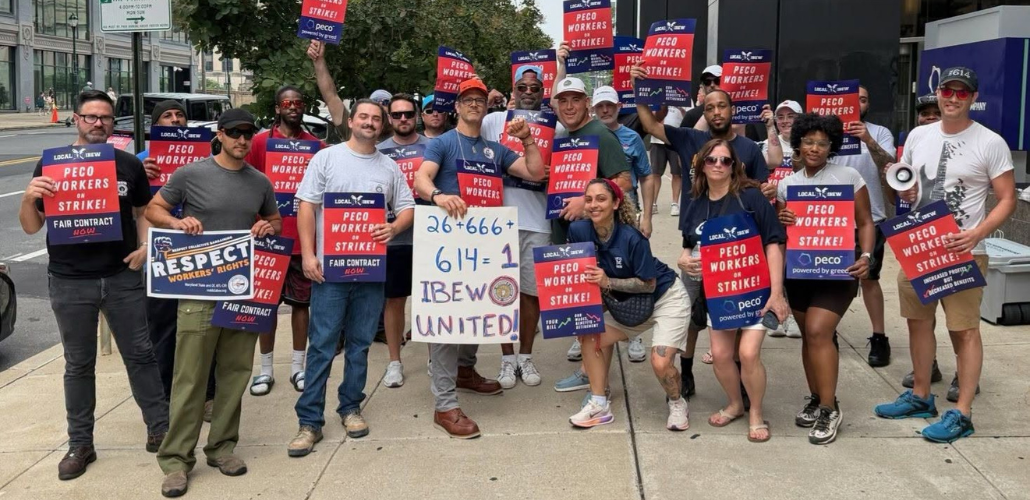
Members of other IBEW locals visited the picket line, and refused to cross it to do repairs after storms knocked out power the night of July 4. Photo: IBEW Local 614
Workers at PECO, the electric company for the Philadelphia region and Pennsylvania’s largest electric and natural gas utility, went on strike just after midnight on Saturday, July 4, winning a tentative agreement for the 1,500 workers just before midnight on Monday, July 6.
They restored defined-benefit pensions for the 600 newer hires who had been relegated to 401(k)s, and won full medical coverage in retirement.
They had leverage: Philadelphia celebrates the July Fourth holiday massively, with a giant concert in Center City, and this year was even bigger with the country celebrating its 250th birthday and the city hosting some World Cup games.
The strike also occurred during a heat wave, when temperatures climbed to 100 degrees. Then violent storms knocked out power. More than 57,000 customers were without power on the night of July 4, the company said.
Other Electrical Workers (IBEW) locals (and one United Association local) at utilities in Pennsylvania, New Jersey, Delaware, Maryland, Virginia, and Georgia refused to cross the picket line to do repairs, the union said.
Bargaining began in January, but the contract expired on March 31, and this was the first time Local 614 members had worked without a contract. While going on strike is never easy, “I think for the most part the members were ready,” Vassallo said. “They were fed up.” The strike was the first since the union was established in 2004.
The ratification vote will be in the next two weeks.
SOARING PRICES AND PROFITS
PECO, formerly the Philadelphia Electric Company, was bought by Exelon in 2000. Workers started organizing after the purchase, losing their first union election in 2003 by 43 votes, but winning the same unit in 2004.
Joe Vassallo, a power line worker by trade and a part-time business agent for the union, started at the company 20 years ago and voted on the union’s first collective bargaining agreement.
“We went union because the big corporation came in and things changed drastically, and they voted the union in relatively quickly,” he said. “The older guys know the difference from before it was Exelon, and now everyone is seeing what happens when we have these major corporations and have to literally fight for everything.”
PECO delivers electricity to more than 1.5 million people, and natural gas to half a million. In 2025, after raising rates, PECO’s profits rose almost 50 percent in one year, to $814 million. Electricity users were forced to pay 10 percent more, and gas users faced a steeper increase of 12.5 percent.
Members of Local 614 who live in the Philadelphia metro region had to deal with the same rate hikes as other customers, while seeing no increase in their paychecks.

“The rate hike affects my family,” said Vassallo. He said the last negotiation was during Covid, and because of the uncertainty, “we got a little bit behind with regards to inflation,” in the contract. “You feel the pressure of having to pay your electric bill—we have to work a lot of hours overtime to make ends meet.”
PECO has asked state regulators for another rate hike in 2027 to cover grid upgrades driven by growing demand, including from data centers, and to make infrastructure improvements to prepare for more extreme weather.
PENSIONS FOR ALL
The new tentative agreement is a five-year contract that includes significant wage increases for members: 4 percent annually for the first four years and 4.5 percent in the fifth year for workers out in the field, and 3 percent annual raises for call center workers. The union had sought equal raises across the board.
They also won upgrade pay for members who complete tasks outside of their job description, a requirement that call center workers get 24-hour notice of mandatory overtime, and full medical coverage during retirement.
But the big sticking point in negotiations—and the impetus for the strike—was retirement benefits. Workers hired before 2021 had been grandfathered into pension benefits, albeit different plans, but the roughly 600 workers hired after 2021 only had access to 401(k)s. In the new agreement, all members are covered by a defined-benefit pension, including those hired in the future.
STRIKERS SERENADED
It helped that the rest of the labor movement showed up for them. “The amount of support was absolutely insane… from all the different unions in the area, and from customers and residents,” Vassallo said. Even the Musicians' Union, Local 77, showed up on the picket line, serenading the strikers from under a tent in the rain.
“As PECO consumers, every working person in Philadelphia bears the burden of skyrocketing energy prices while PECO/Exelon’s profits continue to grow,” said Jana Korn, chief of staff at the Philadelphia Council AFL-CIO. “We are clear that all of our fights are interconnected.”
“Labor sticks with labor,” Teamsters Local 107 business agent Shawn Dougherty told public radio station WHYY.
The union also alleged that three strikers were physically assaulted on the picket line—one pushed down by a security guard, one struck by a PECO truck, and one struck by a third-party vehicle.
Nonetheless, Vassallo told Labor Notes that the successful strike will make the union more confident in negotiations for future contracts. And besides the massive contractual gains, they also helped build a stronger Philadelphia labor movement.
“We want to continue to forge those relationships with other unions, and we want our people to get out to their fights,” Vassallo said. “We’re planning on pushing that moving forward. We used to feel like we were on an island. We don't feel that way anymore.”
Mindy Isser works in the labor movement and lives in Philadelphia.