Letter: United Farmworkers' Complex and Contradictory History
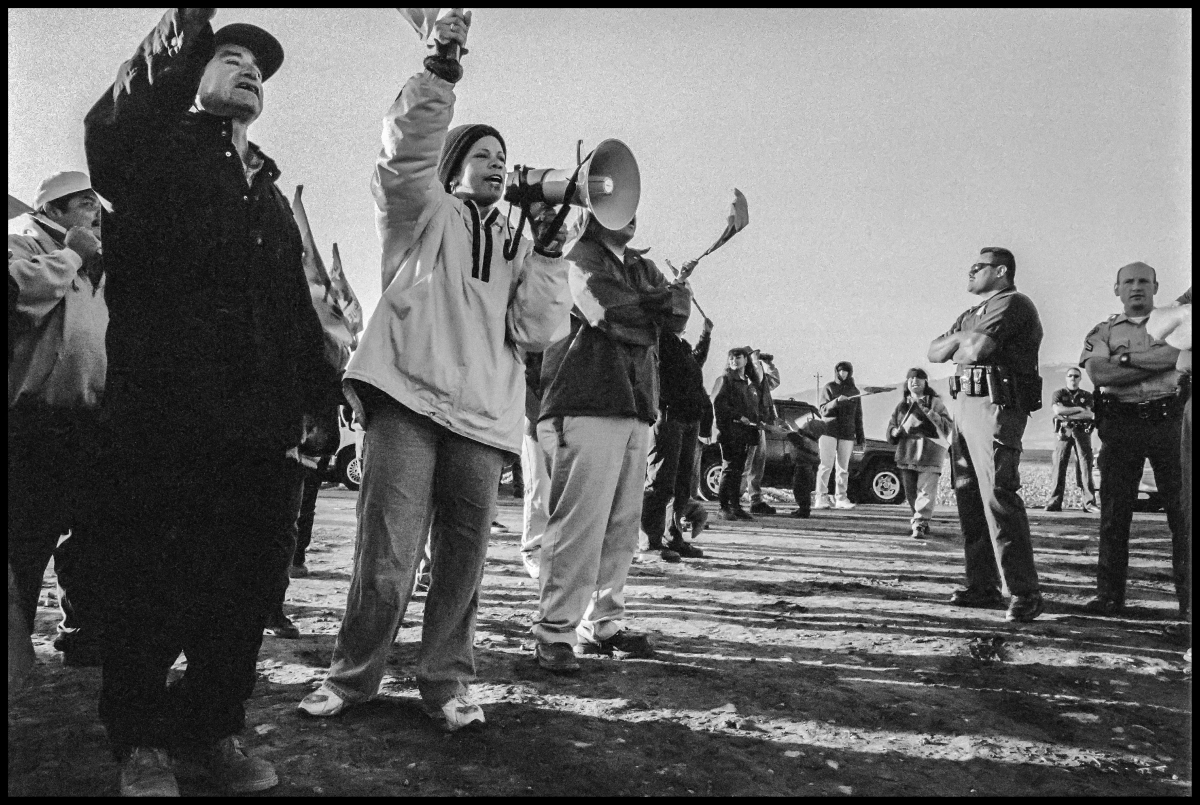
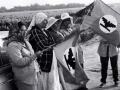
Strikers called other workers out of a broccoli field in Salinas, part of a 1998 strike at the D'Arrigo Brothers Company. The company was a bitter enemy of the United Farmworkers for many years, but workers kept their committee inside from the early '70s to the time of that strike and beyond. The company was eventually forced to agree to a contract in 2018, as a result of California's mandatory mediation law, an amendment to the Agricultural Labor Relations Act. Photo: David Bacon
In response to Jane Slaughter's interview of Frank Bardacke, I think Bardacke is right in pointing to the lack of democracy in the United Farmworkers as one reason why Cesar Chavez went unchallenged for so many years after sexually abusing women in the farmworker movement. The UFW had no structure between the ranch committee, the organization elected by workers at their individual employer, and the union convention, where the leadership was elected and empowered to make all decisions until the following one. This enabled Chavez to exert such power that even otherwise aggressive and militant organizers and workers were afraid to challenge him, whether about sexual abuse or political purges. Organizers could be, and were, fired at Chavez' discretion, with no recourse. That often created a fear of doing or saying anything that could lead to getting terminated.
But that fear was more than just fear of being fired. It meant being cast out of a movement in which people had given their lives. What alternatives faced families when they knew what Chavez was doing to their daughters? These were not weak uncritical people or pushovers. The choice about whether or not to speak out must have been agonizing for the young women and their families. But why didn't the people of the inner circle say or do anything to help them? Lack of democracy? Maybe in part. But the same sexual harassment happened in my union in Pittsburgh, and progressive leaders of the union stayed quiet. And we know there are more examples than that. So democracy is a protection, but not enough. What Chavez did to these young women has a lot to do with the power of men, and of the system of male supremacy that is deeply embedded in our labor movement, and society in general. We have to confront this directly, and not assume that being able to vote for leaders will take care of it.
If treating Chavez as a celebrity and putting him on a pedestal was an enabler and a fatal mistake, then we need to see the union's accomplishments not simply as the achievements of one man. The creation of the boycott was the result of many discussions among many people. The first national director of the boycott was Larry Itliong, whose political history and role in the union also needs reevaluating, as does the boycott itself.
Bardacke poses the boycott against the actions of workers in the fields. What workers did and do in the fields is fundamental, but the boycott itself also had aspects of a mass social movement. Many talented organizers, including many Communists, socialists and other left-wingers, some of whom were farmworkers and some who came from cities, made the boycotts work, and gave them real power for the union's first two decades. The contract Bardacke refers to, which created the repre system, was won as much by the lettuce boycott and pressure on certain producers, like Interharvest, as it was by the strike.
The first years of the union were crucial—the five-year grape strike, and the lettuce strike in Salinas. The culture of the union during this time was much more participatory and democratic, with big meetings debating every strategy. In the original meeting in which the Mexican workers agreed to join the Delano strike that Filipinos had already started, workers themselves debated and decided to join together. Chavez and Itliong had discussions with each other about it, and Chavez did not want to go on strike. But he agreed because that was obviously what workers wanted to do, and to do otherwise would have meant the end of the movement at its very beginning. So an important question is how the union went from this to an organization centered on a single person with such power, in the space of about a decade?
Despite Chavez's role as a decision-maker who could not be overruled, the union became a large and complex organization in which many talented workers and organizers played crucial roles. Bardacke says "Chavez had never dealt with contract disputes. He was sick of the complaints, he thought contracts were a pain in the ass. He was busy with the boycott, which he thought was the most important tool the union had." This is an oversimplification. Contract negotiation and enforcement was a major part of the union's work when I worked as an organizer in the mid-’70s.
The union had brilliant people, from Jessica Govea to Eliseo Medina to Ruth Shy to Ben Maddock and many more, whose responsibility this was. Bardacke himself talks about the achievements of these contracts. I know that the impact of the work I did negotiating and enforcing contracts in Coachella lives on, decades later, and there are other examples like it. And while most of the contracts we won in the ’70s eventually were lost, and in some areas their achievements were reversed, farmworkers made real gains in labor rights, working conditions and health and safety protections.
Bardacke emphasizes the importance of the elected repres in Salinas, an important rank-and-file current in the union. The repres were brave and committed people, but they were not the only workers who fought for, or won, democratic rights. The wine grape contracts, for instance, were some of the union's biggest, with workforces over a thousand workers at peak. The workers in companies like Almaden, Paul Masson and Christian Brothers formed their own organizing and negotiating committees, and then administered those contracts without any staff. I worked at Almaden when I left my job as an organizer, and was dispatched out of the hiring hall in Hollister by the ranch committee. Agustin Ramirez, who became one of the ILWU's best organizers, talks of his own family's experience as workers enforcing the Christian Brothers contract.

One of the most important, politically radical traditions brought into the union was that of the Filipinos, who came in with a real left history. Many had participated in organizing the Alaska salmon cannery union in the ’30s and ’40s, fighting deportations and red-baiting. Their union eventually became Longshore (ILWU) Local 37. At the time of the grape strike and for years afterwards, many Filipinos were dual members of the UFW and Local 37. When Filipino workers and their leaders were sidelined early in the union's history, their CIO traditions of militant democracy were lost, instead of being elevated. Today their history is being unearthed by the Filipino community in movies like "Manong." California Attorney General Rob Bonta, who grew up partly in La Paz, made Larry Itliong's birthday a state holiday when he was in the legislature, and wrote a bill mandating the teaching of Filipino history in California public schools. What happened in Delano made changes like these possible.
Bardacke says Chavez was "busy with the boycott" and has said elsewhere that Chavez didn't like strikes, preferring the boycott as the way to pressure growers. I think that was true from my experience. By the late ’80s the union no longer organized big strikes, as a result of its political weakness and a shrinking base. But by the time Chavez died in 1993 there was no boycott either, except as threats against individual employers. He was actually no great friend of the boycott, and was responsible for dismantling the boycott structure in 1976-7, and purging many of its best organizers. The boycott was too much a home for people with "hidden agendas"—Chavez' way of referring to organizers and workers with left-wing politics and vision that went beyond the union's immediate goals.
It is also important to present a real picture of the UFW's position towards undocumented workers, and Bardacke's is incomplete. The union has had undocumented members, in large numbers and percentages, from the beginning. In the interview Bardacke points to a particular period after the lemon strike in Yuma and the ’73 grape strike, where for three years Chavez directed union staff to call the migra [Immigration] on people without papers. While he excused this by pointing to the way growers brought people across the border to break the lemon strike in Yuma and the ’73 grape strike, with the active connivance of the Border Patrol, this policy led to disaster.
You can imagine how unpopular his edict was among many, if not most, workers and organizers. When the union wrote the Agricultural Labor Relations Act, it made sure undocumented workers had the same organizing rights as any others. In the election campaigns that followed in ’75-’78, when organizers asked undocumented workers to join, they would sometimes ask, "How can you ask us to join now when you called the migra on us three years ago?" But ultimately many did join, becoming activists and organizers themselves.
The UFW has been one of the most important organizations fighting for the rights of undocumented workers for five decades. I certainly have had my disagreements with the union about immigration proposals like the Farm Workforce Modernization Act, but I would never deny what it has basically fought for, especially legal status for the undocumented. Who's suing ICE now? Who opposed Bovino's raid in Bakersfield when Trump was just elected?
Thanks for this opportunity to present another view.
David Bacon is a California writer, documentary photographer, and former union organizer.