Viewpoint: Labor’s Answer to A.I.? Give Us Our Time Back
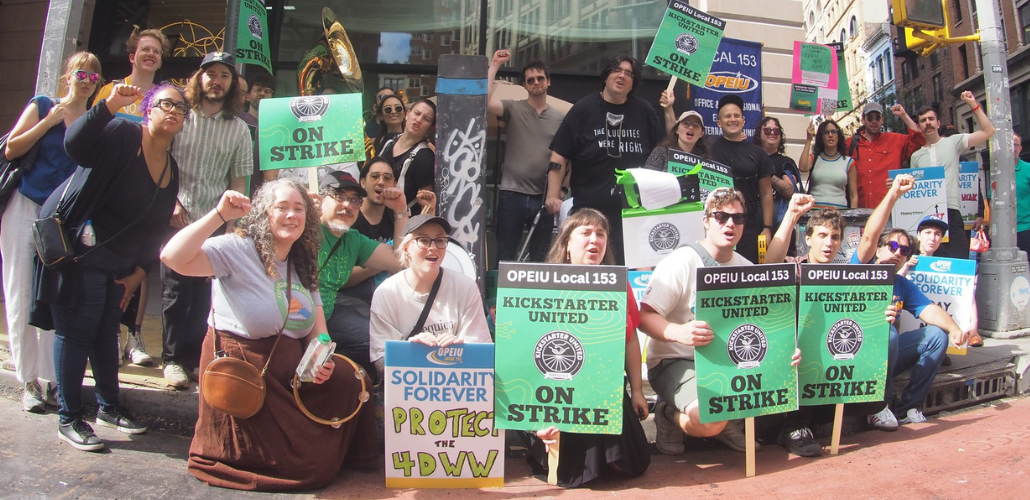
Workers at the fundraising website Kickstarter struck last year to defend their "4DWW," or four-day workweek. The contract language specifies that the 32-hour week "is premised on continuing to pay 100 percent of pay, when working only 80 percent of the time, and still achieving 100 percent productivity." Photo: OPEIU Local 153
When it comes to A.I., there’s a stark gap in ambition between business and labor.
If A.I. ushers in a technological boom, corporations intend to use it to wage total war on labor. They will use efficiency gains to cut human jobs, surveil workers, and degrade work. Even if A.I. falls short of its lofty (perhaps inflated) valuations, the working class may still suffer severe consequences, since our economy and retirement increasingly depend on A.I. investments.
Workers sense that corporations have laid a trap for them. A recent Pew survey indicated most workers feel worried about A.I. in their workplaces, with anxiety highest among low-wage workers. Only 17 percent of Americans think A.I. will have a positive impact in the next 20 years. Despite that collective dread, the 10 richest tech barons increased their combined net worth by half a trillion dollars last year, largely based on A.I. speculation.
And yet, in response to these disturbing trends, unions and allied politicians have largely converged on defensive and process-oriented solutions. The AFL-CIO’s organizing and bargaining principles emphasize defensive tools: transparency, consultation, procedural safeguards, and workforce development.
These are necessary but insufficient. They move too slowly compared to the speed A.I. is evolving, and require sustained mid-contract enforcement. Even if they enjoy broad support, they fail to generate the mass enthusiasm needed for collective action.
These tools are focused on preserving the little workers have, rather than fighting for what they could gain in this moment. They won’t fundamentally change who benefits from technological progress.
So how can labor make sure technological progress is redefined on labor’s terms, not the oligarchs’?
THE 32-HOUR WORKWEEK
We may not be able to control the economy, but we can control our ambition. The rise of A.I. give us a chance to set an economic agenda that gives people hope that technology will improve their lives, not worsen them.
A four-day, 32-hour workweek with full pay and benefits should be at the center of this offensive agenda. The demand for shorter work time shows how the gains from technology can flow outward, not just upward. If A.I.’s promise is that it’s going to “save us time,” then it can give us our time back from work.
Over the last few decades, unions have almost exclusively fought to redistribute economic gains to workers in the form of money or benefits. But it can be just as powerful, or even more so, to distribute gains in the form of time, just like when labor demanded the eight-hour day.
As labor historians Phillip Foner and David Roediger observed in Our Own Time: A History of American Labor and the Working Day, labor history suggests that the most effective way for labor to exert control over technology is not to minimize the role of technology at work, but to minimize the role of work in life.
At WorkFour—the national campaign for this demand—we’ve identified four areas of leverage that unions can use to win shorter workweeks.
It’s urgent to renew this fight now. Workers are already feeling precarious about A.I., which gives us momentum, but the scale of actual displacement is still limited—which means our leverage remains intact.
OVERWORKED AND BURNED OUT
The last real reduction in work hours happened in 1940. Up until then, the labor movement’s signature demand was less work: eight-hour day, the five-day week, the weekend, and paid time off. After decades of militant labor organizing, we won the 40-hour standard via the Fair Labor Standards Act.
Since then, productivity has soared by 400 percent, women’s workforce participation has increased, service work has increased, and the computer revolution has occurred. But the workweek standard has stayed frozen. As a result, dual-earner families now work more than they did in the 1960s.
Working families have paid the price in less time and more stress. Burnout is rampant, hitting low-wage workers, workers of color, and young workers especially hard. All workers have been hit by overwork, due to a cutthroat economy and a weakened social safety net.
That’s why hours worked is a cost-of-living issue, just as central to job quality or affordability as wages and prices are. If we focus exclusively on ensuring workers have more hours or higher wages, we’re neglecting the magnitude of the exhaustion and burnout that the working class is facing, and we’re missing the opportunity to win something inflation-proof: more time.
An economy that demands even longer hours just to survive is broken and needs to be reset, not modified. That’s why approximately 80 percent of workers support a four-day workweek if it means no loss in pay.
IS THIS FEASIBLE?
Workers want it; workers need it. But the same pay for less time at work sounds too good to be true, right? How do you propose it to your co-workers or your boss without being laughed off? Workers aren’t likely to rally behind a pie-in-the-sky idea.
Well, it’s now a proven and evidence-backed “win-win” for employers and employees. Over the last five years, hundreds of organizations in the U.S. have instituted a four-day, 32-hour workweek.

In previous North American pilot studies, 97 percent of employers continued with the schedule after testing it, citing improvements in productivity, revenue (up 30 percent), resignations (down 23 percent), and absenteeism (down 39 percent). Workers reported improved health (40 percent), 60 percent better work–life balance, and 69 percent lower burnout.
Redistributing time also reshaped who does care work and how. In pilots, men increased their household labor by around 28 percent, and parents reported more time for childcare.
While most four-day weeks so far have been employer-led, a range of unions have won it too. Electrical workers in Florida are one example. Another is local government workers in San Juan County, Washington, who won the shortened workweek when the county said it couldn’t afford meaningful wage increases during a period of rising inflation.
Tech workers at Kickstarter secured theirs in 2021, when Covid, supportive management, and the Great Resignation gave them unusual leverage at the table. But even when those conditions reversed in 2025, Kickstarter workers went on strike for 42 days to defend their shorter week.
The four-day workweek has worked across a variety of industries and job types, including health care and manufacturing. For places that employ hourly workers, employers have formulated several ways to ensure workers aren’t losing net pay—including converting them to salaried, raising their hourly wage, or crediting the fifth day as paid time off.
All these examples should give workers ammunition to make a credible and persuasive argument at the bargaining table.
Even when it’s not feasible to win a 32-hour week in one contract campaign, we’ve seen unions win stepping-stone victories like a 36-hour week, a guaranteed paid fifth day off every other week, or Summer Fridays. We’ve also seen unions phase in the implementation.
BOOSTS MILITANCY
There’s a growing consensus across the labor movement that we need more militant, strike-ready unions; two necessary ingredients are solidarity and class consciousness. Bargaining for the four-day, 32-hour workweek builds both.
Every worker can immediately picture it: more rest, more three-day weekends, more time to care for family and participate in community life. A four-day workweek can bind workers together across wide differences of job type and pay, because everyone stands to gain.
The demand also sharpens class consciousness. On one side is an overworked, burned-out working class; on the other, a class whose lives are full of leisure. As United Auto Workers President Shawn Fain put it, the real freeloaders in our economy are the “masters of passive income” who profit off the labor of others.
Even after 1940, there’s a legacy of workers responding to new technologies by taking militant action to win back their time. In 1960, West Coast longshore workers won a workweek reduction from 40 to 35 hours as containerization technology and globalization reshaped port labor. In 1994, 11,500 UAW Local 599 workers walked out in Flint to protest overwork driven by new production technologies.
And in the last three years we’ve seen powerful strikes for the four-day, 32-hour workweek by Big 3 auto workers (though they didn’t win this demand) and by tech workers at Kickstarter.
The New York Times Tech Guild didn't win the demand either, but the union's zine on the topic shows how it opened up organizing conversations asking, “How could this actually work here? What would you do with your extra day? What would this mean for your family?” Workers talked about care, rest, community, and dignity. In the ramp-up to a strike, conversations on those themes deepen commitment and optimism.
This simple, meaningful demand can also unite workers across shops, sectors, and unions. Historically, demands that transcend individual contracts can lead to heightened labor militancy and even general strikes.
A DEMAND THAT WORKS
Beyond the bargaining table, the four-day, 32-hour workweek can also be won in legislative chambers. It speaks to unionized and non-unionized workers alike, while most A.I.-related demands rooted in workplace-specific procedures don’t.
Unions with limited leverage at the table may have greater power as a political bloc making a demand that resonates widely. Interestingly, support isn’t very polarized: as a policy idea, this demand has relatively high levels of public support across levels of education, partisan affiliation, gender, and race.
In the past five years, legislators have introduced bills or local ordinances for the 32-hour workweek in 20 states, as well as the U.S. House and Senate. Last year a Republican lawmaker in Maine and a Democratic Socialist in New York introduced shorter-workweek bills in the same month. The bill introduced in Washington state this year was backed by the Washington Federation of State Employees.
A shorter workweek will benefit workers whether the economy is in an efficiency boom, when workers can share the gains by winning their time back; a downturn, when shorter hours stabilize employment by distributing work more evenly; or ordinary times, when shorter hours make labor scarcer, increasing workers’ leverage at the bargaining table.
But beyond any economic rationale, the most compelling argument is the simplest one: working people deserve more leisure, more rest, and more control of their time.
Vishal Reddy is a union negotiator for nursing home workers and the executive director of WorkFour, the national campaign to make the four-day, 32-hour workweek the standard for all workers. He can be reached at vishal.reddy[at]workfour[dot]org. The views expressed are his own.