The Country Where Starbucks Workers Have a National Contract
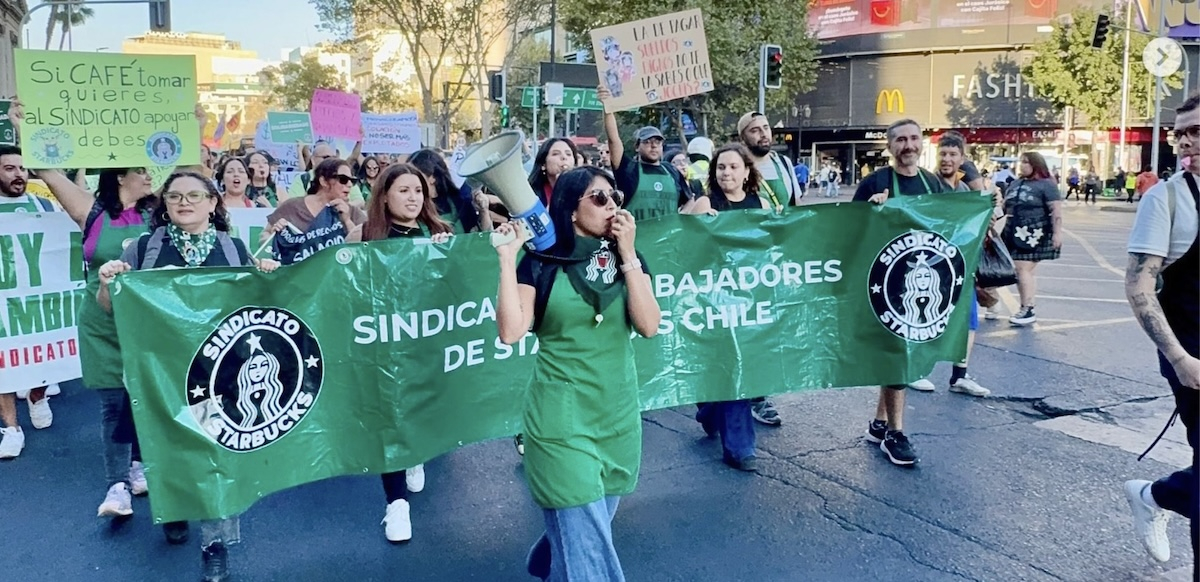
Chilean Starbucks workers marched during their 25-day strike in 2025. Like Starbucks workers in the U.S., they won electronic tipping through organizing, but in Chile they have won a union contact. Photo: SBWU
Starbucks has signed union contracts almost nowhere, but in Chile, workers have a national agreement covering 176 stores. They were the first in the world to unionize, in 2009.
In the U.S., workers at 550 stores finally brought Starbucks to the bargaining table in 2024 and in November last year they began a boycott and strike, in which more than 50 stores are now holding out, and some are walking out in short strikes, like seven stores that struck in Minneapolis for the ICE Out day January 23. Now 666 U.S. stores are unionized, but they still don’t have a contract.
Asked the secret of the Chilean union’s unique success, past president Andres Giordano said, “This is not something that could be done in one or two years.” It took from 2009 to 2022 for the union to achieve a real contract. They did it through many ups and downs and without any full-time paid leaders.
Giordano started working at Starbucks while a student activist, in 2007, knowing nothing of unions. In 2009 he and others began the process to form a union, with only 16 of 2,500 workers officially on board. They recruited quickly, and Starbucks was obliged by Chilean law to negotiate—but “I imagine they imported their manual from the U.S.,” Giordano said, and management refused to bargain in any way. Between 2009 and 2012 Starbucks broke every single labor law, spelling out its illegal policies in internal documents. It is the most fined company in Chile, Giordano said.
MOTIVES FOR UNIONIZING
Meanwhile, workers were hurt by the 2009 financial crisis, with some stores closed down and heavy layoffs. Remaining workers were expected to work harder. Starbucks refused to give the usual annual cost-of-living raise that unionized workers expected. And in Giordano’s store in Santiago, rats were a big motivator. “We were required to clean up dead rats,” he said.
In 2011 a minority of workers struck, for 30 days. Union leaders held a noisy hunger strike for 12 days in front of Starbucks headquarters, twice putting padlocks on the doors (until the police showed up). They eventually had to call off the strike with no progress made.
They got some help from government labor agencies. “They weren’t proactive but they didn’t like to see a multinational violating Chile’s laws,” Giordano said. “If it had been a mine, it might have been a different story.” (Copper is Chile’s number one export, and it is a big producer of lithium.)
But being right about the law went only so far. “We won our suits but not a contract,” Giordano said. Starbucks preferred to pay the fines.

At one point, Starbucks enlisted the help of a pro-employer union in Mexico, which sent a spy to learn the Chilean union’s strategy and report back to management.
In 2015 the union finally won a “contratito”—a little contract without a lot of content. Another change came when a Mexican holding company, ALSEA, took over management of Starbucks stores in much of Latin America. In 2021 Argentinian ALSEA managers—more used to dealing with unions—took over. In February 2022 the union signed a contract that extended the benefits of union membership, including raises, to new hires, a right that had not existed before.
CONTRACT GAINS
Twenty-six-year-old Romanett Belmar, a Starbucks veteran of nine years, is now the union’s president. I talked with her in a Santiago Starbucks that looked familiar. Signs said, “Pistachio returns” and “Reuse your cup and get 15% off.”
Belmar says that Starbucks’ 176 stores usually employ ten workers per store. Of the 1800 workers nationally, two-thirds are in the union, and they make 40,000 pesos per month more than nonunion workers (about $44 more).
The contract clause she’s proudest of is the ability for customers to give tips electronically—credit cards are universal in Chile. Tips, she says, increased from 3,000 pesos a month to 30,000 a week ($3.30 to $33, and the store pays them in cash). The contract’s weakest point is that it allows Starbucks to hire all workers part-time.
Both Giordano and Belmar pointed out how Chilean labor law was somewhat helpful in their struggle and in securing workers’ rights—when the union enforced them. The opposite of the U.S., employers in Chile are literally not allowed to run an anti-union campaign against workers who are organizing. And tired baristas appreciate la ley de la silla (“the law of the chair”): every two hours, workers are entitled to a ten-minute break, sitting down. In Belmar’s eight-hour shift, she’s entitled to 50 minutes of break, including lunch.
But it was organizing that made the difference. Last year, they struck again, for 25 days.
In the end, Giordano says, it was patience and persistence that paid off. “I worked at Starbucks for 15 years,” he said. “Antonio [the next president] worked there 18 years.”