Lessons from an 85-Day Hotel Strike
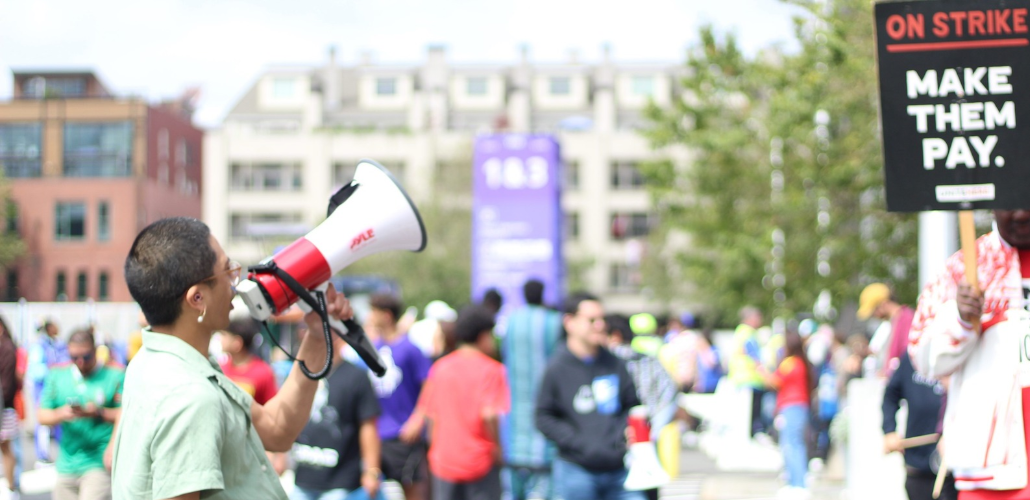
Workers said community support was key to getting Hilton to concede. Strikers' church groups and elected officials joined the picket line. Photo: Aspen Desmarais
You’d be forgiven for worrying, 12 weeks into a strike, that the boss is hell-bent on waiting you out. But after more than 80 days on the picket line at Seattle’s Embassy Suites by Hilton in Pioneer Square, Aspen Desmarais was undeterred. “I can live on a budget,” she said. “Been doing it since day one.”
After 85 days, on September 10, workers won the longest hotel strike in Washington state history. Their union, UNITE HERE Local 8, represents 4,000 hospitality workers in Oregon and Washington.
Desmarais, a strike captain and bartender at the hotel, worked to keep others motivated throughout the fight. She and her co-workers were “tired of people talking down to us and not treating us with respect,” she said, “when we’re the reason that place stays running the way that it does.”
Hilton’s offer, two weeks into the strike, of one cent per hour over its previous proposal helped fuel outrage. The union held open bargaining, so members heard the offer firsthand. “I [felt] frustrated and disrespected,” Desmarais said. “Especially with how much hard work my co-workers put into making sure the hotel and its guests have clean spaces and stays that are welcoming.”
Fritzie Corral, an Embassy Suites breakfast attendant, had only worked at the hotel for two months before walking out. As the strike went on, she said, her son worried that she had made a mistake in taking the job.
“You see other employees that decided to stay in the hotel working," she said. “Even during that time, I still believed I made the right choice. It’s my right to voice out what I feel and to fight for my rights.”
Hilton did not respond to requests for comment.
PROTECTION FROM ICE
Workers won significant pay increases, lowered barriers for health care eligibility, and highly sought-after protections for immigrant workers. Hilton, which manages the hotel, drew protests earlier this year for housing ICE agents and for cutting ties with a Minneapolis hotel that canceled ICE bookings during Operation Metro Surge.
The union’s leaders criticized Hilton throughout the strike for dismissing contract language that would protect immigrant workers. “With ICE-related killings in the news for months causing immigrant workers to worry, why is Hilton refusing to give immigrant workers’ union a heads up if ICE is staying at the hotel?” Local 8 President Anita Seth asked Businesswire.
Ultimately workers won a commitment from Hilton not to punish workers who call out due to an immigration enforcement surge, plus language binding the hotel to an expedited resolution process in such an event. Workers who lose their work authorization due to immigration enforcement will now be able to return to their jobs if their work authorization is restored within four years, and retain their seniority for up to two.
Desmarais told Labor Notes that making sure immigrant co-workers missing work because of ICE “knew they would have a job still and a safe place to come back to” was the “most important” win strikers fought for.
Starting in 2027, housekeepers will make over $31 an hour—a giant step above the $17.63 an hour that housekeepers make on average across the country, per the Bureau of Labor Statistics. The new contract makes them the highest-paid housekeepers in the state, according to the union. Embassy Suites workers classified as “tipped” will now make $1 more per hour than the city’s minimum wage.

Health care eligibility was also a core demand for the union. Many hotel workers under collective bargaining agreements must meet a minimum threshold of hours worked to qualify for health benefits in a given period. Seasonal layoffs, a hallmark of hotel work, often mean inconsistent coverage for workers and their families.
The new contract replaces the month-to-month eligibility standard with an annual threshold of 1,250 hours, or around 24 hours a week, to qualify.
MASS CANCELLATIONS
The strike coincided with five of the six World Cup soccer matches held at Seattle’s Lumen Field this summer, directly across from the Embassy Suites. World Cup-related leverage helped produce quick contract wins this summer for service and hospitality workers in Philadelphia, New York, and Los Angeles, but not so in Seattle.
How did strikers there keep up the pressure for another 63 days after the games ended? The hotel’s proximity to Lumen Field makes it a destination for football fans when the season starts in September. On game days, the hotel sets up a bar facing the stadium. Workers set up a separate picket line mere feet away from the customers, and urged fans not to cross.
In between sporting events, Desmarais said solidarity from other union workers played a big role.
Combined pressure from BNSF rail workers (represented by the Brotherhood of Locomotive Engineers and Trainmen Division 518) and sympathetic elected officials pushed Sound Transit to move its contract to another hotel with no promise of return. The transit agency had maintained a block of rooms for the BNSF workers who operate its commuter rail—accounting for 25 rooms nightly, or roughly $18,500 in weekly revenues, according to Local 8, and a significant portion of the hotel’s income during low-traffic winter months.
Embassy Suites workers like Desmarais worked hard to push Sound Transit and other hotel clients to honor the picket line. “There was one day I had to make over 90 phone calls,” she said. “For the most part, it was actually a pretty positive reaction.”
Teamster sanitation and UPS workers also refused to service the hotel during the strike. Corral reported seeing the hotel’s director and assistant director hauling garbage out during the World Cup. “It felt so rewarding,” said Desmarais. “Yeah, you have to get your hands dirty and not just do paperwork. I think it gave them a real experience of what we have to deal with.”
Corral said community solidarity was key in getting Hilton to concede. Strikers’ church groups joined the picket line. So did several Seattle elected officials and even some hotel guests. Guests also brought workers donuts, contributed to the strike fund, and left Google reviews urging hotel management to “come to the table” and “sign the contract already.”
One temp worker walked off the job after only an hour to join the picket line. Corral said such displays of solidarity made workers “more motivated to keep on.”
Many workers worried about money, the future of their jobs, and their families while on strike. But when someone was scared or upset, there was always another worker to help uplift them, said Corral: “We’re like family.”