Vermont Hospital Workers Fight for Immigrant Neighbors
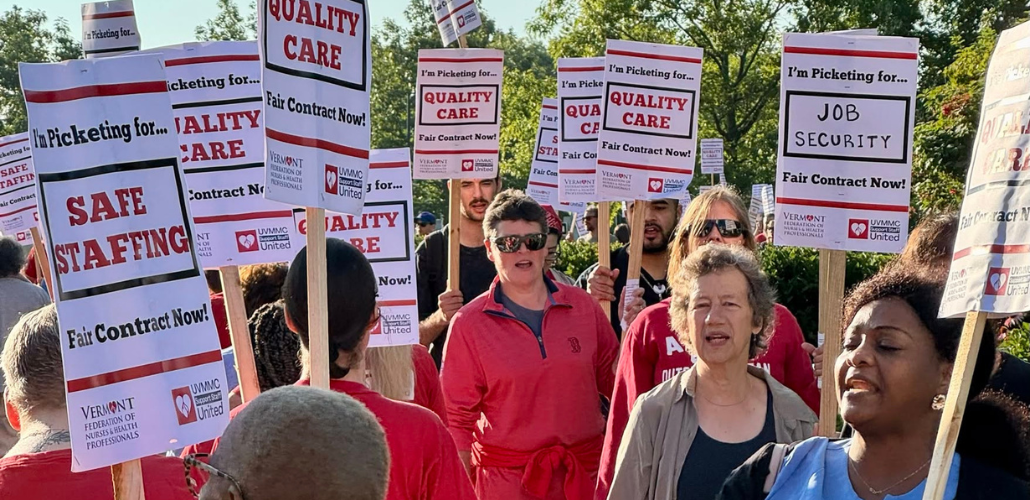
500 healthcare workers and allies rallied on August 14 at UVM Medical Center. Photo: Support Staff United
Health care workers fighting for a contract in Vermont have come to the table with not only their own demands for safe staffing and fair pay, but also a more unusual demand—one made in solidarity with farmworkers.
They want their employer, the University of Vermont Medical Center, to join the Milk with Dignity program.
“We’ve been in spaces with folks, seen them, heard their stories. They’ve come to our rallies,” said administrative assistant Melissa Lavallee, secretary of the union, Support Staff United (AFT-VT). “We’re doing for our neighbors what they do for us.”
Milk with Dignity, a framework authored by farmworkers through the local organizing project Migrant Justice, requires affiliated farms to commit to a number of labor standards. It’s modeled off of the Fair Food Program developed by the Coalition of Immokalee Workers, which organizes tomato pickers in Florida.
Farmworkers receive better wages, paid sick time, protection from discipline should they stop performing a task that could put their safety and “serious and immediate danger,” and education on their rights under the agreement.
Migrant Justice notched a big win in 2017 when Ben & Jerry’s—which produces more than 500,000 pints of ice cream a day in its facility in St. Albans, Vermont—signed an agreement to source dairy from farms that comply with Milk With Dignity’s labor standards. Grocery chain Hannaford has faced years of pressure, but has yet to commit.
Farmworkers and advocates set their sights on the University of Vermont Medical Center for good reason: “Every day, UVM Medical Center serves thousands of patients and workers. It is undoubtedly one of the largest institutional sourcers of dairy in the state,” said Will Lambek, an organizer with Migrant Justice. “By joining Milk with Dignity, the hospital can play a leadership role, inspiring other institutions—including hospitals, schools, and universities—to follow suit,” he said.
Organizers tried to bring the medical center to the table around 2022, but were unsuccessful. “Migrant Justice did not on its own have enough power to take on this important step,” Lambek said. “That’s why it’s so important to have [hospital] workers as allies in this fight.”
“Some don’t understand: ‘What does a farmer’s working conditions have to do with us?’” Lavallee said. “I grew up on a farm in Vermont, and it is the hardest work. Their working conditions are creating our food. Why would we want food created in terrible conditions?”
STRETCHED THIN
Health care workers are stretched thinner than ever. Across the country, 52 hospitals and health systems have announced staffing cuts since January. Trump is adding fuel to the fire with his two-pronged assault: Medicaid cuts, and the revocation of work permits for immigrants from countries including Cuba, Haiti, Nicaragua, and Venezuela, many of whom work in health care.
Support Staff United members have been in bargaining for their second contract since April. Among their key priorities is a safe staffing pay differential, to be paid when staffing drops below 80 percent of what is scheduled. They also want to see more paid time off to recover from injuries sustained at work: “My co-workers have been punched in the face. They’ve had ribs fractured. They’ve had fingers broken,” LNA Saer McCillian told Vermont Business.
Brett Rhodes, a nursing assistant who is now the union’s vice president of organizing, first decided to organize in 2022 after seeing how different things seemed for nurses compared to nursing assistants.
“The nurses had a union. I didn’t really know much about it, I just knew they were getting more respect and more staff,” he said. “When they said something, it had more weight to it. It seemed like they could solve their problems.”

On a typical shift, a nursing assistant must monitor a patient’s heart rate, blood pressure, respiratory rate, and body temperature, reposition them to prevent bed sores, monitor their blood sugar and any changes to their mental state, and help them eat and drink. They also shuttle the patient to and from the bathroom safely, and if necessary, clean them up after a bowel movement.
Now try adding nine other patients to the mix. That’s the average load that nursing assistants must attend to in a shift, weaving between rooms and balancing many competing needs.
And the job takes an emotional toll: “Lifting patients is hard,” said Rhodes. “Getting hit by confused patients is hard. But you forget about that stuff.” What sticks with him: “I’ve had to sit with patients who were dying, I’ve been with patients as they died. That’s the stuff that doesn’t really leave you.”
Rhodes got to talking with co-workers, and they formed an organizing committee. “My mom’s a nurse. My stepdad’s a nurse. My grandma was a nurse,” he said. “I always wanted to do something where I could help people. And I feel like the union work is an extension of that.”
‘NOT THE SAME VERMONT’
In February, Support Staff United member Steven Tendo was taken into ICE custody.
Tendo, a pastor and nursing assistant from Uganda, had fled his home country after being tortured for his civic education work. He is also a diabetic, and said he was denied his medication for three days in ICE detention.
“I followed the rules. I’ve done great in the community. I’ve never abused any of the conditions of the stay or of my supervision,” Tendo told Mother Jones at the time. “I’m so scared, I cannot go back.”
Following the outcry, Tendo was released, but forced to attend regular check-ins with ICE where he could be detained at any moment.
“We go with him every time he has a check-in,” Rhodes said.
Shared struggles like this one have deepened the relationships between Migrant Justice and AFT-VT members. “Over the last two years, we’ve collaborated a lot [in response to] attacks against immigrants,” Lambek said.
Despite the grim political moment, organizing here has made a big difference. “The Vermont I knew when I arrived is not the Vermont we have today,” said Thelma Gómez, a former dairy worker who now organizes with Migrant Justice.
“When I arrived, [workers] couldn’t leave the farms,” Gómez said. “We fought for drivers licenses so people could go to stores, go to school, and leave the shadows.”
The Milk with Dignity campaign represents another major stride. “Under the program, you have to make the minimum wage, which is not required on other farms,” Gómez said. (Farmworkers in the state are exempt from minimum wage regulations.) “When there are accidents you can get workers comp. And there are also zero-tolerance rules for sexual harassment, violence, or threats. It’s something I would have wanted when I got here.”