Counter Manufacturers are Killing Workers with Silica Dust, Safety Group Charges
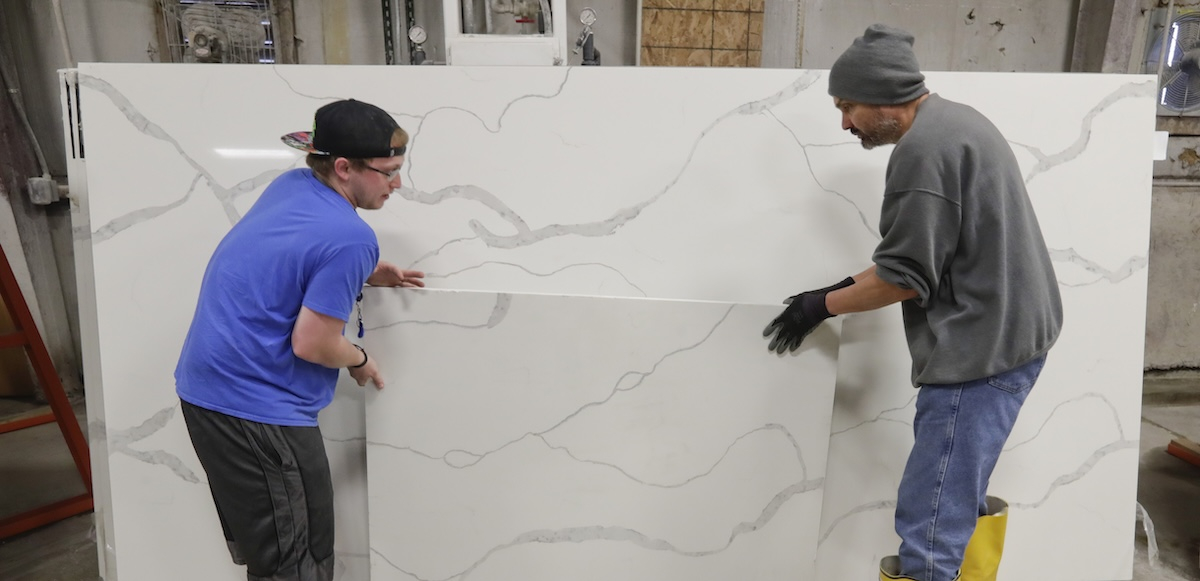
For Workers Memorial Day, the National Council for Occupational Safety and Health has raised the alarm on manufactured stone (also known as quartz or engineered stone), shown here in a warehouse in Tipton Indiana. Cutting and polishing the material is causing deadly silicosis, even when strong safety measures are taken against the dust. Photo: Michael Conroy/AP
Silicosis is a lethal workplace illness that killed thousands each year up through the 1960s. In recent decades, thanks to union workplace safety fights, it became much rarer. Annual deaths dropped to the hundreds. The disease affected mostly older workers with longer exposures.
So it was hard for stonecutter Gustavo Reyes Gonzalez, 35, to get a clear diagnosis in 2019 when he first developed a cough and shortness of breath. It wasn’t until two years later that he was told he had silicosis—and only had a year to live.
Reyes Gonzalez had worked for 15 years in a fabrication shop cutting and shaping the manufactured stone now commonly used for countertops and showers (also known as quartz or engineered stone).
Around the time Reyes Gonzalez started working as a stonecutter, the material was becoming popular in the U.S. as a cheaper, more durable replacement for natural stone (marble or granite). But manufactured stone, which is made of crushed quartz and resin, contains much more silica–it comprises up to 95 percent of the material, compared to 5 percent for marble or 10 to 50 percent for granite. This makes manufactured stone much more hazardous for workers to cut, grind, and polish. These processes release silica particles that can embed themselves in the lungs, causing scarring and ultimately lung failure.
As many as two million workers may risk exposure, from manufactured stone as well as from mining, quarrying, sandblasting, and another new hazard, “frac sand” used in hydraulic fracturing in the oil and gas industry.
NO PROTECTION IS ENOUGH
Only now, after many workers have spent decades working with manufactured stone, is the horrible truth coming out—no amount of protection is safe. There is no treatment for silicosis other than a lung transplant, and even transplants may only prolong life by 5 to 10 years. Many workers are getting sick in their 20s or 30s.
For Workers Memorial Day in the U.S. this year, the National Council for Occupational Safety and Health (National COSH) raised the alarm. They named the Minnesota-based Cambria Company, the nation’s biggest manufacturer of engineered stone slabs, as one of their “Dirty Dozen”—a badge of shame awarded annually to companies with terrible work safety records.
After Cambria was hit with lawsuits by workers whose lives are being cut short by its product, the company tried to deflect blame to the fabrication shops that customize orders. These shops are small and often have only a few workers. There are around 1,300 fabrication shops in California, according to National COSH, and thousands more around the country.
Many fabrication shops do have poor workplace safety practices. Some workers report being told to use only surgical masks against the dust. “I didn't receive any type of training, any type of warning, on the risk of its use,” Reyes Gonzalez said about the Cambria product used in his shop.

But even when fabrication shops use strong measures to keep the dust down and protect workers, the higher silica content in engineered stone means these measures are not enough. Even with strict dust controls, National COSH warns, “cutting, grinding, and polishing artificial stone releases respirable silica at levels that overwhelm existing protections.”
Respirators, wet saws, and wet cleanup that might be adequate for other types of stonecutting do not make manufactured stone safe. Even powered air-purifying respirators are inadequate, safety experts say. And the best equipment and procedures may be abandoned during on-site installations involving cutting and shaping.
Radio station KQED quoted Aki Vourakis, former large fabrication shop owner, who said that even with excellent safety equipment and protocols, eight of his workers fell ill, and one died. “Even one of the best-run, best-capitalized, award-winning shops in the country cannot keep its workers safe,” Vourakis said.
Still, Cambria insists that the fault lies not with the product, but with those running the fabrication shops. Rather than change, Cambria is pushing federal legislation to make itself immune from lawsuits.
BANNED DOWN UNDER
In Australia, regulators banned all use, supply, and production of manufactured stone in 2024 after tightened workplace rules failed to prevent workers from developing silicosis. The ban came thanks to campaigning by the Construction, Forestry, and Maritime Employees Union and the Mining and Energy Union. They argued that there is no safe exposure to engineered stone. Even before the ban, the Swedish furniture giant Ikea stopped buying the material in Australia and the U.S. in response to reports of its deadliness.
Now California regulators are considering a ban, over the objections of Cambria. The California Occupational Safety and Health Standards Board is considering a petition from occupational safety doctors to ban any manufactured stone with more than 1 percent crystalline silica.
Meanwhile, COSH committees around the country are working to find fabrication shops in their areas and let the workers know they need to get screened for silicosis.
Reyes Gonzalez was able to get a double lung transplant. The doctors now tell him that he could live “maybe 5, 10, 15 more years. We don't know.” He said the medication he has to take causes damages to other organs.
“It is possible that I could get a second transplant, but it is very challenging to go through that process,” he said.