
Renee Good, Killed by ICE, Was Standing in Solidarity with Her Neighbors
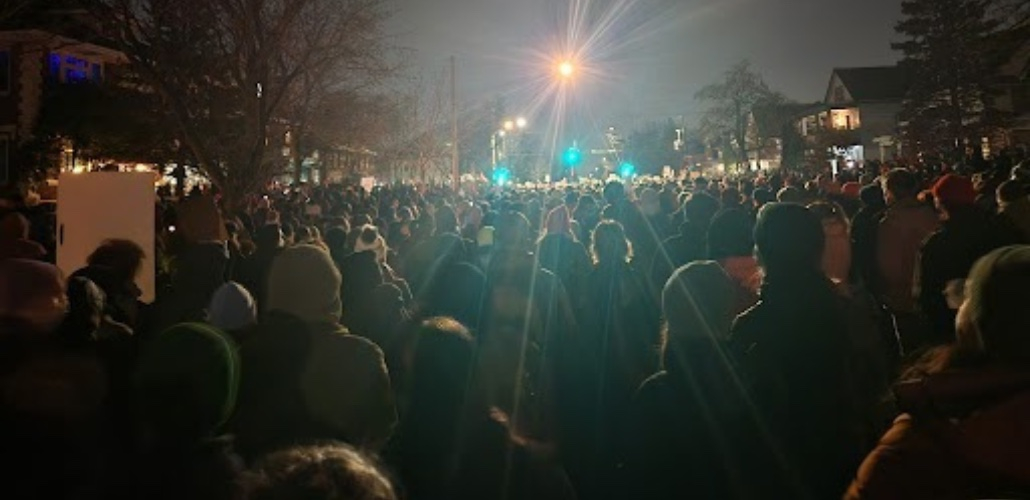
Ten thousand people attended a candlelight vigil in Minneapolis honoring Renee Nicole Good's life. Photo: Daniel Mendez-Moore
The whistle blows in short bursts: PHWEEE! PHWEEE! PHWEEE! PHWEEE! Code: ICE is nearby. Then comes the long blast: PHWEEEEEEEEEEE! Code: ICE has taken someone.
These are the codes rapid responders are using to alert their neighbors and co-workers to ICE sightings and kidnappings.
Federal agents are armed with military-style weapons. Up against them, everyday people have whistles, boundless courage, and the acronym S.A.L.U.T.E. for information to gather: the size of deployments of federal agents, the actions they are taking, the specific location, the uniforms they are wearing, the time, and the equipment, or type of weapons.
At trainings across the country, rapid responders are role-playing how to show solidarity with immigrants, and overcoming their fear to defy the terror. They are continuing a proud American organizing tradition, stretching a history of struggles that abolished slavery, established our big unions, and won the democratic revolution in civil rights.
The 37-year-old Renee Nicole Good was a champion in that freedom struggle. Like legions of other Americans from all walks of life, she was acting as the eyes and ears of her Latino and Somali neighbors, alerting them to where ICE and other federal agents were deployed.
Good, a mother of three, was part of a loose ICE Watch rapid responder group made up of parents at her son’s charter school. She “was trained against these ICE agents—what to do, what not to do, it’s a very thorough training,” a parent told the New York Post, a conservative tabloid that tried to put a negative spin on her activism. “To listen to commands, to know your rights, to whistle when you see an ICE agent.”
‘THE LIVES OF OTHERS’
The Trump administration has portrayed her as a “domestic terrorist.” But people who knew Good described an avowed Christian, a widow to a veteran, a queer woman, a singer, and a poet. “What I saw in her work was a writer that was trying to illuminate the lives of others,” said a teacher, describing her interest in the lives of the elderly, veterans, and people from different countries and eras.
Like many of us who have busy lives but make time to show up for others, she had dropped her six-year-old child off at school shortly before ICE murdered her. Video footage analysis from three angles by the New York Times shows that Good appears to be steering her SUV away from federal officers as ICE agent Jonathan Ross walks in front of it. Then he fires three shots into the vehicle at point-blank range, killing her, in broad daylight, on video, not far from her home.
Her wife was on the scene with her. “On Wednesday, January 7th, we stopped to support our neighbors. We had whistles. They had guns,” Rebecca Good said in a statement Friday. “We were raising our son to believe that no matter where you come from or what you look like, all of us deserve compassion and kindness.”
Last September, cook Silverio Villegas-Gonzalez was shot and killed at a traffic stop in Chicago, shortly after dropping off his two kids at childcare, while allegedly attempting to flee. Farmworker Jaime Alanís García broke his neck in July, when he fell from a greenhouse roof in Ventura County, California, while attempting to flee ICE agents on the hunt. He later died at a hospital. Thirty-two people died in ICE’s custody in 2025—the agency-turned-paramilitary force’s deadliest year since its founding in 2003.
Unlike Villegas-Gonzalez and Garcia, who were both Latino immigrant workers, Good was a white U.S. citizen. She wasn’t supposed to be on the target list of those people ICE has been brutalizing with impunity because of their racial and ethnic backgrounds, or immigration status. But she refused to be a bystander to injustice and looked out for her neighbors. She didn’t have to take sides, but she did. In fact, some family members would have preferred she didn't.

“I wish she would’ve minded her business and stayed out the way,” Joseph Macklin, Good’s former brother-in-law, told the Washington Post. “I know families are being broken apart… and it’s heartbreaking, but now it’s our family.”
We often say solidarity is a verb, and Good acted, by exercising the democratic rights we all have, regardless of immigration status, to document police activity and speak out.
Claude Cummings, Jr, president of the Communications Workers, tied her solidarity to labor struggles. “We have a tradition in our union of wearing red every Thursday to honor a very special CWA member, Gerry Horgan, who was killed while exercising his fundamental right to strike and walk a picket line,” said Cummings in a statement. “Just like Gerry, Renee Nicole Good was killed while exercising her constitutionally protected right to speak out and to stand in solidarity with her community.”
GOOD VS. ICE
We are what we do. If the choice we face is between Good and ICE, the people of Minneapolis are choosing Good. An estimated 10,000 people attended a candlelight vigil January 7 to honor her life. One of those people was Daniel Mendez-Moore, a union organizer with SEIU Local 26 in the Twin Cities.
“The only reason why this isn’t a picture of my blood is pure luck,” he said in a Facebook post, sharing a photo of the bloody seat of Good’s SUV. “I too live 3 blocks away from the murder site. I too bring my kids to school in the morning. I too stop my car to observe federal agents when they are in my neighborhood.
“I share this horrendous picture to urge any of you on the fence right now, that if you love me, the only way to protect my life is to get active,” he wrote. “It doesn't even matter what you do... just take 2 steps more than what you are currently doing to stop this creeping [fascism]. This is in fact the only way to keep ourselves alive.”
One day after Good’s murder, news broke that ICE agents had shot and injured a man and a woman in Portland, Oregon. An ICE spokesperson accused them of weaponizing a vehicle to run over the law enforcement agents.
“There was a time when we could take them at their word. That time is long past,” said Portland Mayor Keith Wilson, calling on ICE to leave and for an independent investigation into the shootings.
What can stop all this? “My own morality. My own mind. It’s the only thing that can stop me,” an emboldened Trump told the New York Times, musing about his power, after the U.S.’s military attacks on Venezuela and kidnapping of the country’s president.
It’s up to us to stop him. Building the mass movement we need will take millions of people acting like Good, practicing good deeds, making good trouble.
This story has been updated to clarify some unclear phrasing





You must log in or register to post a comment.