
Organizing Down the Supply Chain: Logistics Workers Win First Contract
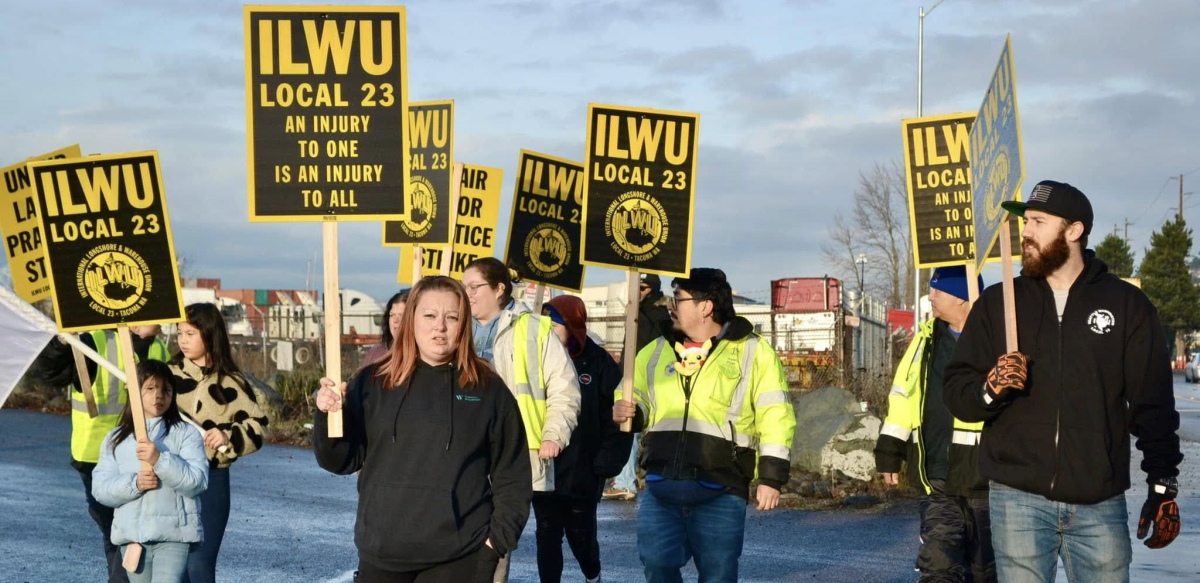
Wallenius was paying nonunion workers 40 percent of what union workers across the street were making. Photo: ILWU Local 23
One hundred and fifty workers at a vehicle processing center in Tacoma, Washington, won their first contract last year, in a huge step for the International Longshore and Warehouse Union organizing down the supply chain.
Wallenius Wilhelmsen Logistics had opened the VPC across the street from a major terminal in the Port of Tacoma, where longshore workers are represented by ILWU Local 23. This “roll-on, roll-off” (ro-ro) terminal handles vehicles and other cargo that is driven on and off ships.
Wallenius is the largest ro-ro carrier in the world, with 128 vessels. In 2024 it brought in $5.3 billion in revenue and more than $1 billion in profits. Yet, until ILWU’s win, it was running a non-union operation immediately adjacent to longshore work.
Operations like this pose an existential threat to ILWU standards. Already, nearly every warehouse handling marine cargo along Washington state’s Kent Valley and Southern California’s Inland Empire is nonunion.
If employers are allowed to maintain these sweatshop conditions, the union could lose everything we’ve built over generations of struggle. ILWU’s founders understood this; it’s why we have the “W” (for warehouse) in our name. Longshore workers need to follow our work down the supply chain and build union power along the way.
SAME WORK, LOWER WAGE
The lowest wages at the facility were less than 40 percent of what ILWU members earned doing the same work for the same company across the street. Other problems loomed even larger: abusive management, dangerous speed-ups, and high turnover.
Wallenius is familiar with union standards as a member of the Pacific Maritime Association, which represents West Coast carriers, terminal operators, and stevedore companies. The PMA negotiates the coastwide contract for 24,000 longshore workers.
However, that contract doesn’t cover other employees of PMA member companies like Wallenius. Thousands work in non-union sweatshops within arm’s reach of major ports in Tacoma, Seattle, Oakland, and L.A.-Long Beach.
Though it has unionized facilities around the world, Wallenius intended to keep its Tacoma VPC non-union. Workers there prepare Hyundai, Nissan, Volvo, and other vehicles before they go to dealerships. This includes post-factory accessory installs, parts-handling, moving cars to and from satellite yards, quality control, a body shop, and loading vehicles onto train cars.
ILWU Local 23 knew organizing the facility would strengthen our position, and VPC workers knew with longshore power at their backs, they could disrupt the flow of cargo and force Wallenius to the table.
UNION HAMMER
The workers launched their organizing drive in 2024 with a march on the boss. They delivered a majority petition demanding action to address worker injuries, forced overtime, imposed 10- and 12-hour shifts, pressure to violate speed limits, inadequate equipment, and failure to train and certify drivers and forklift operators.
After management threatened to fire them, workers held a one-day strike on February 7, 2024, which happened to coincide with a vessel offload. Longshore workers discharging autos refused to cross the picket line and operations at the facility ground to a halt.
The next day, workers announced they were joining ILWU Local 23. Wallenius flew in a union-busting team, texted anti-ILWU propaganda to employees, and held anti-union meetings almost daily. Still, the union won the March 21 election by 2 to 1.
Workers elected a 20-person bargaining committee, which became a thorn in the company’s side. Wallenius’s chief negotiator complained for months about the committee’s size and lack of “decorum.” His real issue: The big committee gave workers across the departments a firsthand view of what the company thought of them.
FIRST-CONTRACT BATTLE
Wallenius management dragged out negotiations into 2025. They showed up late, cancelled bargaining dates, and picked weird fights just to waste time, like arguing over the definition of “cool water.”
But the company’s worst behavior was back at the facility. Before or after almost every bargaining session, a committee member or supporter would be given an unsafe assignment, written up for fabricated infractions, or even fired. The union filed 15 unfair labor practice charges during negotiations.
ILWU organizer Jon Brier had told everyone from the beginning that the bargaining table is only where we measure our strength. The job itself is where we have power. Workers marched on the boss regularly. They struck twice in response to illegal discipline, including a four-day ULP strike after a bargaining committee member was fired. Longshore workers, truck drivers, and railroad workers honored picket lines, shutting the facility down.

Bad publicity and the threat of further disruption finally forced Wallenius to begin addressing core issues, backing off from company demands for 12-hour days and mandatory extra shifts.
INTERNATIONAL SOLIDARITY
Then the union took a hit. When General Motors imports, which had temporarily been coming through Tacoma since the pandemic, returned to Baltimore, Wallenius imposed layoffs. The company blamed the union’s “unreasonable” demands and tried to slow the pace of negotiations.
So our committee turned to international allies. Letters of support flooded in from every corner of Wallenius’s global supply chain, including East Coast longshore workers, unions in Belgium, Benin, Bermuda, New Zealand, Ukraine, and Uruguay, the International Dockworkers’ Council, and the International Transport Workers’ Federation.
Dockers with the Maritime Union of Australia in Port Kembla and the All-Japan Dockworkers Union (Zenkowan) in Yokohama picketed on the docks and hand-delivered letters on Wallenius vessels demanding good-faith bargaining.
The next time we met, we secured tentative agreements on nine articles in two days. And on May 1, 2025, workers voted on a contract. It passed by 97 percent.
The contract included 50 to 60 percent raises, a full-time guarantee, 95 percent employer-match health care, three weeks’ vacation after three years, and the right to stop work over safety issues—the best standards for vehicle processing workers in the country.
Now came the next fight: enforcement. Less than a week into the new contract, Wallenius announced a punitive round of layoffs. A slew of flagrant violations followed: misclassifying employees into lower-paid categories, denying medical leave, management doing bargaining unit work, and understaffing. Then the company targeted bargaining committee members in a second round of layoffs.
Members have fought back using their new contract, filing more than 80 grievances to date. Several have been adjusted in members’ favor so far and there have now been two big rounds of recalls, including key bargaining committee leaders. One illegally fired member’s case is moving toward arbitration, and safety issues that went ignored before the contract have also been finally redressed.
BARGAIN TO ORGANIZE?
The Wallenius facility is our biggest win yet in a string of local victories. In Seattle and Tacoma, we’ve organized mechanics at P&B Intermodal and bunker fuelers at North American Energy Services. We call our organizing model “heat and hammer”: Workers bring the heat and the union drops the hammer by disrupting cargo.
Other ILWU locals are organizing down the supply chain, too, including in Hawaii, Oregon, and California, and with the ILWU’s Inlandboatmen’s Union. Last year, ILWU Warehouse Local 6 in Oakland organized an off-dock chassis storage and repair site with help from ILWU Longshore Local 10 and its Young Workers Committee. Off-dock facilities do the same chassis repair work as ILWU longshore mechanics at marine terminals, but for a fraction of the wage, threatening union jobs and standards.
Though the ILWU Coast Longshore Division has grown in the past two decades with the rise of imported goods moving through West Coast ports, we haven’t kept up with the exponential growth of non-union warehouse jobs nationwide.
Containerization and the transfer of union work away from the docks over the last half-century has reduced our overall numbers and undermined our power.
In the past, individual pieces of cargo moving through warehouses were stowed in ships by hand. Now they are palletized and stuffed into 40-foot steel boxes. Each container is handled just once on the vessel by a single crane pick. Work that used to require a 16-person gang over a week or more can now be done in just two or three shifts.
However, we still have incredible power at the table—more than many other unions. And we can use that power to expand our ranks through “bargaining to organize.” The United Auto Workers used this strategy in its 2023 negotiations, demanding that workers at battery plants owned by Big 3 automakers be brought into the UAW and incorporated into master contracts. We should consider a similar tactic when ILWU-PMA negotiations resume in 2028.
Meanwhile, the ILWU has to recapture this off-dock work the old-fashioned way: by building majority support and forcing employers to sign contracts or else see the flow of cargo disrupted. Moving on this now would build our leverage to win organizing rights for workers at non-union plants owned by our employers.
If you’re a longshore or warehouse worker, start thinking about where the goods you handle go to and come from. If you know somebody who works at one of these warehouses, fulfillment centers, or cross-docks, talk to them about how they can improve their pay and conditions. The ILWU Organizing Department can help. Let’s use our heat and hammer!
Zack Pattin is a longshoreman and labor representative with ILWU Local 23. He can be reached at zpattin[at]ilwulocal23[dot]org. A version of this story first appeared in the ILWU Dispatcher.



You must log in or register to post a comment.