Interview: Repression of the Minnesota 15 is Part of a Larger Assault on Labor

Federal agents stood on Nicollet Avenue in Minneapolis on the morning they killed union nurse Alex Pretti. Photo: Luis Feliz Leon
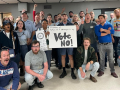
In June the federal government arrested and indicted 15 people, many of them union activists, on conspiracy charges over last winter’s protests and massive strike against ICE in Minnesota. The “Minnesota 15” include union carpenters, electricians, teachers, university staff, and nursing home workers. Donate here to support their legal defense. Below is an interview with members of the Minnesota 15: Cal Robinet, a member of Electrical Workers (IBEW) Local 110, Alec Stewart, a member of the Minnesota Association of Professional Employees, and Isaac Sant, a member of SEIU Healthcare MN.—Editors.
Kip Hedges: Can you tell me a little about how you came to be so involved with the resistance to ICE during Operation Metro Surge?
Alec Stewart: For me it really began with the uprising after George Floyd was murdered by the Minneapolis Police Department. I got involved with Cop Watch efforts to monitor the activity of police, mutual aid to the community, and community patrols back in 2020. The people who plugged me in were active in the labor movement and I was a union member so I definitely had a strong orientation to the working-class movement.
Cal Robinet: I was part of a coalition, an organization called Workers Solidarity Circle. It is a group of union members and other workers that are looking to build real worker power. We knew that massive repression was coming with the election of Donald Trump, so we started to build up our capacity through mass meetings, speakers, skill shares, and fundraisers so that we could have mass community self defense once we found ourselves where we did. And we had been talking about the idea of a general strike as one of the most important ways we could push back. We talked with workers and unions about this for over a year before ICE got here.
Isaac Sant: I was opposed to the ethnic cleansing that ICE had done in Chicago and Los Angeles, and to what is really an attack on the entire working class by attacking the most vulnerable part of the class, which is immigrant workers. It became very personal to me when ICE abducted one of my co-workers, a Liberian grandmother, someone who was very well respected at work and in the West African community here. But I’ve been organizing in the labor movement for 16 years and immigrant workers have strengthened the workers’ movement in a big way. It’s in every worker’s best interest to defend immigrant workers, because if they can drive down and marginalize immigrant workers, it acts as a downward pressure on every worker.
What impact do you think Metro Surge had on the labor movement and on workers generally?
Isaac Sant: Some unions took really bold and decisive action in response to Metro Surge. A lot of credit has to go to SEIU Local 26, Minneapolis Federation of Educators Local 59, and St. Paul Federation of Educators Local 28. Local 26 has a ton of immigrant workers so they led the way, I think because so many of their members were suffering. Local 26 took a real risk in being at the front of the parade. The educators were out in front probably because so many of the kids and parents were under the gun from ICE and educators felt they had to step up to protect the kids that they care about.
My SEIU local, SEIU Healthcare, is much more conservative and my leadership didn’t step to the fore. In fact, they discouraged people from not going to work on January 23rd, the day of the mass strike, where more than 300,000 workers chose not to go to work. Of course a lot of my co-workers chose not to go to work anyway.
It’s also important to remember that the big majority of workers who didn’t go to work were not in any union. That day, January 23, the day of the march of 100,000 in the streets in minus 25 temperatures, also had a real multicultural, celebratory feel to it. Like, you’re not going to drive us down.
Cal Robinet: I think the whole idea that the labor movement should only deal with our own union contracts and stay away from so-called political issues has been a disaster for workers everywhere. It was the hundreds of thousands of working-class people involved in rapid response, mutual aid, and school defense that dragged the union leaders along. There were a lot of workers that figured out that they had to be the union, even where they didn’t have a union.
In my union, IBEW Local 110, a group of rank-and-file electricians fought to reinstate the idea that workers don’t have to work under unsafe working conditions. Stewards have a right to shut a job site down. We organized to bring a resolution forward that said if ICE is on a job site, it’s unsafe and should be shut down. I thought we might face some opposition, but it passed unanimously except for one guy who sort of half raised his hand in opposition because he was embarrassed to oppose it publicly. The Minneapolis local, IBEW 292, had the same experience.

Alec Stewart: Metro Surge was a big issue in my union, Minnesota Association of Public Employees, even though most members are not immigrants. The Solidarity Caucus led the way in getting the union on record against Metro Surge, and we had a contingent at the January 23 mass strike.
How has the labor movement responded to the case of the MN 15?
Alec Stewart: I have been pretty impressed with how much the labor movement in Minnesota has come through with support. I mean dozens of unions in the state have signed onto a letter supporting us (link here), including the Minnesota State AFL-CIO and the Minneapolis Regional Labor Federation. I know my union, MAPE, which has 20,000 members in the state, has been pretty supportive. We had a delegation at a recent support march and rally. I think the union support is spreading across the country and, in fact, the world.
Cal Robinet: I think one of the reasons the labor movement has responded so well is because the government is not just going after the MN 15 but the entire labor movement. We learned from discovery in our case that Homeland Security considers the Minnesota AFL-CIO a part of a vast Antifa network. They have subpoenaed the financial records of the Communications Workers of America international union around our case.
We held a workers assembly on February 15 this year. Four hundred workers and people from 30 different union locals showed up to democratically discuss next steps in the fight against ICE. It was fantastic. But at that meeting there were five undercover ICE agents. They were very interested in a gathering of workers.
So what does your defense committee have planned next?
Isaac Sant: We want to build this defense effort bigger and broader. So we are taking it across the country with a multi-city speaking tour. We have dozens of cities where we will be going to speak, not just about our case but about the Prairieland defendants in Texas [activists who staged a protest at an ICE detention facility], the Michigan 8 [anti-genocide activists], the Spokane 3 [anti-ICE activists], and the Righteous 39 [anti-ICE protestors]. More cities are being added all the time. You can check out our website Minnesota15.org to see if your city is on the tour. If not, contact us and we will get you added.
This case isn’t important because we are particularly important as individuals. We’re not. We did what everyone else in Minnesota was doing this winter: resisting ICE. But it’s definitely part of a much bigger attack on workers everywhere, and for that reason it’s going to take all of us to beat it back.
Kip Hedges is a union activist and former Delta Air Lines baggage handler and ramp worker.