The First-Ever California State Workers’ Strike
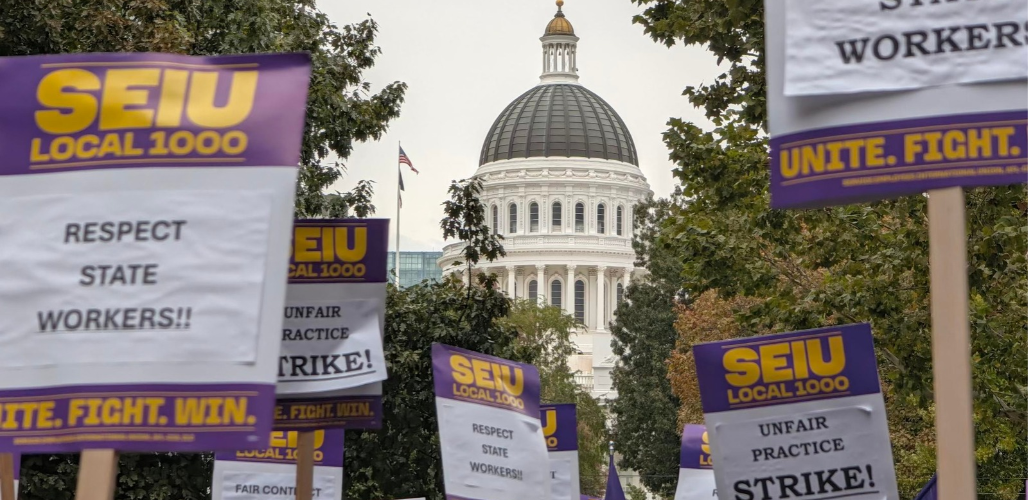
This was the first strike in the history of SEIU Local 1000, which represents about 100,000 government employees in California. Photo: Nick Cruz
State workers went on a one-day unfair labor practice strike across California October 21, with picket lines in Sacramento, San Francisco, Los Angeles, and other cities. They're demanding better pay, affordable health care coverage, and flexibility to work from home.
This was the first strike in the history of SEIU Local 1000, which represents about 100,000 government employees, ranging from accountants to custodians to nurses at state offices, hospitals, and prisons.
They have been working without a contract since July 1. Some 5,000 employees were excluded from striking.
Governor Gavin Newsom’s “return-to-office” mandate went into effect this past summer. It requires workers to be in the office four days per week—even though workers report there isn’t enough space for all of them.
Workers argue the return-to-work policy compounds the lack of pay increases. Being forced back into the office is “more than just a pay cut,” said Jonah Paul, who works for the Employment Development Department in Sacramento. ”It’s a huge reduction in quality of life.
“Telework is a stopgap for a lot of problems our society is not willing to address,” Paul said: “the cost of childcare, and insane commutes. Telework becomes a catch-all solution for a grueling life.”
ZERO RAISE
Last year, Local 1000 agreed to a pay freeze to help the state meet a budget shortfall. This summer, however, workers were supposed to see raises. But they got zilch.
The union is asking for a 20 percent raise over three years to catch up, especially given increased state revenue over the past two years.
Though Local 1000 and the state have met several times to negotiate a new contract, the union says CalHR, the bargaining representative for the state, has not been negotiating in good faith. It filed unfair labor practice charges with the state Public Employment Relations Board against CalHR for delaying negotiations and failing to respond to proposals.
“When I first started working for the state 10 years ago, for the most part CalHR would throw us a bone,” said steward Giovanni Martinez, a state worker in Sacramento. “This is the worst bargaining cycle I’ve witnessed. They don’t want to budge on a lot of stuff. Newsom takes us for granted, and the people he’s appointed in CalHR are the same way.”
Under previous leadership, the union kicked in $1 million to help Newsom fight a recall campaign in 2021. Members question why a governor they supported doesn’t have their backs now.
STRIKE SCHOOLS
Members of Local 1000 have been organizing over the past few months to increase membership numbers. Activists have been approaching nonmembers at their own worksites to ask them personally to join the union, and calling others on the phone.

Stewards did their best to increase communications across the membership, though they were hampered by limited updates from the official Bargaining Unit Negotiating Committee.
Paul said that three years ago, the local offered “strike schools” to members, but these were more about discouraging members from planning for a strike. This time, he said, strike schools emphasized that the decision to strike was one for members to make, building membership numbers along with enthusiasm for walking out together.
In a strike authorization vote held from September 9 to October 7, 96 percent voted “yes” to walk out.
On the final day of the vote, the union held informational pickets to encourage participation in the vote. One picket happened to be next door to a building where Newsom was giving a speech.
With just a half-hour’s notice, stewards and other union leaders managed to get members together to cover every entrance of the building and make enough noise that Newsom had to comment on it during his event.
Despite this pressure from members, there was no last-minute deal to avert the strike, as happened 10 years ago under Governor Jerry Brown.
“For a lot of folks this is their first strike—this is mine,” Martinez said. ”We didn’t want to walk off the job—we have a good relationship with our supervisors—but we had no choice.”
WORLD’S FOURTH-LARGEST ECONOMY
Strike participation appeared strong, with thousands of workers joining rallies and marches in cities across the state. Striking workers in the state’s capitol shut down multiple blocks with a march from CalHR headquarters to the capitol building.
“I was up on the truck with our president and a few other folks, leading people to different rally points,” said Emily Ingram, a Department of Education worker in Sacramento. “All you could see in every direction was more people. It was a pretty powerful feeling.”
In Los Angeles, hundreds of workers rallied outside a state building. Arielle Mangabat-Lowe, who works at the Department of Toxic Substances Control, said she was surprised how many people showed up, after prior actions had only a few dozen participants. She reflected that it can be hard as an organizer to put so much work into the union without knowing whether other members will participate.
But being with others at the strike rally boosted her spirits. “The state of California is a terrifying employer—it’s the world’s fourth-largest economy. We showed up today anyways,” she said. “It’s cool to feel like you have a voice, especially in these times.”
“As someone who has been trying to get folks to join up, I think a lot of state workers are fired up,” said Martinez. “The energy is here. Where we go with it, that’s up to us as members and our leadership.”
The union continued to pressure CalHR after the strike. On October 27, about 20 members disrupted a CalHR event in Sacramento, distributing flyers and shouting a message to the crowd demanding that the state stop intimidating members and bargain fairly.
The two sides are scheduled for contract mediation on October 30, but members are skeptical that the state will come ready to negotiate a deal. “We are continuing to prepare for another strike if needed,” Ingram said.