Mississippi Transit Workers Strike for Better Protections and Service
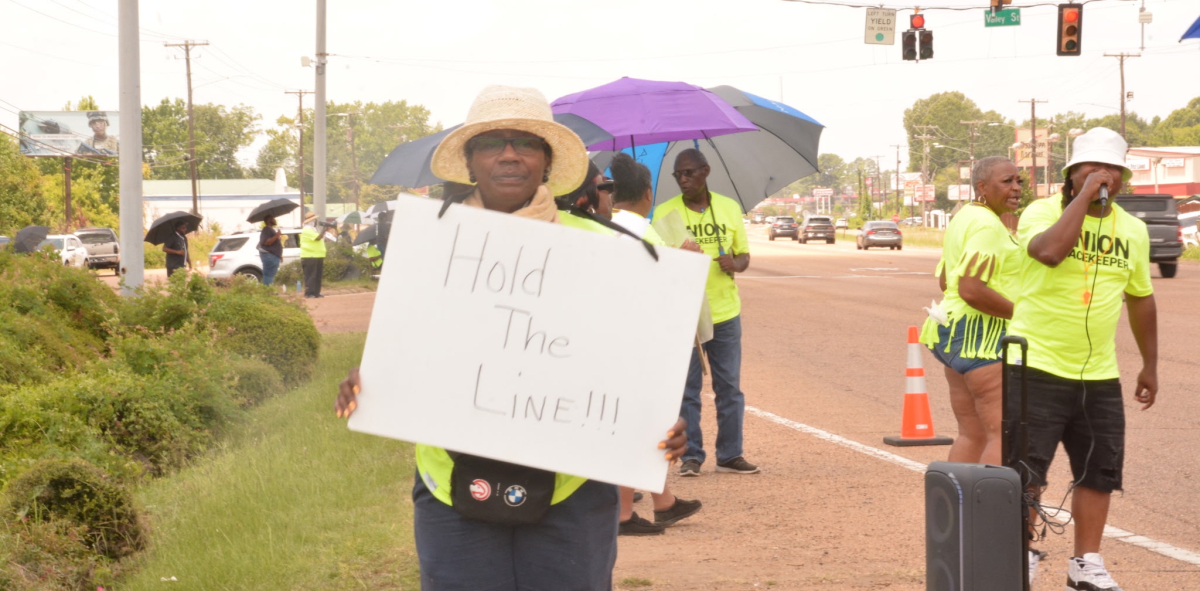
Local 1208 has built support from the public and worked to build pressure on the city council, which manages the contract with MV Transportation. Photo: Printiss Glover
Mississippi has the highest poverty rate in the U.S., and is a “right-to-work” state with only 4 percent of its workers in unions. But since July 13, Highway 80 near Jackson has been lined by chanting picketers. They’re on strike at JTRAN, the city’s public transit system.
Around 1,000 people rely on JTRAN’s services daily, and Transit (ATU) Local 1208 represents its 80 bus operators, mechanics, cleaners, and customer service representatives.
The service is operated by MV Transportation, the largest private transportation company in North America and a consistent foe of the union. JTRAN workers went on a two-week strike two years ago.
The contract expired on December 31. In negotiations so far, MV Transportation has moved on some issues but refused to budge on other important ones.
Starting pay is just over $17 an hour, and the union is seeking more competitive wages to deal with inflation. The company has proposed raising starting pay to $22, but higher-seniority top-rate drivers are already at $23 and would only get to $27.58 by the end of the three-year contract.
An unfair disciplinary system also has members fired up. Bullying safety managers have abused the system to terminate drivers for minor infractions outside of their control. Drivers on fixed routes, where the buses don’t have seat belts, have been terminated for a passenger falling out of their seat.
Many incidents stem from inadequate training. “You need to give people appropriate training. You need to give them a chance,” said four-year bus operator Tammy Flowers.
Local 1208 has proposed a three-person accident review board with a union rep, a company rep, and a neutral party. MV wants to stack the deck with two company representatives instead.
Drivers’ seniority is also being attacked. Currently routes are chosen every quarter based on seniority. But the company is pushing for a clumsy system where operators have to call in every morning between 5:30 and 8:00 a.m. to find out what route they have.
Other proposals will significantly hurt service for riders. MV Transportation wants to eliminate Saturday service and begin to use microtransit, a form of private, on-call transit service. These drivers would be brought in on a lower pay rate, effectively creating a two-tier system. The union understands that once two-tier is allowed in, it's extremely difficult to remove.

The microtransit drivers would also not be required to have a commercial driver’s license (CDL), putting the public’s safety at risk. This would be used to replace paratransit, which is a public transit service designed for people with disabilities who are unable to ride the regular fixed bus route.
“Microtransit cannot reliably pick up as many people on call. People with disabilities will suffer,” said Local 1208 President Charles Tornes, Jr. Disability rights advocates have been supporting the union on the picket line.
TAKING IT TO CITY HALL
Local 1208 has built support from the public and worked to build pressure on the city council, which manages the contract with MV Transportation.
A dozen JTRAN workers rallied at City Hall on July 14, and Local 1208 President Tornes testified against the mayor’s announcement that CDL requirements would be waived for scab replacement drivers. While a CDL is not required for certain smaller vehicles, the union has not been given the ability to track what licenses the replacement drivers have.
One councilman even threatened to push for an end to the city’s contract with MV Transportation if workers do not get a fair deal.
So far the replacement drivers have been struggling to learn new routes and deliver timely service. But the company has paid them $35-$50 an hour, well above what Local 1208 members have been asking for. MV has also paid to put them up in hotels and provided meals.
Meanwhile, riders have brought water and food to support the strikers. A snow cone truck even made the trip from Tennessee to help them cool off in the heat.
“We’ve had people who ride the bus come on our strike line and tell us that they miss us and want us to get what we deserve,” says Tornes. The union has emphasized that declining ridership and revenues have been caused by route cuts in lower-income neighborhoods, which need to be reversed.
Federal mediators were brought in at the end of July, but bargaining still hasn’t yielded any progress. “Everyday working people depend on the buses,” said Flowers. “They know what we go through and support us. If the people who ride the buses support us, then the company should.”