Persecuted by Trump, Will Unions Build Towards May 2028?
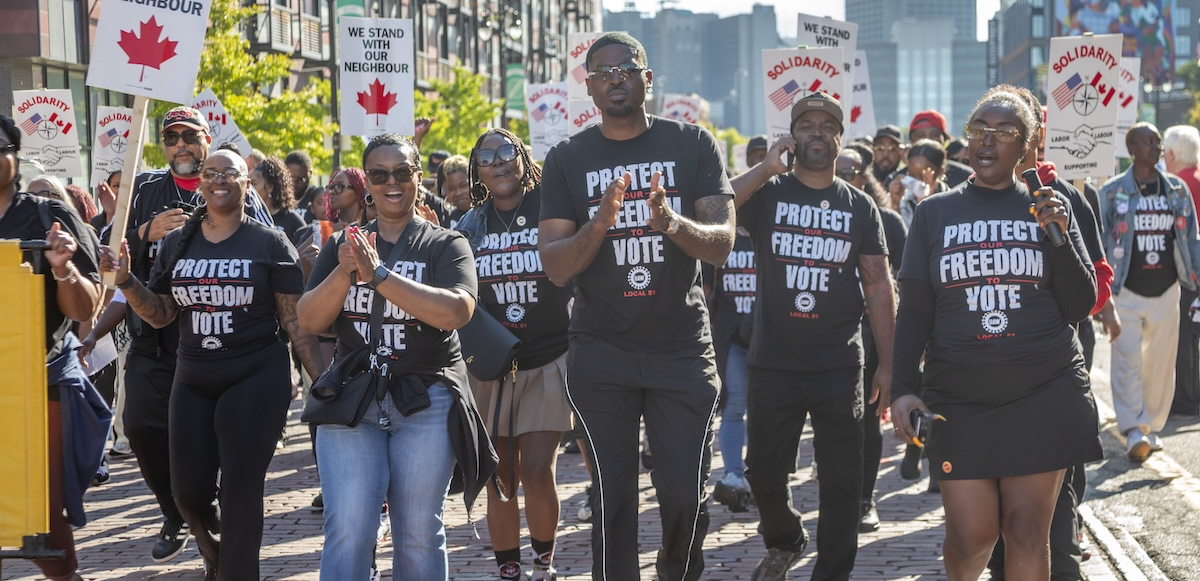
Members of Auto Workers Local 51 marched in Detroit on Labor Day. The May Day Strong coalition is holding 750 “Solidarity Schools” from late August through mid-September nationwide, bringing together labor organizers and community members to confront the authoritarian threat we face. Photo: Jim West, jimwestphoto.com
Three years ago the United Auto Workers, glowing with confidence after a successful strike at the Big 3 and pledging ambitious new organizing drives, put out a call for a national strike on May 1, 2028.
UAW President Shawn Fain called for unions to align their contracts with the Big 3 to build leverage and create a crisis for the billionaire class. It was a new day in the UAW, and a wider labor renewal felt possible.
May 2028 is now only a year and a half away. Are unions getting in gear for a season of strikes and labor action around then, as contracts expire in manufacturing, education, logistics, grocery, and the building trades?
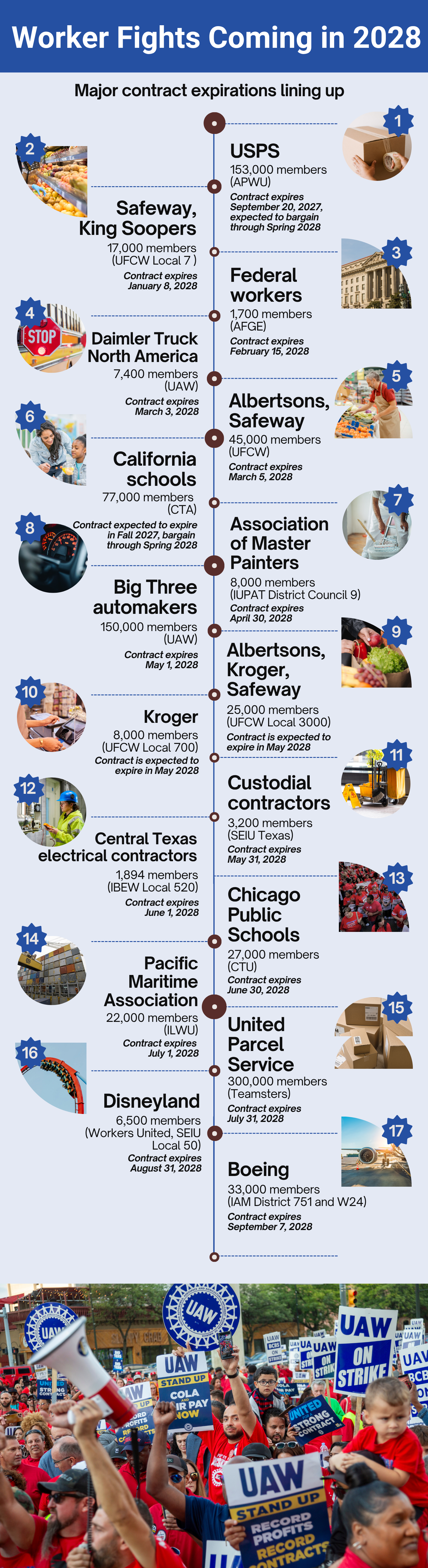
Some are. Labor Notes has found 830,000 workers with contracts planned or expected to expire from March to July 2028 (see illustration below).
These include 150,000 auto workers at the Big 3, 153,000 Postal Workers (APWU), though they are unlikely to strike, 95,000 grocery workers with the Food and Commercial Workers Union (UFCW), and 77,000 K-12 educators with the California Teachers Association.
“Together, we can turn May Day into a national day of reckoning,” Fain wrote last year, taking stock of the progress towards this goal. “If more union workers stand up together, we will all have more power to win what we’re owed.”
FIGHTING ON NEW TERRAIN
What we are owed has been growing, amid Trump’s extreme attacks on workers and unions.
One million federal workers have lost their right to collective bargaining. The National Labor Relations Board and other federal agencies meant to protect workers have been left unable to fulfill their essential roles. Tens of thousands of immigrant workers, including union members, have been stripped of their legal status and rights, subjected to criminalization and detention.
May Day 2028 wasn’t initially about fighting Trump’s billionaire power grab. But since Trump took office, the terrain has shifted. Mass protests have become more frequent, and more urgently needed to stem the volley of attacks on workers and on democratic elections.
Massive weekend protests that drew millions, organized by Indivisible and No Kings, haven’t been able to reverse Trump’s attacks, though they are important training grounds to welcome new activists. (Bring your union banner!) The next big one, “No Kings: Vote Early,” is scheduled for October 17. It will include block parties, rallies, and walks to the polls.
But the lessons from these mobilizations have started to shift tactics to include large economic disruptions. Today’s resistance movement recognizes that one-off weekend protests aren’t enough.
Unions are powerful members of a resistance coalition not only because they are robust voter turnout operations, but more importantly because they can channel the structural power of workers in key industries to grind the system to a halt.
In January, when Trump sent a swarm of federal agents into the Twin Cities on a rampage, he lit a match to the tinder that unions and community groups had been laying through decades of coalition work. People’s resistance spread into school walkouts, sit-ins, demonstrations, and strikes.
“We modeled our ‘ICE Out’ work similarly to how we prepare to go on strike—leaders in each building and regional leads who work together to cover the city,” said St. Paul educator Mara Solis. “Each school had parent captains to work with our educator captains.”
These escalating actions grew into a mass uprising that nearly shut down a large metro area. Federal agents beat a retreat from the terror spectacles in Twin Cities streets after January 23, when at least 100,000 people marched through downtown Minneapolis and nearly 1 million across the state skipped work to participate in a massive political strike, including nonunion construction workers and restaurant workers who called out from popular downtown venues and supermarkets.
It showed how, when unions act like movement organizations, nonunion workers can join them in common cause, which is necessary in a country where 90 percent of the population working for a private-sector employer earns a living in a nonunion workplace.
If the Twin Cities offered an example of layer after layer of society erupting into open rebellion, how can that be replicated nationally? We already have a rendezvous date for massive economic disruption, in the months leading up to the next presidential election.
DURABLE ORGANIZATION
May 2028 might still seem like a long time from now, given the urgency of the current crises. But as we witnessed with Black Lives Matter protests, it took years for grassroots activism to culminate in a major wave of protests, with effects that went on resonating for years more.

With union contracts set to expire in a presidential year, there’s an opening to coordinate bold demands and worker action to defend democracy, as well as to win economic gains.
Workers can put pressure on their employers to call for free and open elections. They can build broad alliances to pressure the state and employers for strong pensions, Medicare for All, a shorter workweek, and taxing the rich.
In times of crisis, new organizations can spring up like FEMA tents in disaster areas, and fold away just as quickly until the next crisis. But movement-building isn’t the same thing as crisis management. To win real change and defend it, you have to keep applying pressure over years; that takes durable organizations that become rooted in people’s lives.
The May Day Strong coalition of unions and grassroots organizations, formed in March 2025, is organizing under the banner of “workers over billionaires” to concentrate resistance efforts on the tech oligarchs who prop up Trump’s MAGA coalition, and to defend the vote ahead of the midterm and presidential elections.
This coalition could take the lessons from the Twin Cities and spread them nationwide. If some unions strike together, other union and nonunion workers can join in other ways, like using sickouts and disruptions to shut things down. Workers at airports and other key economic nodes might have to skip work if they find “abnormally dangerous” working conditions.
This level of mass organizing will require unions spending down their vast financial reserves to support workers without union strike funds, which could include legal defense funds and mutual aid networks.
If your union has bargaining this year or next, it might not be realistic to line up your contract to expire again in 2028. But one possibility is organizing to win sympathy strike language that permits union workers to honor each other’s picket lines. Article 9 of the Teamsters National Master Freight agreement and other Teamster contracts offer a model to emulate.
STANDING UP TO TRUMP
Meanwhile, Republicans are launching fishing expeditions against unions backing President Trump’s political opponents. The initial targets of Homeland Security spying and subpoenas of financial records were Minnesota unions plus the Communications Workers (CWA) and Service Employees (SEIU).
Now, according to the Guardian, House Republicans are also investigating the American Federation of Teachers, the United Auto Workers, SMART Transportation Division, and two railroad arms of the Teamsters: the Brotherhood of Locomotive Engineers and Trainmen, and the Brotherhood of Maintenance of Way Employees Division.
And Trump is threatening the integrity of the November elections.
The May Day Strong coalition is holding 750 “Solidarity Schools” and actions from late August through mid-September nationwide, bringing together labor organizers and community members to confront the authoritarian threat we face.
The trainings are geared towards equipping people with the tools to conduct election defense. Participants learn how to monitor poll sites, and they play out scenarios for how we could respond if federal agents and others attempt to undermine democratic elections through deception, disruption, or suppression of the vote.
The scale of action the labor movement will be able to muster on May Day 2028 depends on the organizing we do now.