May Day Actions Call for 'Workers Over Billionaires'
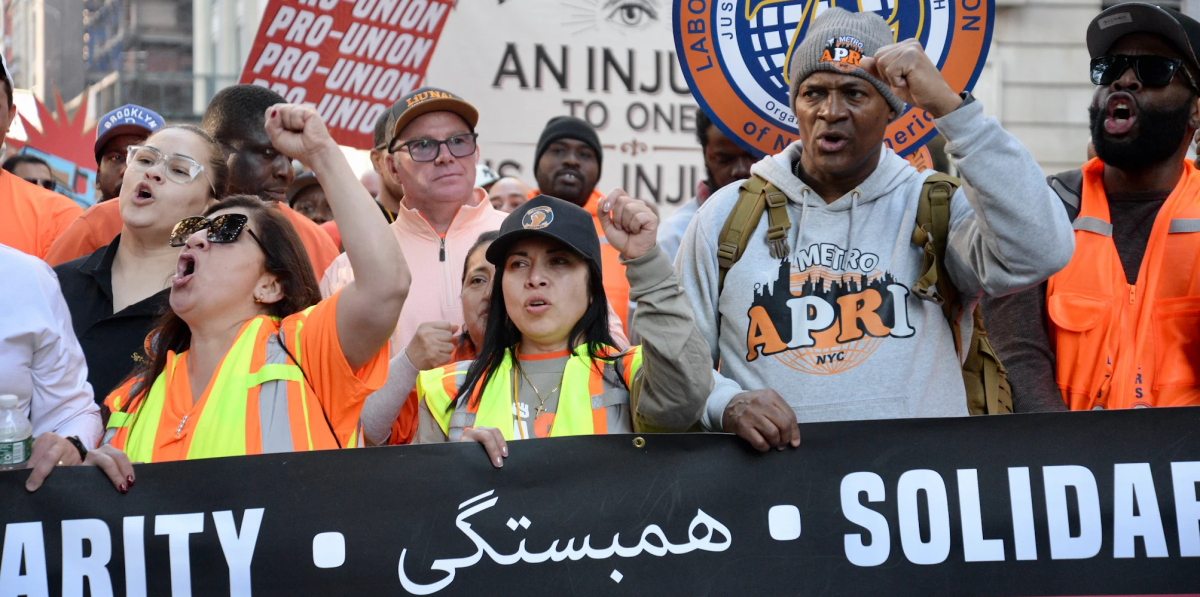
Thousands gathered in New York City for a march on May Day. The largest contingents included Laborers who came from nearby states to join Locals 78 and 79, turning the Washington Square Park into a sea of orange shirts. Photo: Jenny Brown
On May First—International Workers’ Day—people across the U.S. and the world joined rallies and other actions calling for “Workers over Billionaires.”
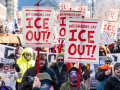
In the U.S., workers organized over 4,000 May Day actions in big cities and small towns. They focused on three demands: tax the wealthy, no to ICE, and expand democracy, not corporate power.
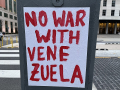
The protests came in the wake of a recent Supreme Court decision further gutting the Voting Rights Act and amid ongoing wars in Iran and Lebanon, as well as a continuing ICE assault on immigrant communities. Our current administration is upholding the same anti-worker, anti-immigrant, and anti-democratic laws that May Day martyrs fought against back in the 1880s.
The May Day Strong coalition called for a day of “no work, no school, no shopping” to highlight the economic impact from people’s resistance. On the ground, the call translated to bigger rallies and disruptive actions in North Carolina. Nearly two dozen school districts closed as thousands of educators marched to Raleigh as part of a “Kids Over Corporations” mobilization. In Memphis, Tennessee, student protestors staged a die-in to protest industrial pollution stemming from billionaire Elon Musk's xAI data center.
Chicago’s high-energy May Day rally was fueled by organizations from across the city, including the Chicago Teachers Union, Arise Chicago, the Illinois Coalition for Immigrant and Refugee Rights, and SEIU Healthcare Illinois and Indiana. Speakers honored the region's labor history and celebrated local culture and community. They also railed against billionaires who profit from workers’ suffering and a corrupt government. The day included a morning action against the CEO of Highlands REIT, a real estate company that owns a Colorado prison that ICE wants to lease as a detention center.
The teachers’ union pushed to make May Day a day of civic engagement. “We negotiated with the district to make May 1 an official Civic Day of Action, secured buses for students and educators, and guaranteed no retaliation for anyone who participated,” said CTU Vice President Jackson Potter.
“What happened on May Day didn't come out of nowhere,” Potter said. “It came from solidarity schools, picket lines, and months of organizing in Chicago and cities across the country, from Memphis to Philadelphia to Denver.”
STRIKES AND RALLIES
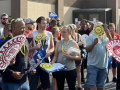
In a demonstration of solidarity, New York City Amazon workers, Teamsters, and local politicians marched on Amazon corporate offices to demand an end to their contracts with the Department of Homeland Security (DHS). Later in the day, thousands gathered in Washington Square Park and marched down Broadway to Foley Square. The largest contingents included Laborers who came from nearby states to join Locals 78 and 79, turning the park into a sea of orange shirts. Unlike previous May Day rallies, many unions mobilized sizable groups, including the Hotel and Gaming Trades Council, SEIU 32BJ, the Professional Staff Council, stagehands with IATSE, the United Auto Workers, AFSCME District Council 37, the New York City Taxi Workers Alliance, and a smattering of federal workers’ unions.
The resistance against anti-immigrant attacks mirrored in San Francisco with the arrests of several elected officials during a blockade at the San Francisco International Airport in support of union members picketing for higher wages and an end to ICE presence at airports.
In New Orleans, protesters rallied in support of local National Nurses United members, who kicked off their five-day unfair labor practice strike against LCMC Health on May Day. This prominent hospital has spent more than two years delaying and bargaining in bad faith. Their blatant retaliation against the organizing drive has not stopped nurses from confronting management and mobilizing community support.
Minneapolis saw two more May Day strikes: Normandy Hotel and Hotel Ivy workers walked out on May 1, demanding the hotel negotiate faithfully. And later in the day, concessions workers with UNITE HERE Local 17 voted to authorize their first strike.
Meanwhile, Sunrise Twin Cities shut down the Hennepin Avenue Bridge in a peaceful direct action against ICE. A hundred people stood in solidarity, singing and chanting to protest ICE terror in their communities. Six activists were arrested.

Louisville, Kentucky, hosted its inaugural May Day action, an event centered on working-class advocacy and creative community engagement. Although previous scheduling conflicts with the local Kentucky Derby festivities had prevented earlier celebrations, this first event successfully established a foundation for future multinational labor gatherings in the state. The program featured speakers from UAW Local 862, the Kentucky AFL-CIO, Louisville Democratic Socialists of America, and Teamsters Local 89.
INLAND AGAINST EMPIRE
In California's Inland Empire, the region east of Los Angeles, hundreds of residents joined the Inland Coalition for Immigrant Justice, SEIU 2015, Teamsters, California Faculty Association, and UAW 4811 for a May Day rally. They marched in front of the San Bernardino City Hall and the local Department of Homeland Security chanting “ICE out of the IE.”
The region has seen a huge influx of new warehouses and logistics centers that community members have resisted. This predominantly low-income and immigrant area has been targeted for its vast land, labor, and resources by corporations looking to build logistics facilities. The companies promise jobs for local communities, but most of these are warehouse jobs where workers face unsafe conditions, unsustainable wages, no benefits, and no protections against ICE. Amazon relies on the Inland Empire to function: 40 percent of the company’s goods pass through the region.
Vincent Kraus and Juan Mereles, who work at the Amazon air hub facility in San Bernadino and are organizing with the Teamsters, addressed the crowd to spread the word about their petition to Amazon’s collaboration with ICE. “We do not want the company that we work for to collaborate with ICE,” said Kraus, “and Amazon better listen.”
The May 1 protest brought unions and community groups together to demand worker protections, immigrant rights, and climate justice in the Inland Empire.
MAY DAY IN ITHACA
Ithaca, New York, was among the many smaller cities and towns across the country that rallied on May Day.
Addressing a crowd of hundreds of students and workers, UAW Local 2300 President John Jarvis said, “Everything we have as working people, none of this was handed to us. We fought for it.” Jarvis’ local was one of the 30 unions and community organizations sponsoring Ithaca’s May Day rally. Local 2300 represents over 1,000 Cornell University service and maintenance workers.
(Four days after the May Day protest, Cornell made headlines when university president Michael Kotlikoff backed his vehicle into two students, including one student-worker, in a confrontation with students over the free speech restrictions the university imposed to comply with the Trump administration.)
Catherine Johnson and Melanie Little, clinicians at Family and Children's Service of Ithaca, attended the Ithaca May Day rally just days after 22 of their 27 fellow co-workers voted to unionize. Both Johnson and Little were on the organizing committee that helped affiliate the workplace with Communications Workers of America Local 1111.
Johnson said workers organized because “We badly needed to redistribute the power in our agency in order to feel like we can keep doing our work.” She decried the broader political conditions that now shape their work, including federal policies that are “anti-care, anti-humanity, anti-immigrant.”
Little added, “The organizing we're doing in our workplace is part of this much larger movement and important work that's happening in the country and all over the world.”
Rene Cabrera and Priscila Esparza are interns at Labor Notes.