
Gearing Up for May Day: Solidarity Schools Spread
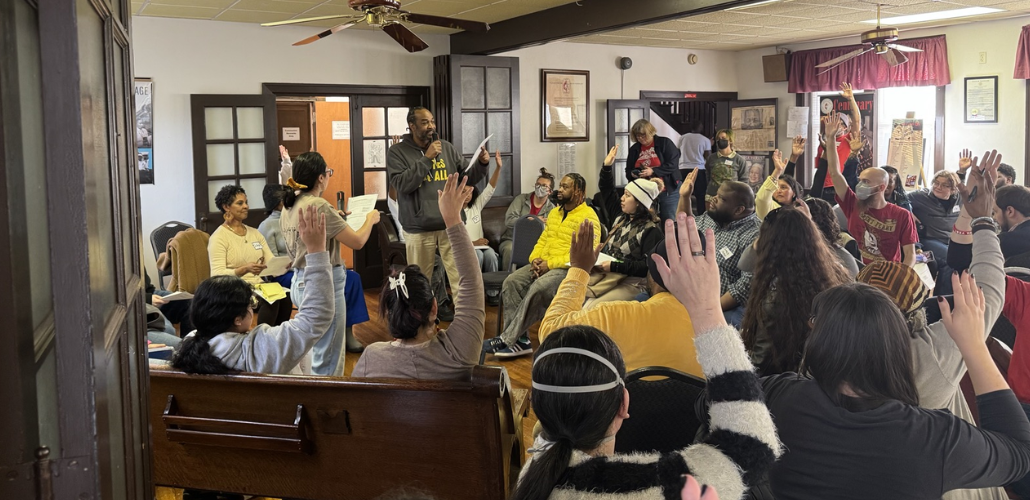
This Solidarity School in Memphis, held on January 23, was one of nearly 100 events held so far around the country to get local labor-community coalitions ready for a day of “No Work, No School, and No Shopping” on May 1.
Last year a network of unions and community organizations organized the largest May Day actions in U.S. history: 1,200 actions in all 50 states. This year, the stakes are even higher, and the examples inspiring us are even bolder.
The Chicago Teachers Union’s House of Delegates, the union’s governing body, has endorsed a national call for “no school, no work, no shopping” on May 1. Recent boycotts of Disney, Target, and Tesla have shown us that we can shake the pillars of corporate America. The massive Day of Truth and Freedom in Minnesota January 23 showed us that we can remove the head of the Border Patrol.
But before upping the ante, we needed to get trained up. Our union has a proud history of strike action. In 2016, we went on a one-day strike to fight back against massive budget cuts and threats to cut 7 percent of teacher salaries. Now Solidarity Schools can spread the know-how for militant, disruptive action to knit a national movement.
This regime of billionaires and aspiring authoritarians is threatening the integrity of elections and the very concept of government as a tool for public good. The May Day Strong coalition is organizing to use all of our organizations’ capabilities to respond.
Over the past few months the May Day Strong networks have planned nearly 100 local solidarity schools—some in partnership with Freedom Trainers, Labor Notes, and local coalitions—to get ready for a day of “No Work, No School, and No Shopping” on May 1.
In fact, the forces that powered the January 23 day of action in Minneapolis had started their preparations with a May Day solidarity school three months earlier. There they established red lines for what would trigger automatic city-wide action. That set the stage for their response when ICE agents pulled teachers out of their car windows in school parking lots and executed Renee Good and later Alex Pretti.
A JOYFUL VISION
The Memphis Solidarity School, held the same day that the Twin Cities rose up, brought together 100 labor, faith, and community organizers.
The school was hosted at Centenary United Methodist Church in the same room where sanitation workers had planned their historic 1968 strike. Samara Solomon, a member of Memphis Public Library Workers United, said the event built on existing local campaigns, like one to win civil service status for library workers.
The Philadelphia Workers over Billionaires campaign, launched in December, has already had thousands of conversations with workers about their vision for the city, said organizer Jana Korn.
“Over and over, workers shared with us their dreams of a safe, community-based, joyful city,” Korn said. They plan to unveil the results of those conversations at a meeting in March, then mobilize for May Day to demand this vision be realized.
NEW CROSS-POLLINATION
Representatives of 20 unions and 20 community organizations gathered in Maryland in January. Members of the building trades (Electricians, Steamfitters, Carpenters, Laborers) joined Teamsters, teachers, federal workers, higher education workers, graduate students, and service industry unions (UNITE HERE, SEIU 32BJ).
This was the most diverse set of organizations that most participants had ever trained with.

In Denver, a new labor, community, and youth coalition called United Denver organized a solidarity school in February. “We mapped how to escalate collectively in order to defeat the billionaire agenda and built real alignment between labor and community,” said Brian Winkler, a vice president of Communications Workers Local 7777.
In New York City, the May Day Strong school was held in four languages and brought together labor and community organizations who don’t usually work closely together.” They included the Laborers, federal workers, United Auto Workers, immigrant worker center Make the Road New York, and tenant group CAAAV: Organizing Asian Communities.
TARGETING TARGET
In San Francisco, 150 organizers from dozens of community and labor organizations across the Bay Area gathered in February, convened by Bay Resistance, for a May Day Strong “train-the-trainer” solidarity school.
United Educators of San Francisco highlighted their recent four-day strike, which won fully funded family health care and boosted wages for the district’s lowest-paid workers.
In small groups, participants contemplated potential May Day actions and discussed creative tactics to build the ongoing campaigns against ICE collaborators Target, Home Depot, and Palantir. The next step was a much larger solidarity school/non-cooperation training in mid-March.
In Boston, 250 people from 70 organizations came together. Greg Nammacher of SEIU Local 26 brought news from Minneapolis. Workshops and sector-specific meetings made plans for defending immigrants, organizing against corporate interests, and defeating authoritarianism.
Simultaneously, organizations along the North Shore of Massachusetts held an education conference on the same themes.
The next day the Chicago Teachers Union and several neighborhood and community groups hosted 400 people in their second Solidarity School.
More schools are coming up in the South and the Southwest, parts of the country that have a deep history of movement organizing yet a low union density.
The May Day Strong network is pulling together different forces—from small-town Indivisible chapters to the largest unions—to build momentum for the world we all deserve. Join the growing movement at MayDayStrong.org and check out our toolkit here.
Jackson Potter is vice president of the Chicago Teachers Union.



You must log in or register to post a comment.