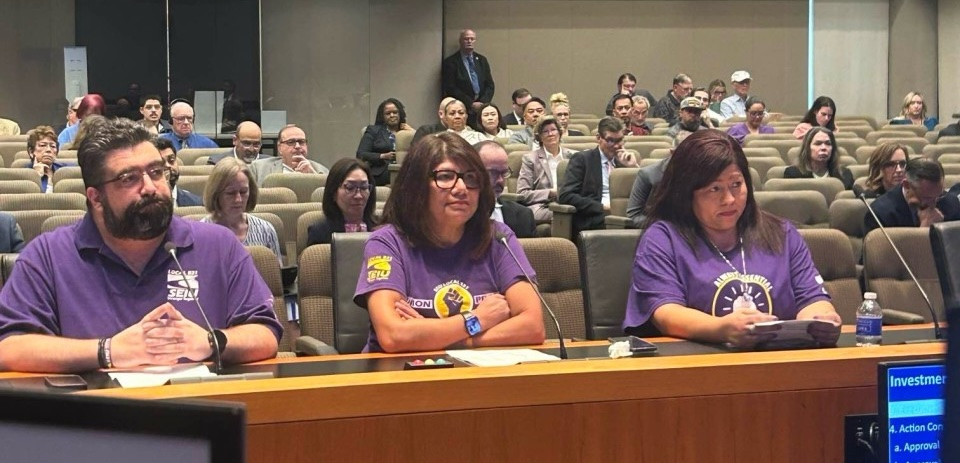
Union members in many states and cities are pushing for a stronger voice in pension investments. And sometimes they’re actually winning: They’re holding pension boards accountable and advocating for investments that insure worker protections, climate resiliency, and decent retirement benefits.
Public pension funds in the U.S. manage $6.7 trillion in investment capital. That amounts to almost 10 percent of the entire U.S. stock market. This capital comes from the deferred wages of 36 million public employees, like teachers, firefighters, transit workers, and health care providers.
States and cities first set up these pension funds because workers—including police, firefighters, and teachers—campaigned for and won the right to a decent retirement. Massachusetts created the first U.S. state pension in 1911.
But while pensions operate for the benefit of retirees, workers often have little or no voice about how their retirement savings are invested. Now, union members, acting as elected or appointed pension system trustees, or simply as pension beneficiaries, are changing that.
A SEAT AT THE TABLE
The California Public Employees Retirement System has $600 billion in assets. Union trustees pushed for and got CalPERS to incorporate labor standards into the set of principles that guide its investments.
CalPERS now must research whether the companies it invests in respect collective bargaining rights and uphold workplace health and safety standards. That’s good for the fund’s financial health, since research shows that better workplace standards result in stronger long-term returns.
Mullissa Willette, president of SEIU Local 521, is also a CalPERS board member. “As trustees, we aren’t day traders,” she says. “Our duty is to guarantee retirement security for decades to come. Closing our eyes to systemic threats like climate change or failing labor standards isn’t ‘neutral’—it’s a dereliction of duty.
“My members go out every day and sustain our communities and our economy,” Willett said. “We can’t let short-term, predatory thinking gamble away the retirement they earned.”
INVESTING FOR CLIMATE RESILIENCE
In Oregon, unions backed State Treasurer Tobias Reed’s “Decarbonization Plan,” which included the creation of a beneficiary advisory committee to guide the state’s decisions on where to invest workers’ pension funds. After that plan was accepted, unions actively supported legislation that directs the Oregon Investment Council (which manages state treasury funds) to invest in “climate resilience” and reducing “carbon intensity.”
Mike Powers of SEIU Local 503 said members support such climate legislation because many of them “endure the most extreme weather conditions, from extreme heat and cold at work to ice storms to floods to wildfires at home.” Powers says the workers he represents can see how extreme weather is wrecking the infrastructure: “Extreme weather reduces the value of the investments that form the foundation of their retirement."
Union members in Washington state are also calling on their pension board to ramp up investment in sustainable energy and climate risk reduction. Environmental and natural resources staffers in the Washington Federation of State Employees, an AFSCME affiliate, formed a Natural Resources Policy Committee, which tracks environmental issues and lobbies staff and trustees of the state pension.
“We're making progress on bringing our pension board into dialogue with our members, and it started with talking to the folks in our union who work on the front lines of climate change,” said WFSE member Keith Gonzalez.
INVESTING FOR HUMAN RIGHTS
In many states, union members are pushing pension funds to rethink investments in companies that build private prisons, profit from Israel’s attacks on Gaza and Lebanon, and contract with the U.S. government to spy on and deport their immigrant neighbors.
Members of Education Minnesota, a statewide federation of NEA and AFT locals, voted at their 2025 convention to investigate how teachers’ pensions are invested in ways that violate human rights and civil liberties, desecrate cultural and ethnic identities, and promote war, illegal occupation, and military conflicts.
At a recent meeting of the Minnesota State Board of Investment, union members called on the Board to stop investing in Palantir Technologies, which contracts with U.S. Immigration and Customs Enforcement and the Israeli Defense Forces.
“We should have a say in how our pensions are invested,” said Minneapolis Federation of Educators member Theresa Tauer. “We should know that our money is being used in a way that benefits us and supports our communities and uplifts humanity.”
Pension beneficiaries also noted that companies involved in human rights abuses face legal, regulatory, and reputational risks that can lead to stock price collapses.
“We have experienced a surge of militarization in our communities like nothing we have experienced before,” Tauer said, reflecting on ICE’s “Operation Metro Surge,” which sent 3,000 agents into Minneapolis. “But through the escalation of violence, we saw a massive outpouring of support” for those being targeted. She said it’s an extension of that same spirit of solidarity to assess what teacher pensions are funding.
BILLIONAIRE BACKLASH
Unions that pay any attention to their pension investment policies usually come down on the side of policies that promote good jobs and strong communities. But some bad actors want to stop workers from having a say.
The Trump administration, along with officials in Texas, Oklahoma, and elsewhere, are seeking to prevent public pension funds from setting investment standards. The Trump administration is restricting shareholders’ rights to vote on resolutions that would target anti-union companies and polluting industries. Not only do these moves restrict democracy, they’re likely to cost workers big money in lost retirement fund returns (see box below).
Opponents of environmental, social, and governance (ESG) policies often pretend to be concerned about public employees’ well-being. In February, GOP leadership launched an investigation of sustainable investments at CalPERS, claiming it was necessary to protect workers and retirees.
A recent article co-authored by a Heritage Foundation staffer accused funds pursuing ESG policies of “undermining the principle of respecting diverse viewpoints among fund beneficiaries.” But neither the GOP nor the Heritage Foundation asked workers where they wanted to see their money invested.
By learning about our pensions and speaking up to pension boards and elected officials, union members can protect our retirement savings and make sure those funds benefit our families and communities, not the billionaires.
Dan Nicolai works with Climate Finance Action, an organization supporting union members seeking a stronger voice in their pensions. He is a former union organizer with SEIU Local 32BJ and the Oil, Chemical and Atomic Workers.
BY THE NUMBERS: The High Cost of Political Meddling
While politicians claim that laws against environmental, social, and governance (ESG) pension fund policies “protect” retirees, the receipts show a different story: Workers and their communities are paying a massive price for anti-environment, anti-social pension investments.
$300 Million–$500 Million: That’s how much extra interest Texas taxpayers paid in the first eight months of its "boycott" law, which prevented local governments from using major banks that restricted investments in fossil fuels or firearms manufacturing. With this law, the state killed competition, forcing local school districts and cities to pay higher rates to build classrooms and roads.
$6.7 Billion: This is the projected loss to Indiana’s pension system over the next decade if restrictive investment laws remain in place.
$3.6 Billion: The estimated hit to Kansas retirement earnings over 10 years due to narrowed investment options.
$500,000: The amount of taxpayer money Missouri was forced to pay in legal fees to the financial industry in late 2024 after a court struck down its "ESG disclosure" rule as unconstitutional.
UNCONSTITUTIONAL: On February 4, 2026, a U.S. District Court struck down Texas SB 13, ruling that the state’s “blacklist” of financial firms violated the First and Fourteenth Amendments. The judge found the law was "impermissibly vague" and used by the state to punish companies for their speech and associations.