
Maybe a General Strike Isn’t So Impossible Now
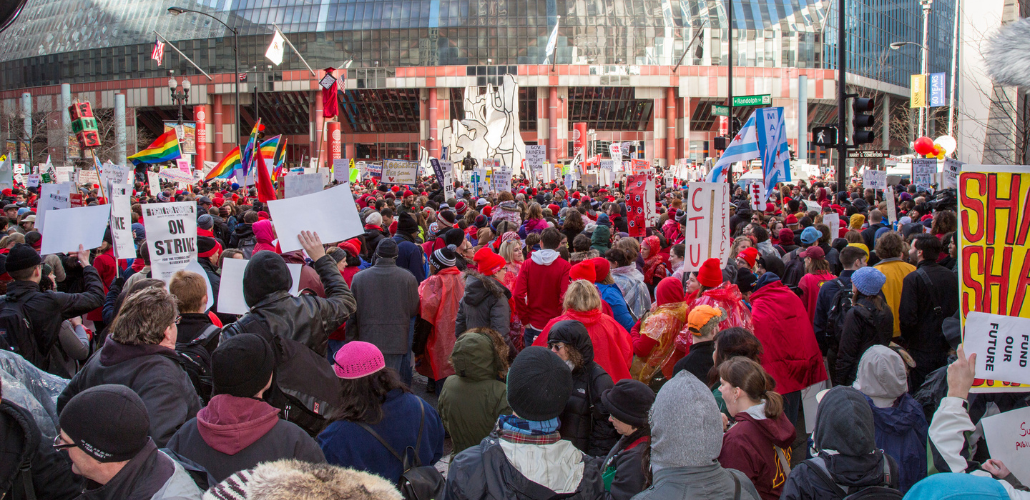
A dozen unions in Chicago struck for the day on April 1, 2016—one of several examples from recent history that hold lessons for how the labor movement could "speed-run" to larger, more disruptive actions. Photo: Jim West/jimwestphoto.com
[This article is part of a Labor Notes roundtable series: How Can Unions Defend Worker Power Against Trump 2.0? We will be publishing more contributions here and in our magazine in the months ahead. Click here to read the rest of the series.—Editors]
Trump’s attacks on working people—threats to send troops into major U.S. cities, ripping collective bargaining rights from a million federal workers, an immigration enforcement terror campaign that borders on unconstitutional—have been so extreme that many people are talking about a general strike. These calls are coming not just from the usual suspects, but even from my own mayor, former Chicago Teachers Union leader and organizer Brandon Johnson.
We’ve all heard calls for a general strike before—usually not as a serious proposal or strategy, but as a reaction to the attacks that working people face on a regular basis from existing political and economic power. Such calls are easy to dismiss, because they tend to come from well-meaning people without the knowledge of how difficult a strike is to launch and win in a single shop, let alone across a country of 330 million people that hasn’t seen anything approaching a national general strike in almost 150 years.
Those of us who have done the hard work of organizing our co-workers, winning union recognition, and negotiating with recalcitrant employers have frequently dismissed the idea out of hand. But two years ago, in the wake of the “Stand-Up Strike” at the Big 3 U.S. automakers, United Auto Workers President Shawn Fain put the idea on the table when he called on the labor movement to prepare to strike together on May 1, 2028.
At first glance it sounds impossible—but a strategic look back at the coordinated strikes and militancy of the past two decades shows we might be much closer than we think. We’ve laid the groundwork. Now we have to harness the lessons from those fights and “speed-run” to much larger, disruptive actions.
PROVOCATIVE CONDITIONS
The preconditions for large-scale coordinated actions are being laid out in plain view. Draconian, racist attacks on entire communities with the veneer of immigration enforcement. Gigantic tax cuts for the wealthy and corporations—which, along with economic contraction and federal budget cuts, will lead to huge budget challenges in statehouses and city halls across the country.
The attacks on democracy, immigrants, and the rule of law have already led to some of the largest mass mobilizations in U.S. history, including on October 18, when millions of people across the country joined thousands of “No Kings” protests. For the labor movement, the question is: when do we shift from mass mobilizations to mass economic action?
The first half of 2026 is the critical moment. State legislators across the country will begin their deliberations over budgets hobbled by the hollowing-out of the federal government, at the same time that the $170 billion increase to ICE’s budget begins moving in earnest. Public colleges and universities will begin feeling the even deeper impact of the Trump administration’s cuts and attacks, as tech oligarchs and finance capital continue to bleed workers and the public sector.
We need to plan now to connect and coordinate these fights in our cities and states. Not a top-down national plan or centralized day of action, but to make a plan in every state.
FOUR LESSONS
Here are four important lessons we can learn from the recent past:
Immigrant community defense must be understood as economic action, and lifted up. In 2006, the national movement for “A Day Without an Immigrant” began with a march of 100,000 on March 10, and peaked on May 1, when 500,000 immigrants and allies marched through downtown Chicago.
So many immigrant workers and their allies participated in that day’s action, also known as the “Great American Boycott,” that large parts of the Chicago area were effectively shut down for economic activity. Stores and restaurants closed either in solidarity with their workers or of necessity, with not enough staff to function.

Bring labor and community together to coordinate campaigns. Ten years after the reemergence of May Day, in the midst of what would become a two-year-long Illinois state budget stalemate under a billionaire Republican governor, the Chicago Teachers Union went on a one-day strike to protest the budget impasse and call for full funding of schools.
For most of 2015, CTU and SEIU Healthcare Illinois had jointly convened a coalition of local unions, united in a commitment to progressive working-class politics and militant action, to coordinate campaigns and share strategies.
Because of that coalition’s work, a dozen unions participated in the 2016 one-day strike, including fast food workers with the Fight for 15, higher education unions from Chicago State and Northeastern Illinois universities, and childcare and homecare workers from SEIU HCII, along with a large community coalition led by both longtime neighborhood groups and key organizers of the Black Lives Matter movement.
Push our unions to take bigger risks, especially in key sectors. In February 2018, incensed by insulting wage proposals from another billionaire Republican governor, West Virginia teachers set off what would become a nationwide wave of city and statewide teacher strikes, the Red for Ed movement. Some were one-day strikes billed as “days of action”; some were sustained for weeks. Importantly, almost all of the multi-district and statewide walkouts happened in states where teachers were prohibited by law from going on strike—but they went on strike anyway.
Public school teachers, by their nature, are embedded in communities. To varying degrees, so are many other groups of workers: in state and county governments, nursing homes and health clinics, community colleges, grocery stores, and restaurants. These are all potentially key sectors that have public reach and visibility across diverse communities.
Line up contract expiration dates and demands across industries, and work with community allies to publicize demands for the common good. In March 2024, unions representing more than 15,000 workers in the Twin Cities coordinated strike authorization votes across several industries.
This effort, launched publicly in October 2023, included teachers, transit workers, janitors, nursing home workers, and retail workers from six different unions. It was the product of intense joint campaigning and leadership development.
The simple threat of coordinated strike action led to big contract wins for transit workers, Minneapolis city workers, and security officers, while an even broader coalition of labor and community allies supported janitors, nursing home workers, and retail workers through their strikes.
PROGRESS IN UPHEAVAL
One thing we know about the coming months is that the attacks from Trump and his corporate allies will only sharpen. And the structures that exist now—our unions and other organized groups that are fighting for immigrant justice, tenant rights, and a fair economy, as scattered and weak as they may be—are the vehicles we have to organize a fightback.
In the history of this country, worker movements have been the critical central driver toward justice and equality. But workers have always faced daunting odds against powerful opponents with the ability to disorganize and disorient us.
The progress we make is not linear, but happens in moments of upheaval and upsurge. Our task isn’t to create the perfect strategy for the masses to follow. It is to use the lessons of the past to set the table for the fights of the future.
Alex Han is executive director of In These Times magazine, and a former union organizer and elected officer.


You must log in or register to post a comment.