
To Get on Offense, Offer Workers Many Ways In
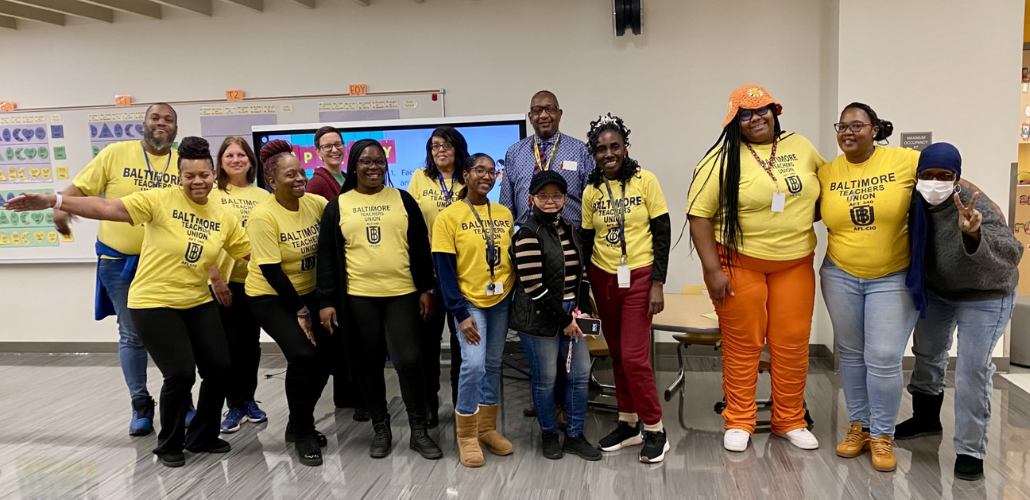
Baltimore teachers hold weekly "Wear It Wednesdays" with union shirts: "We have to show people, not just tell them, that they are not alone." Photo: Baltimore Teachers Union
[This article is part of a Labor Notes roundtable series: How Can Unions Defend Worker Power Against Trump 2.0? We will be publishing more contributions here and in our magazine in the months ahead. Click here to read the rest of the series.—Editors]
To fight back against authoritarianism and the billionaire takeover, the labor movement must get on offense. We must have our own agenda, set by rank-and-file members, rooted in the issues that members care most about—issues that unite us and build power.
Maybe our agenda includes a starting wage of no less than $30 an hour, expanding workers’ rights, and building union membership to a supermajority in our bargaining units. We can be fighting for a lot of things.
But to fight for any of them, we need enough involved union members, armed with political education and trained on organizing skills, to increase our fighting capacity. Getting this critical mass of people to do the work—and money to do it—means we need to increase the number of dues-paying members in our locals.
Therefore, we have to offer as many ways as possible for workers to get engaged in the union: meaningful roles to play and ownership over the work, but also practical help on the job, frequent opportunities to feel solidarity, and fun stuff, too.

BUILD COMMUNITY THROUGH POLITICAL EDUCATION
During this chaotic time, people are looking for community, knowledge about the current political climate, and ways to get more civically engaged. This presents an opportunity to educate people on politics, labor, and organizing.
Some people may already be thinking in terms of ideas like authoritarianism and democracy. But many people will find it more relatable when we can connect the dots on how the political landscape explicitly impacts their lives, like how it impacts the neighborhood they live in, the grocery store they shop at, and the public transportation they patronize.
We have to teach content and strategy. We need more people to know how to have one-on-one organizing conversations, how to compile communication lists, and how to build campaigns. We have to capitalize on such a chaotic time instead of surrendering to fear and uncertainty. Our members are wondering what happens now, so although things are chaotic, this is a perfect opportunity to increase union members’ engagement!
MEMBERS MUST OWN THE STRATEGY
Members want to be together, so give them something to do together. Working together with shared responsibility and specific tasks makes people more invested in the work.
For example, there is a group of union members working to repeal Maryland’s no-strike laws for public employees. One member is making a one-pager of talking points, another member is making a PowerPoint presentation, a couple of members are working on a digital media plan, another is looking for someone to build our website, and others are researching legislators’ direct numbers, so we can more easily access them.
We didn’t brainstorm together and then expect union staff to produce a product and report back. Rank-and-file members are doing the work.
SHOW, DON’T TELL: GENERATE JOY
Also, everything is not about work. It’s also about creating solidarity, because people want to be together and feel a sense of belonging. You can be in a room of 50 people and still feel alone. Solidarity actions and events show people they are not alone.

Make your union shirt a thing; only members get shirts. Pick a day every week to wear them. In the Baltimore Teachers Union, we do “Wear It Wednesday.” This increases our visibility and shows that we are united—join us!
We have to show people, not just tell them, that they are not alone. Wearing union shirts once a week helps members identify other union members. And supporting the actions of other locals or our state affiliate often helps workers to realize that others are facing similar challenges.
The same energy we put into the work is the same amount of energy we need to put into joy. Joy must be a part of organizing, because people will disengage if they don’t feel replenished. Create opportunities where people can be together without working. Host a gala, happy hours, and fun activities.
Make some of your membership meetings social gatherings where no business gets done on purpose. Instead of meeting, have a cookout, make bracelets together, throw pies at pictures of management. It’s important to have gatherings and convenings that don’t just focus on planning, plotting, and strategizing, because there are union members who are just not with all that…yet.
I’ve noticed that far less members come to meetings than come to fun events. The holiday party, the general membership cookout, the new staff happy hour, and conferences get attended at maximum capacity. People like being happy, and want to have fun with each other.
We do need to have all the meetings to plan, plot, and strategize… and we need to have opportunities for fun and joy, so we have the opportunity to touch as many members as possible. You can’t engage people who you don’t even have access to.
LEADERFUL UNIONS
Once we have access to union members, we can start to build the necessary structures in our locals to take on any fight. Have a building steward/representative at every worksite. Build union chapter committees at each worksite, so that stewards don’t have to fight alone. Increase and improve the democratic processes and shared decision-making in our locals.
Rank-and-file members shouldn’t just be giving feedback on a meeting agenda; they should be the ones to build the agenda. Make sure people know when a union election is coming up; encourage them to run, even if it’s against you. Encourage them to vote, and make voting as accessible as possible. Use meetings as spaces where members can vote on priorities.
You should have several access points for members to join your union. Have a plan to capture all the new hires. Host your own new staff gatherings, union orientations, events, and new staff committee. New hires need help; give them opportunities to come to the local headquarters for help and community, and sign them up when they get there!
In the Baltimore Teachers Union we offer help with licensure, for union members only. We don’t just give the information; we go into the licensure portal with you and support you as you push all the buttons. Non-members sign up just because they want this support.
Definitely make a plan to build a supermajority in your union. You want to have one leader for every 10 members. This creates a structure for rapid responses, effective mass communications, relationship-building, solidarity, and universal messaging—all the things we will need to fight authoritarianism, fight for democracy, increase wages for workers, improve our working conditions, and get on offense.
Diamonté Brown is president of the Baltimore Teachers Union.





You must log in or register to post a comment.