2025 in Review: Stark Battle Lines, Big Potential
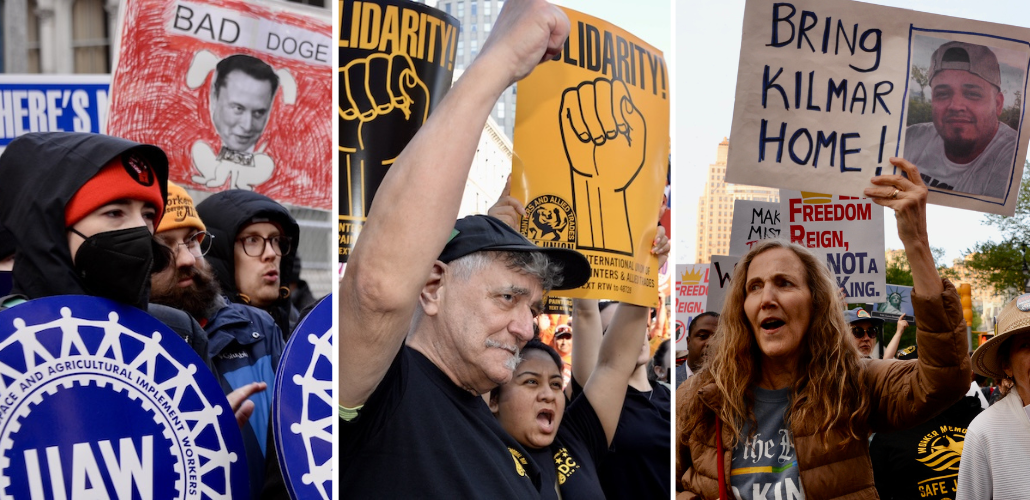
The Trump administration gave workers many reasons to protest this year, including the "DOGE" onslaught against federal workers and services, and the ICE detention of immigrants like union sheet metal worker Kilmar Abrego Garcia. Photos: Jenny Brown
Already before Donald Trump was inaugurated in January, there were dire omens. Poultry workers reported that their supervisors were using Trump’s anti-immigrant rhetoric to divide workers up—allowing white workers bathroom breaks but denying them to Hispanic workers. “The more people are afraid to organize, the more the bosses will take advantage to create worse working conditions,” wrote Magaly Licolli of the worker center Venceremos in January.
Racist divide-and-conquer contributed to an organizing loss when bosses at a North Carolina Amazon warehouse tried to divide Black workers from Hispanic workers for their union vote in February.
In March, farmworker leader Lelo Juarez of the independent union Familias Unidas por la Justicia was one of the first notable worker activists grabbed. Unions started to mobilize a response.
ICE arrests accelerated. With a quota of 3,000 a day, the administration’s claim to target the “worst of the worst” became an obvious lie as anyone who looked or sounded like an immigrant was targeted. ICE snatched Sheet Metal Workers (SMART) Local 100 apprentice Kilmar Abrego Garcia and sent him to a torture prison in El Salvador—only strenuous objections from his union forced the U.S. to bring him back.
Service Employees (SEIU) protested across the country when SEIU California leader David Huerta was arrested in June. He had shown up to defend union members during a raid in Los Angeles when ICE tackled him to the ground. He was pepper-sprayed, hospitalized, and then hit with conspiracy charges. Machinists (IAM) worked to defend detained member Maximo Londonio, a member of Local Lodge 695, and eventually got him freed.
Starbucks Workers United cranked up “know your rights” trainings and protested at detention centers; Painters (IUPAT) educated members on unity in the face of racial divide-and-conquer; teachers in Chicago (CTU) and Los Angeles (UTLA) developed rapid response to ICE in schools; UTLA canvassed neighborhoods with rights info; electrical workers in North Carolina learned practical steps to limit ICE access to a workplace, like posting “restricted area/employees only” signs; federal workers picketed in New York, Chicago and Seattle against workplace raids and courthouse arrests.
Under threat, immigrant workers stood up anyway. In June, 160 Teamsters struck at Chicago’s Mauser Packaging Solutions, where they recondition steel drums used in the transport of materials like acetone, ammonia, and paint. They were demanding safety equipment and also that Mauser not let ICE onto workplace property unless it has a signed judicial warrant. Many unions have been making similar demands.
CONTRACTS TORN UP
Federal workers held down the front lines against Trump’s assault on unions as the regime canceled union contracts for a million federal workers. No more dues deduction, no paid time for union representation work, no grievance procedure. It was the largest act of union-busting in generations.
Transportation Security Officers had waged a 10-year struggle to unionize with the Government Employees (AFGE) and won a contract in 2012. The 47,000 workers finally got on the federal pay scale in 2023, but the Department of Homeland Security unilaterally canceled their contract in March. Without a union, “the rot is coming back quickly,” said Lowell Denny, a TSO in Austin, Texas. Workers were immediately told not to take sick leave.
Federal unions AFGE and the Treasury Employees (NTEU) sued to stop the broad assault, but the courts have at best delayed Trump’s illegal actions. The Federal Unionists Network, a cross-union group, has taken an organizing approach, building connections between members in various agencies and teaching each other the best ways to fight. “Everybody can become an organizer, and in fact that’s the only way we’re going to be able to… raise the political cost high enough,” said FUN co-founder Chris Dols in April.
Federal unionists are the first line of defense against cuts to vital programs, and FUN has made connections with other unions, veterans, and environmental groups to protect the Department of Labor, Occupational Safety and Health Administration, Veterans Affairs, and Environmental Protection Agency, which have all faced devastating cuts. In some cases, promised cuts were reversed and workers rehired.
STRIKES ON PACE
Ten thousand grocery workers with UFCW in Colorado struck Kroger in January, setting the pace for strikes this year. By the time the federal shutdown paused the official counting of strikes in August, 183,000 workers had gone out on strike.
Despite the pause in reporting, it looks like more people will have walked out in 2025 than in 2024. This continues a post-pandemic strike wave that nearly tripled the number of workers on strike compared to the median of the past two decades.
Hilton housekeepers in Houston struck for 40 days—the first hotel strike in Texas history—and won a $20 minimum wage.
After three years on strike, Pittsburgh Post-Gazette strikers with the NewsGuild-CWA finally won in November.
Workers at the Horseshoe Casino in Indiana revived a classic tactic, the recognition strike, after the government shutdown delayed their vote to join the Teamsters. They walked the lines for 50 days and won their rescheduled election on December 5.
Teamsters at the University of Minnesota, many of them East African immigrants, won a five-day strike in five languages.

Starbucks workers began a spreading strike to stop the company’s union-busting and finally secure a first contract for 12,000 union baristas.
CAUCUSES GAIN MOMENTUM
Where union leaders aren’t bringing the fight to bosses, workers have been organizing to reform their unions from below. Caucuses in the Letter Carriers (NALC), Stage Employees (IATSE), and Electrical Workers (IBEW) gained momentum this year.
Workers are refusing sub-par contract offers. Kaiser mental health workers in Southern California struck for more than six months and won doubled prep time and a 20 percent raise in May. Indiana Kroger workers defied scare tactics and voted down proposed contracts twice. Midwest Boeing Machinists (IAM) voted down three offers and struck for three months. The 3,200 workers won a 24 percent wage hike. Teamsters working for the school district of Richmond, California, voted down an offer in spite of their union leaders’ recommendation and struck together with the teachers.
News from overseas gave U.S. workers something to aspire to. In the face of public service and school cuts, 100,000 New Zealanders went out on a one-day strike in October—the largest since 1979. In Italy, the main union federation called a one-day general strike October 3 to support a flotilla of aid for Gaza that was stopped by the Israeli military, and for “constitutional values, to stop the genocide, and in support of the people of Gaza.” Two million marched.
BIG RALLIES, BIGGER PLANS
Workers on 170 campuses rallied April 17 to stop attacks on immigrant students, to defend free speech on the genocide in Palestine, and against Trump’s retaliatory budget cuts. “ICE took our students, we want them back!” chanted college teachers in New York City, demanding rights to “teach, study, learn, speak, and dissent.”
May 1 is labor’s day around the world, but it started in Chicago in 1886 with a strike wave for the eight-hour day. This year the Chicago Teachers assembled a “May Day Strong” coalition and spurred 1,300 rallies around the country for “Workers over Billionaires,” in the largest May Day mobilization since the massive rallies and walkouts in the 2006 “Day Without Immigrants” that drew 1.5 million.
May Day 2025 also saw 60,000 University of California workers (AFSCME and UPTE) strike—a big issue was overwork and the resulting turnover. Auto Workers President Shawn Fain reiterated his call for unions to line up contracts for May 1, 2028. Many contracts are expiring around then, creating the possibility of a season of strikes, big contract gains, and political muscle.
June 14 drew even larger “No Kings” demonstrations—5 million marched in large cities and small towns, then October 18 saw the largest demonstrations yet under the banner “No Kings, No Billionaires,” with 2,700 protests and 7 million people participating, the largest single-day protest in U.S. history. Notable union sponsors included the Communications Workers, AFGE, and the Teachers (AFT).
But there is plenty more unions can do, and a vigorous debate about how to approach the situation. The leadership of some unions has caved to Trump regime demands, while others have played along. A series of articles on strategy can be found at labornotes.org/roundtable.
POWER SHIFT?
November elections showed changing political tides. In an astonishing political upset, New York City elected pro-union candidate Zohran Mamdani mayor, beating out former New York governor Andrew Cuomo. Mamdani received overwhelming union support—especially after winning the Democratic nomination—and assembled a 100,000-volunteer army on a platform of freezing rent, free buses and universal childcare.
Seattle also elected as mayor a socialist organizer who ran on an affordability platform: Transit Riders Union organizer Katie Wilson emphasized housing costs and ending the homelessness crisis.
Another ray of hope near the end of the year: in December, a judge freed sheet metal worker Kilmar Abrego Garcia from immigration detention. As he continues fighting his case to stay in the U.S., he is finally back home with his family.
The working class is in the fight of our lives, and the battle lines are stark. The unity between Trump and the billionaires exploiting us isn’t even hidden anymore. The collective net worth of the top 12 U.S. billionaires now exceeds $2 trillion, soaring by $1.3 trillion since March 2020.
It will take a lot of organizing and ironclad working-class unity to match these forces, but the fight is definitely on, with the conditions ripe for brilliant, courageous leaders to emerge in every workplace and every town. Talk to your co-workers, and let’s go!
Labor Notes staff contributed reporting throughout the year.