
New Voices Gain Ground at Letter Carriers Convention
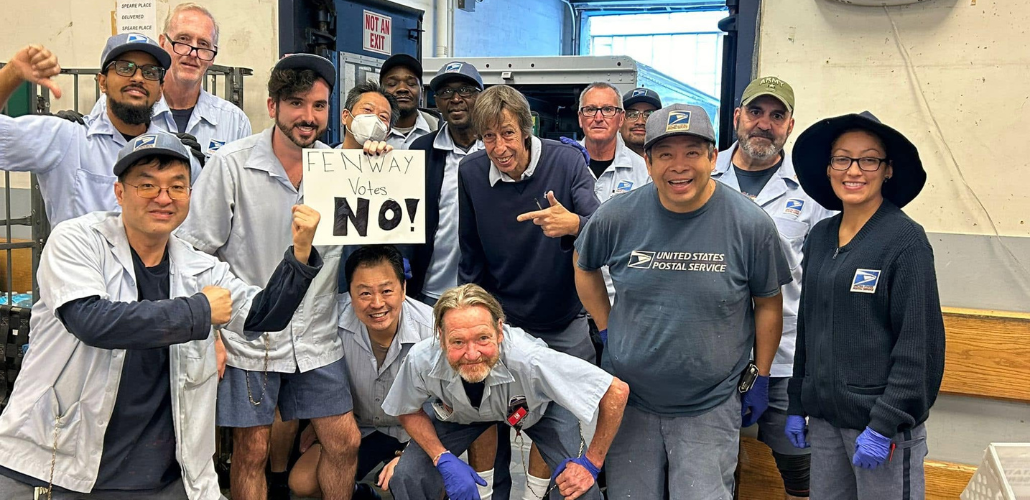
Letter carriers in Fenway, Boston, were among many around the country who posted "vote no" photos online in 2024. Discontent over an unpopular contract that was imposed anyway is fueling reform momentum in the union. Photo courtesy of Build a Fighting NALC.
Update, September 23: Letter carriers are now receiving (and delivering) ballots in the highly anticipated national officers election. Two members have compiled an even-handed voter's guide.
“The number one takeaway is that the times in the NALC, they are a-changing,” said Margo O’Neill of Branch 352 in Des Moines, Iowa, who attended her first Letter Carriers convention August 3-7 in Los Angeles.
“It was quite different than any convention that I’ve been to,” said retiree activist Jamie Partridge of Branch 82 in Portland, Oregon, who has been attending since 1988. “There were many competing factions and five times as many constitutional amendments as have been offered in the past, and many more resolutions, which I attribute to the uprising against the current leadership.”
President Brian Renfroe was already in hot water at the last convention. He had been negotiating in such secrecy that even the rest of the executive council was kept in the dark; when he took a months-long leave for alcoholism treatment, he left no bargaining notes.
But discontent really boiled over afterwards, when Renfroe came out with a tentative deal. Members were furious at the low raises and continued two-tier, and voted it down; Renfroe agreed to most of it anyway and rushed the economic parts into arbitration, citing Trump’s attacks. A near-identical contract was imposed.
The union will elect a new president this fall, from a field of four candidates. After months of speculation, Renfroe announced at the convention that he isn’t running again. Delegates cheered.
“I think that eased a lot of people’s minds, and also helped sharpen the dialogue about how this isn’t just about Renfroe,” said John Murphy of Branch 4716 in Naples, Florida. “We’ve gotta move forward, get some checks and balances. The younger members want their voices to be heard. They want more transparency, they want more democracy, they want more say.”
“We’re clearly rapidly expanding what democracy looks like in our union,” said Derek Liemohn of Branch 34 in Boston. “It would be a stretch to call this a winning convention for the reformers. But this was, I think, the strongest that independent reform politics has ever looked” in the NALC.
HOMELESS IN SEATTLE
The latest contract expired in May, and the union and management went through a required mediation period this summer. Interest arbitration is expected next, but delegates didn’t get any update on the proposals or timeline.
In the week’s biggest surprise, convention delegates bucked the executive council’s recommendation and approved (1,909 to 1,781) a resolution committing the union to lobbying for a wage boost in areas with a higher cost of living, like federal workers get.
“We had old guys coming up to us and saying they had been trying to get this passed since the 1980s,” said C Moline of Branch 79 in Seattle. “This was a huge win that none of us expected this go-round.”
Letter carrier pay is tiered by hire date and job type, but not by location. The union’s longstanding position is that bargaining a local differential would pit the interests of some carriers against others.
However, carriers in Alaska, Hawaii, and Puerto Rico already get a “Territorial COLA” allocated by Congress. The resolution calls for locality pay within the continental U.S. to be accomplished the same way.
“Some of our carriers have ended up homeless because they can’t afford rent in Seattle,” Moline said in an impassioned speech on the convention floor, drawing applause. “This is the way we can do it and not use any of our bargaining power. This is legislative.”
PARTICIPATION OVERLOAD
Some proposed constitutional amendments were clearly inspired by the recent contract debacle, such as requiring the president to keep the executive council briefed on bargaining progress, and preventing the union from making a deal without a member vote.
Resolutions ran the gamut from contract demands, like $30-an-hour starting pay and an end to two-tier, to political positions, like opposing the war with Iran.
Most of these efforts failed, but some modest reforms did pass. Future union conventions will be livestreamed, as this one was. The president will be required to keep written records of bargaining proposals.
Under NALC rules, any resolution or constitutional amendment submitted in time by a branch (the union’s equivalent of a local) or state association was heard by the 5,000 delegates.
Proposals where the executive council recommended a “yes” were batched together. Those the council opposed were taken one by one, in a confusing process where delegates would have to vote “no” on the council recommendation before voting “yes” on the resolution itself.
Many got significant discussion and a “teller vote,” where tellers with clickers went around tallying up yeas and nays. It all took so long that workshop sessions on Wednesday and Thursday were canceled. Delegates had some ideas for process improvements, like perhaps modernizing the time-consuming voting mechanism to something electronic.

On the reformers’ side, “the best piece of constructive criticism that I could give us is better communication between individual branches” ahead of time, said Wyatt Gilderson of Branch 82 in Portland, to avoid dragging things out with votes on many similar proposals.
FOUR-WAY RACE
Four presidential candidates were nominated—two as part of slates, and two on their own. The likely front-runner is Nicole Rhine, current secretary-treasurer, who is running with a slate of mostly incumbents that came together in the final days before the convention. Ballots will be mailed out September 28 and due back October 19.
Rhine is seen as the establishment pick and is “pretty widely respected as being basically a competent administrator and well-connected for our legislative program,” Liemohn said. She would also be the union’s first woman president.
Two reform tickets have been campaigning for two years, and were part of a loose vote-no coalition on the last contract. Mike Caref, business agent for Illinois, is running solo for president. The Concerned Letter Carriers slate, led by current Vice President James Henry, includes a number of branch presidents and popular podcaster Corey Walton. The Caref and CLC platforms emphasize similar themes, including raising pay, ending two-tier, and confronting the grievance backlog.
A fourth candidate, Lew Drass, seems unlikely to get much traction. Still, it’s likely that someone will win with substantially less than a majority of the votes. That’s one reason why convention delegates heard 11 versions of a proposed constitutional amendment for ranked-choice voting (where voters can indicate their second- and third-choice candidates and the resulting votes are tabulated in “instant runoffs”), though none passed.
Three of the four presidential candidates have agreed to a debate on a live August 23 episode of the Next Generation Carriers podcast.
1,000 PODCASTS BLOOMED
Many carriers will likely split their votes across tickets. Virgilio Goze of Branch 79 in Seattle has been a supporter of Caref, whom he called “the people’s candidate,” since he first heard him on Walton’s podcast.
He says Caref was one of the first to raise the alarm about management’s systematic obstruction of contract enforcement, which has created a backlog of 50,000 stalled grievances, and Caref has won escalated remedies in Illinois that should become the national standard.
For the number two spot Goze is leaning towards Walton, whom he credits with opening up communication. “The NALC of 2026 is very different from the NALC of 2022,” Goze said. “Without his podcast there wouldn’t have been people realizing that we can talk to each other beyond our regions. And it’s like, a thousand podcasts bloomed after that.”
Convention delegates stood in two-hour lines to elect the union’s seven delegates to the AFL-CIO. Young candidates associated with podcasts and reform caucuses who ran on a progressive political vision (including Moline, Murphy, and O’Neill) were proud to have turned a ceremonial position into a competitive race, though they finished well behind the candidates associated with the Rhine-Peralta slate (who won all seven seats) and the CLC.
‘WORK CUT OUT FOR US’
Not much discussed were strategies for confronting the existential threats facing the postal service—Trump’s attacks on vote-by-mail and his appetite for privatization—nor the day-to-day hazards of heat, smoke, workload, harassment, and robberies.
The union’s next convention, in 2028, will be in Minneapolis, where the Build a Fighting NALC reform caucus has perhaps its strongest chapter.
“Every organizer I know has been hitting the ground running,” O’Neill said a few days after the convention. They’re spreading the word about the election, inviting candidates onto podcasts, and getting a two-year lead on strategy for the 2028 convention.
“I think our work is pretty cut out for us,” she said. “For example, with ranked-choice voting, the number one argument they [opponents] kept falling back on was, ‘None of the branches do it, it’s too confusing.’ Which frankly is insulting, especially when we already use it to bid on routes. But the very clear next steps for that are to start passing it at your branch.”
Rank and Filers Create Voter Guide
September 23: Letter carriers are now receiving (and delivering) ballots for the union's highly anticipated election. Though the four-way race for president has gotten the most attention, there are also contests for nine other national officers, three trustees, and 15 regional business agents.
Virginia Beach union steward Jamie Gregory decided to compile a voter's guide for his co-workers, and soon found that carriers beyond his branch were interested too. It covers each candidate's record, experience, and positions, plus the history and duties of each role. Portland letter carrier Charmaine Taylor worked on editing and fact-checking.
It turned out to be a huge task. Gregory has pored through the online archive of the union's national newsletter and listened to hour upon hour of podcast interviews at double speed. "This has been my obsession for the last month now," Gregory said. "When I’m not working or doing steward stuff, basically I come home and do this, till midnight or 1 o’clock, and then wake up and repeat."
The resulting file was so big that Gregory and Taylor learned there's a maximum size for Google documents. They had to split it into three.





You must log in or register to post a comment.