Book Review: A Model for U.S.-Mexico Cross-Border Solidarity
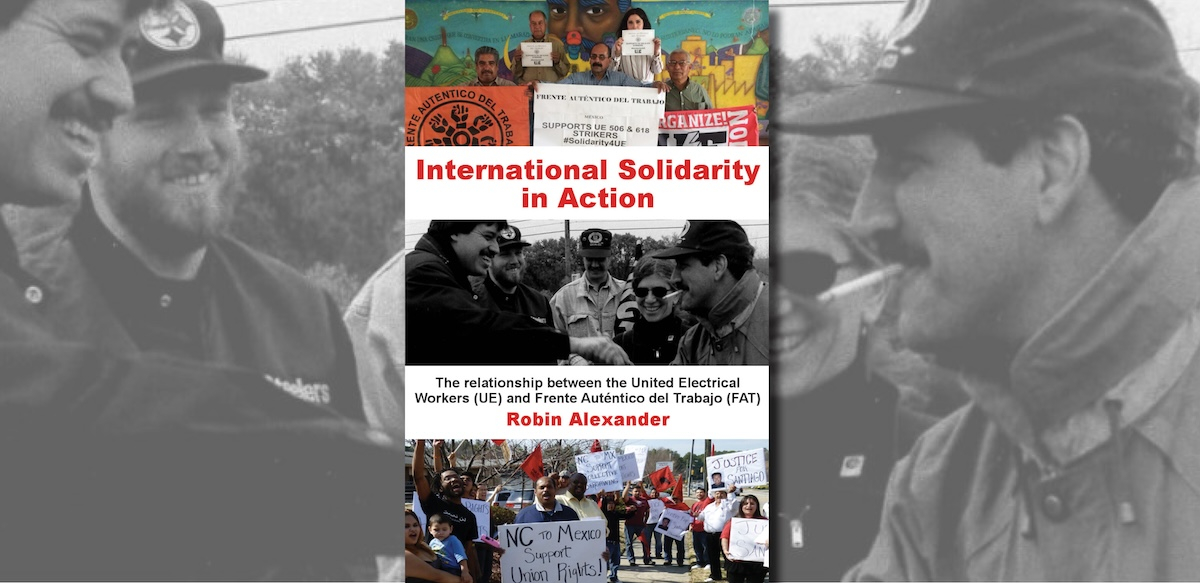
International Solidarity in Action by Robin Alexander is available free at internationalsolidarityinaction.org
Labor law reform in Mexico has opened up a major opportunity for workers fighting for genuine, independent unions. What can U.S. unions do to support our brothers and sisters there? And how can we build cross-border campaigns to confront our common employers?
Unions asking these questions will find valuable ideas in the e-book International Solidarity in Action: The Relationship Between the United Electrical Workers (UE) and Frente Auténtico del Trabajo (FAT), available for free download here.
Author Robin Alexander, retired director of international affairs for UE, led her union’s partnership with the FAT, which began in 1992, during the campaign to oppose the North American Free Trade Agreement (NAFTA).
UE members were seeing their employers cut manufacturing jobs in the U.S. and shift production to Mexico. “The UE leadership became convinced that the union needed to find a labor organization it could work with in Mexico,” Alexander writes, “and also that it was essential to connect international work more directly with UE members and with organizing.”
In a meeting in Mexico to discuss the campaign against NAFTA, the UE found the FAT—the only Mexican labor organization to oppose NAFTA.
Here was a union that had a lot in common with the left-led UE: fiercely independent, with radical roots and leadership. The FAT had long stood out against Mexico's state-dominated unions and fought for workers’ right to form genuine, independent unions.
Both unions were concerned about the growing number of jobs that corporations had moved to assembly plants near Mexico’s northern border with the United States, where unions were either nonexistent or a tool of the government’s development strategy of low wages and long hours.
“The UE,” Alexander writes, “was interested in seeing the plants organized by a union that would serve as a partner and ally in Mexico and believed that it could provide solidarity, including some leverage, where it continued to represent workers employed by those companies in the U.S… The FAT was eager to organize the plants that were moving across the border, but lacked the resources to do so.”
LIKE-MINDED UNIONS
Thus kicked off a partnership that has now lasted 30 years. The book contains several case studies of how the UE and the FAT worked together to back each other’s campaigns against employers such as General Electric and Echlin (a transnational auto parts maker later bought by Dana).
For U.S. unionists unfamiliar with the obstacles that Mexican workers are facing as they struggle to oust protection unions and replace them with genuine unions, these sections will be particularly valuable.
At Echlin, for example, workers attempting to confront dangerous exposure to asbestos and solvents and form a democratic union were met with a barrage of tactics often deployed by employers, official unions, and Mexican labor boards.
For instance, workers were refused a copy of their own collective bargaining agreement. The company fired dozens of independent union supporters, and stalled the union election by claiming the independent metal workers union did not have the proper paperwork to represent auto parts workers.
Worse, it allowed the official union to deploy 170 thugs, “some wielding metal rods, clubs, and guns,” into the plant on the eve of the election. And workers were forced to vote out loud in front of the company, official union, and labor board officials.
TWO-WAY SOLIDARITY
The UE supported the FAT’s organizing by filing complaints under NAFTA’s labor side agreement (NAALC), as well as by providing funds, pressuring shareholders, and organizing speaking tours to draw attention to workers’ rights in Mexico.
The relationship went both ways, with the FAT providing important material support to UE’s organizing efforts and fight for labor law reforms in the United States. During a UE organizing drive at a Milwaukee foundry, the FAT provided a Mexican organizer—an activist who had been fired from a GE plant in Ciudad Juarez—to help campaign among a predominantly Mexican immigrant workforce. The organizer spread the word that the UE was not like the official unions in Mexico which so many had had bad experiences with.

The FAT has also helped draw attention to the severe limitations on labor rights in states like North Carolina—home of UE Local 150, the North Carolina Public Service Workers Union—where many public sector workers are banned from collective bargaining. Mexican unions filed complaints at the International Labor Organization challenging the ban, and the ILO issued a decision that called on North Carolina to repeal it. The FAT also filed a charge under NAALC, and the Mexican government issued a favorable report in response.
While North Carolina’s ban still persists, this work has helped legitimize the union and chip away at the law’s aura of invincibility. Alexander writes, “This was tremendously energizing for the low-wage, primarily African-American workers in North Carolina’s public sector because it turned the long-held belief that public sector workers ‘just don’t have that right’ on its head: from the perspective of international human rights law, it is the state’s ban on collective bargaining that is ‘illegal,’ not workers’ attempts to assert their rights.”
WORKER TO WORKER
Part 3 of the book details worker-to-worker exchanges, which the UE and the FAT used to deepen the solidarity and “undercut the stereotypes that existed” among members on both sides of the border.
The UE-FAT exchanges happened in both the U.S. and Mexico, with an emphasis on rank-and-file participation. Members of both unions “toured plants, exchanged experiences, walked picket lines, attended meetings, assisted with organizing drives, taught high school and university classes, and participated in radio and television programs in an effort to share information, learn about each other, and take the information back to their locals and communities.”
UE Local 150 members were part of one set of exchanges where they met public sector unionists from Mexico and Quebec (the exchanges were not always just binational). The experience raised their confidence and expectations, and led to the campaign on international law.
There have also been exchanges between co-op members of both unions, organizing institutes, and cultural exchanges, including a cross-border mural project.
It showed that “the most effective way to educate workers in the United States and in Mexico—and to motivate them to educate others—was through direct contact with each other,” writes Alexander. “I still have a vivid recollection of workers bonding over their mutual outrage that instead of bonuses the company rewarded both groups by buying them pizza.”
Although social media and Zoom have made it easier to meet with people around the world, they’re no substitute for the extended, face-to-face interactions that such exchanges allow. Yet there are remarkably few such programs in place—and our labor movements are worse off because of it. Setting up more such programs should be an urgent task—and Alexander’s book provides practical advice to help.
EXPANDING OUR VISION
There’s also a glaring need for more education for U.S. unionists about what is happening in the labor movement south of the border (not to mention all over the world)—now more important than ever, as our billionaire-backed president whips up hostility against immigrants and workers abroad.
One part of UE’s solidarity work was “Mexican Labor News and Analysis,” a monthly summary that lasted from 1996 to 2016. Reviving such a project would be a real contribution to promoting an international perspective among U.S. union members. Although the UE and the FAT are both small, they have played significant roles in expanding the vision of their countries’ labor movements.
In Mexico, where, as Alexander writes, “the FAT and their lawyers... were dismissed as dreamers who were a little crazy when they spoke of the need for secret-ballot elections, the elimination of protection contracts, independent labor judges, or registries of unions and contracts,” the 2019 labor law reform included all of those elements.
In the U.S., the UE played a significant role in helping a then-obscure socialist candidate named Bernie Sanders win his first election to Congress in 1990, which decades later helped pave the way for Sanders to popularize an unapologetically pro-worker politics in his two presidential campaigns.
Similarly, these two unions have set out a path for international solidarity. Could more unions follow their example, and lay the foundation for a growing sense of shared struggle by U.S. and Mexican workers as a counter to the rising forces of right-wing nationalism? Alexander’s book is a great guide for anyone looking to push their unions along that path.
A longer version of this article first appeared in New Labor Forum.