‘Treated Worse than Cattle’: 2,500 Tyson Workers Laid Off, Plant Shutters Overnight
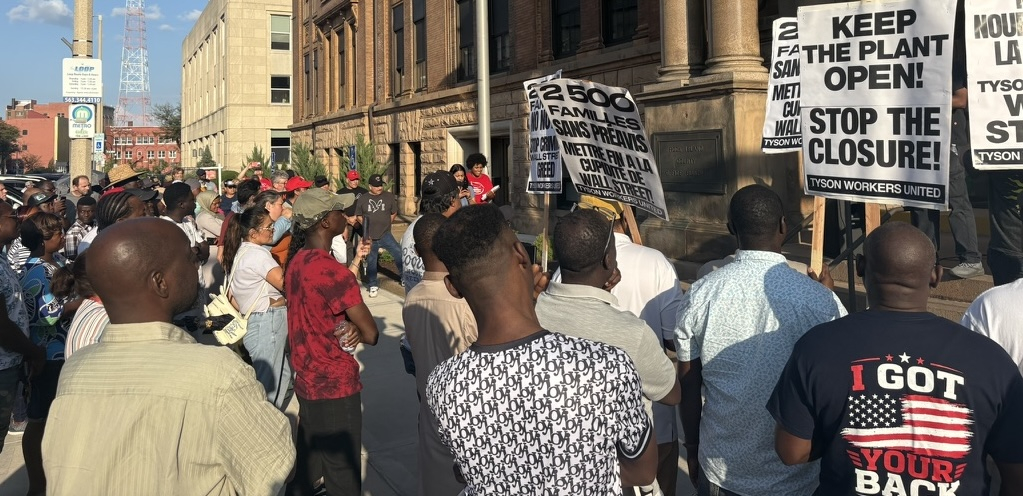
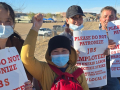
Tyson workers were blindsided by the closure of their plant August 14. Photo: Caitlyn Clark
Ouano Tante worked the afternoon shift at the Tyson beef plant in Joslin, Illinois, for five years. But when she and hundreds of her co-workers arrived at work on August 13, they found the plant closed.
They speculated that someone on the morning shift might have gotten injured. Then two mid-level supervisors came outside in tears. Plant supervisors told workers the plant was closing permanently, effective immediately.
Inside, the early-morning shift had just ended when the workers were informed it would be their last. The cafeteria erupted into chaos. Plant supervisors stood guard by the doors, workers said, while everyone received their closure paperwork.
“People were crying, shaking,” Tante said. “When we were leaving the parking lot, there were so many car accidents. People were so upset.”
“They gave no reason, nothing,” said Ahoro Asselissime. “People have no job. No money to pay our bills. For 11 years, I made money for them. And now they’re not doing anything for me.”
DISASTER FOR COMMUNITY
Joslin is home to just 56 residents. But 2,500 workers from Africa, Latin America, and Burma toiled at the meatpacking plant there, butchering cattle for Tyson, one of the world’s largest meatpacking companies. The workers were represented by Food and Commercial Workers (UFCW) Local 1546.
Most of the workers live in the Quad Cities, clustered around the Illinois-Iowa border 160 miles west of Chicago. Everyone there knows someone who works at Tyson, the area’s ninth-largest employer. The closure announcement sent the community into a tailspin.
Tante, originally from Togo, had the job of determining the age of cattle by checking the size of their teeth. An overhead conveyor would move carcasses, suspended by their ankles, along the chain. Tante checked the teeth, sprinted up a set of stairs to mark the cattle’s ankles with ink, then sprinted back down to catch the next carcass.
Simultaneously, other workers drained blood from the animal by slicing the neck with knives. If Tante didn’t work fast enough or was off-pace with the other workers, she said, she could get cut by their knives.
PALTRY SEVERANCE
The laid-off workers will be paid for 36 hours a week until October, but that’s far less than they had been making with overtime.
“I got $500 this week,” said Asselissime. “My rent is $925. I have to put gas in my car, buy food for my kids. Everything is so expensive now.” Prior to the closure, Asselissime could expect around $900 a week.
“I’ve been sounding the alarm about how Tyson treats their workers for years,” said Nana Ouro-Agoro, founder of Akwaaba, a nonprofit organization that provides support to the Quad Cities’ immigrant population.
Originally from Togo, Ouro-Agoro came to the Quad Cities after winning the immigration lottery in 2008. She learned that many of her neighbors worked at Tyson, where they were frequently injured on the job and afraid to speak out. Workers told her they were being treated “worse than the cattle.”
“It was hard for me to sleep at night, hearing my fellow immigrants were working hard, getting injured, and nothing was being done,” she said.
Akwaaba helped Tyson workers with translation services and resources to help them assert their rights, including when Tyson abruptly fired dozens of Togolese workers as alleged retaliation for reporting injuries and sexual harassment. Now, about 500 of their clients—roughly 1 in 4—are out of work.
And because so much of the local economy depends on income from Tyson workers, “we’re going to see a crisis in every sector,” Ouro-Agoro said.
ONE MONOPOLY AFTER ANOTHER
It’s been a profitable few years for Tyson. So why shutter the plant? Tyson cites the nationwide cattle shortage.
Cattle stock in the United States is at a 75-year low. The costs of raising cattle have gone up significantly for ranchers, in part due to drought and higher prices for fertilizer and diesel, exacerbated by the war on Iran.
But the crisis facing Tyson workers and cattle ranchers alike is driven by one major factor: corporate consolidation. The “Big Four”—Tyson, Cargill, JBS, and National Beef—own over 80 percent of the U.S. beef industry.
The Big Four have, according to multiple court decisions, colluded to fix prices for just about everything, from the price customers pay at the grocery store to the price cattle ranchers receive for their livestock.
Yet despite the strain placed on cattle herds, U.S. beef production in real terms has remained relatively steady, due to the heavier weight of today’s cattle compared to decades ago.
Tyson isn’t the only one closing plants. JBS, the world’s largest meatpacker, closed a facility in Memphis in June, laying off 200. JBS also announced plans to close a 1,500-worker processing plant in Souderton, Pennsylvania, but efforts from union and political leaders pushed JBS to convert the plant to a smaller facility, saving 400 jobs.

With nearly 4,000 meatpacking jobs cut just this summer, is the cattle shortage really to blame?
As of the most recent fiscal quarter, Tyson’s operating income is up 8 percent, or $547 million, over last year. Tyson attributes the increase to growth in its chicken and prepared foods segments.
Tyson CEO Donnie King took home nearly $35 million in total compensation last year, 781 times more than the median Tyson worker and double the average CEO-to-worker pay ratio among S&P 500 companies.
While cattle shortages could be cutting into beef profits (Tyson reported a third-quarter beef operating loss of $138 million), overall the company is making money hand over fist. And as the meatpackers squeeze cattle producers, the shortage itself is a problem of the Big Four’s own making.
But meatpacker consolidation is only one piece of the puzzle. The meatpackers may claim that they are also the victims of collusion—by the grocery giants.
Walmart, Amazon, Kroger, and Albertsons can collude to lower prices paid to meatpackers too. Estimates place Walmart at between 20 and 25 percent ownership of the grocery industry, while Amazon (thanks to its acquisition of Whole Foods) is now the second-largest grocery retailer in the U.S.
Grocers are pushing down prices paid to packers, while packers are slashing prices paid to ranchers. In 1980, cattle producers took home $0.63 of every consumer beef dollar and the packers and retailers took home a combined $0.37. As of 2021, that number is exactly flipped, according to More Perfect Union. All the while, workers and consumers get the shortest end of the stick; price collusion lines the pockets of meatpacking and grocery store executives, while depressing worker wages and inflating consumer prices.
UNION PENS AGREEMENT
After the Joslin plant closure, the union released the following statement: “UFCW Local 1546 has a long-standing and proud union partnership with Tyson Foods, and we were extremely disappointed in not receiving advance notice of this news. If given the opportunity, we could have sat down and found an economic solution to keep this plant operating, but sadly our voice was silenced.”
Four days after the company’s closure announcement, Local 1546 President Robert O’Toole signed an agreement with Tyson, which includes severance pay of one to four weeks, depending on years of service, on top of the two months of payments.
The UFCW agrees to “not to take any steps or action to… interfere in any way with the orderly closing of the Plant, and the Union agrees not to support any such steps or action by others.”
Many workers feel their union leadership has left them hung out to dry. “The union doesn’t care about us, Tyson doesn’t care about us,” said Asselissime. “A lot of immigrants work for this company, from Mexico, from Africa. That’s why they don’t care.”
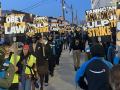
Some workers were already mobilizing independently. The day after Tyson announced the closure, laid-off workers rallied outside the plant gates with community supporters and political groups. The workers demanded Tyson make a plan to keep the plant open; if that wasn’t possible, they wanted six months of severance pay, not two.
At various points in its history, the UFCW has taken up key fights against the packers. In 2007, it spearheaded a lawsuit against the Department of Homeland Security after ICE raids detained 12,000 workers at six meatpacking plants. And in 2008, after a 16-year battle, it organized the world’s largest pork processing plant, the Smithfield plant in Tar Heel, North Carolina.
But in recent years, the International union seems to have changed its tune, tying itself to the meat cartels in exchange for short-term, modest gains. Now Tyson workers say that labor-management “partnership” is swinging back at the members, with little response from union leadership.
“The union hasn’t said anything, aside from telling us to go apply for unemployment,” said Tante. “I thought the union should defend us, so I was surprised they didn’t do anything. The union could have fought for us to get more severance, but they didn’t.”
PROTESTS CONTINUE
Several hundred maintenance workers who remain in the plant are reportedly dismantling equipment and preparing the plant for demolition.
Meatpackers are notorious for refusing to sell plants to other packers, wanting to stifle competition. In 2018, for example, when Tyson closed a plant in Cherokee, Iowa, it refused to sell until the next owners agreed to limit the number of cattle they would slaughter there.
While some workers might move and get jobs at other plants, Tyson has not outlined formal transfer rights or relocation stipends (in previous plant closures, relocation bonuses have been up to $15,000). JBS has held mass hiring events in the Quad Cities for those willing to relocate to Nebraska or Utah.
Veronica Ceballos, originally from Mexico, worked at Tyson for 19 years, commuting on rural backroads through harsh Iowa winters. Even after she injured her back working on the line, she transferred to a different position and continued working. Since her children are now adults, she says, she has the flexibility to relocate if necessary. But she worries for co-workers who don’t have that option.
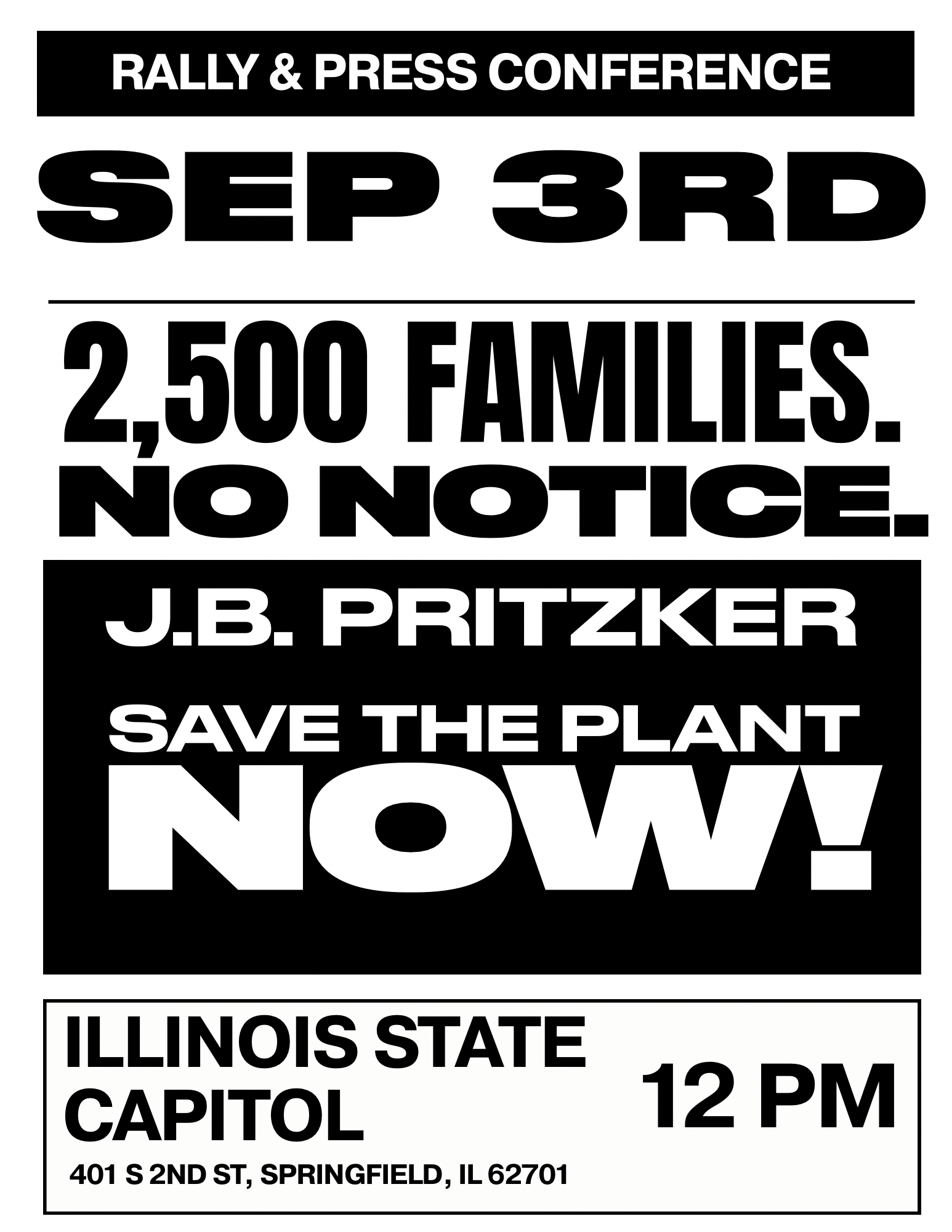
Several hundred Tyson workers and their families have continued organizing protests and rallies, calling on Illinois governor J.B. Pritzker to invoke eminent domain to bring the plant under state ownership and re-open its doors, and on Tyson to increase severance pay to six months. On September 3, workers and community supporters will caravan to Springfield to march on the state capitol building at noon.
“There are people who’ve worked at Tyson for 20 years, 30 years. People with health issues, people who are sick, people who can no longer work elsewhere,” Asselissime said in a speech at a rally of about 100 workers on August 27. “We need fair severance pay, so we can have a future.”
Caitlyn Clark is a national organizer at Essential Workers for Democracy (www.ew4d.org), an organization dedicated to rank and file member education and empowerment for workers in grocery, meatpacking, and retail.