Interview: How We Beat Back Nonunion Subcontracting at Kroger
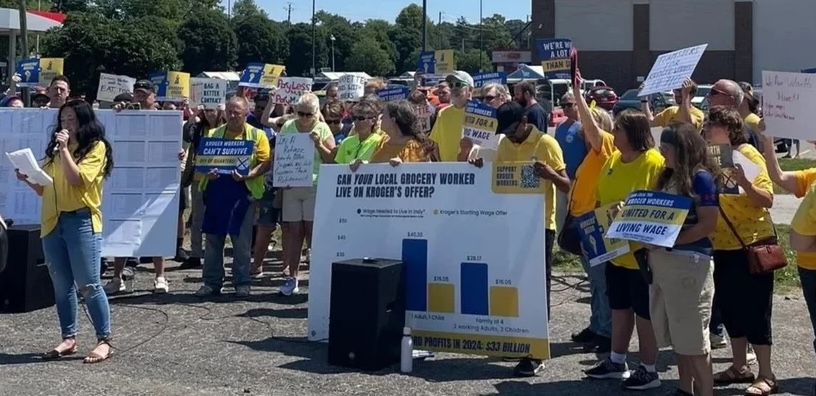
Kroger workers in Indiana beat back subcontracting of their work by persistent documenting and grieving. Photo: O.U.R. Local 700
After more than six months fighting against Kroger’s use of non-union subcontractors, members of Food and Commercial Workers (UFCW) Local 700 in Indiana won a victory in August, when Kroger announced it would be ending the Retail Odyssey direct store delivery (DSD) program entirely.
This means more hours for union members—thanks to those who organized to enforce the contract, file grievances, and educate their co-workers. In this interview conducted by Caitlyn Clark of the reform group Essential Workers for Democracy, shop stewards Andrea Reynolds and Kristen Jackson explain how they did it.
Essential Workers for Democracy: What is Retail Odyssey and why is it a problem?
Andrea Reynolds: Retail Odyssey is a nonunion third-party contractor that solely services Kroger stores. Normally RO does things like rearranging a store layout or auditing whether products are displayed the way the brand wants.
A few months ago, the Kroger Central Division here in Indiana developed a new program utilizing RO employees to stock direct store delivery vendor items on weekends. [DSD items are delivered straight to the store by the supplier, rather than coming through a Kroger warehouse.]
Why is this a problem? Kroger has employees who need hours. This isn't “extra help.” Kroger wants to phase nonunion third parties into the stores to cut hours of its union employees. If we don't speak up, it will only get worse. We’ve seen this happen already with cut fruit vendors, outdoor floral products, floor cleaning, and gift cards, just to name a few.
How did you and your co-workers start taking on Retail Odyssey?
Reynolds: We immediately started gathering as much accurate information as we could and passing it along to our co-workers. We shared information in our Facebook group and we shared flyers with our co-workers.
We wanted them to know why this was a problem and what they could do about it. The company wants us to think that third parties are there to make our jobs easier. But time and time again, we see our hours cut and wonder why.

We also passed along the feedback of our vendors. Their products were being damaged, mixed with other vendors, and stocked incorrectly.
Kristen Jackson: Although in the pharmacy, I am not as impacted, my union brothers and sisters are. As a steward, I try my best to let others know what is wrong with RO taking our work.
I walked around and talked to my co-workers about what the RO workers were allowed to stock. I told them if they saw them, to please take pictures, talk to the RO workers, and be nice.
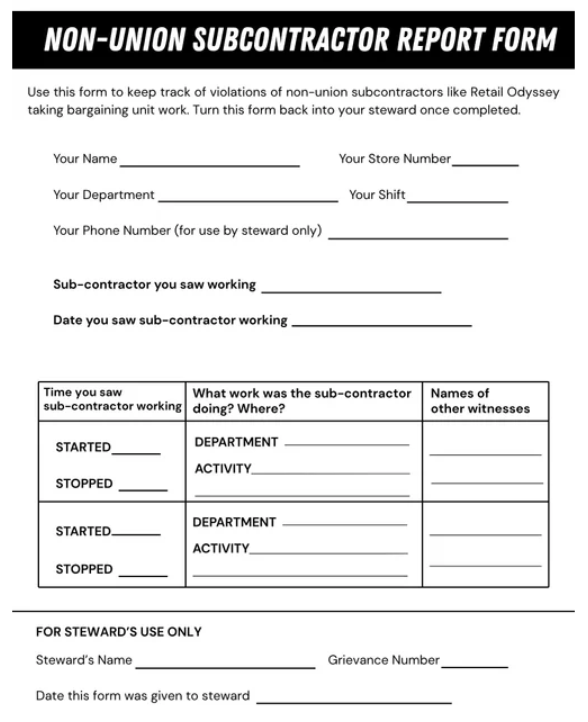
How did you collect information to file grievances? How did you make sure grievances got filed and processed?
Reynolds: Retail Odyssey was scheduled to work Friday through Sunday, noon to 6 p.m. I had a lot of conversations with members I knew were normally there during those hours.
I instructed them to take photos, make note of the day, time, duration of stocking, what non-vendor products were stocked, and anyone who witnessed it. We had them send this info to our stewards or trusted employees who could contact our union rep.
Every week after the grievance was filed, we messaged our reps asking for status of the grievance. We didn't want it to fall through the cracks.
Jackson: I just went up to the RO workers, introduced myself as a steward, and let them know I would be taking pictures of them and why. I explained, “I'm not against you having a job. I'm here to document Kroger violating our contract.”
The RO workers were understanding, and would tell me that the manager told them to stock our product and let me file the grievances. The RO worker at my store location would tell me exactly what he stocked, so I could file the grievances effectively. We filed three grievances at my location.
What advice would you give to anyone dealing with non-union subcontracting?
Reynolds: Document, document, document! You need to prove there was a contract violation.
Talk with your co-workers about how to document. Contact your rep. Don't hesitate to ask for help from a steward or a trusted member.
You have power in your numbers. The more members speaking up, the better! We filed so many grievances in six months that the third-party DSD program has officially ended. When we fight, we win.
Andrea Reynolds and Kristen Jackson are UFCW Local 700 shop stewards in Kokomo and Zionsville, Indiana. Caitlyn Clark is the director of Essential Workers for Democracy.