
Fourteen Hundred Solar Manufacturing Workers Join the Steelworkers

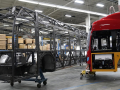
The Michigan win could boost union drives at Corning's North Carolina fiber optic plants that are key to the ambitions of Amazon, Meta, and Nvidia. Photo courtesy of the United Steelworkers.
Workers at a Corning solar manufacturing plant in Michigan voted September 1 to join the Steelworkers (USW).
The vote was a close 520 to 512, following an intense anti-union campaign by the company.
Nakisha West, a wirecutter, voted yes for “fairness and accountability.” She and her co-workers use scorching heat and precision-cutting tools to turn polysilicon crystals, or boules, into slim squares, known as wafers, for solar panels.
“It’s a very dirty job, but somebody’s gotta do it,” she said.
It’s been more than a decade since that “somebody” was a worker in the U.S.; nearly all the world’s wafers are produced in China. But in January 2025, Corning received $325 million from the federal government to build a solar plant across the street from its semiconductor plant in Hemlock, Michigan, which employs more than 1,000 more workers.
The Hemlock Semiconductor plant is one of only two plants in the U.S. that produce the solar-grade polysilicon. Because it produces this material domestically, Corning is insulated from the effects of the 15 percent tariffs that the Trump administration imposed in August on imported products made with polysilicon.
The 1,380 Corning workers represent the largest victorious union drive in a manufacturing plant since the United Auto Workers unionized a Volkswagen assembly plant in Tennessee in 2024. The Steelworkers also notched a big organizing victory in 2023 with 1,400 school bus manufacturing workers at a Blue Bird factory in Georgia.
Corning employs 12,000 production workers in the U.S., in the fields of glass and ceramics, life sciences (laboratory tools), fiber optics, and solar. Its products include Gorilla Glass, ceramics for catalytic converters, optical communications cables, automotive glass, and iPhone screens.
The Steelworkers have long represented workers in several other Corning plants. After this win, the union now represents 4,400 Corning workers at facilities in New York, New Jersey, North Carolina, Kentucky, Virginia, and now Michigan.
But the company has increasingly been moving its operations to non-union facilities. Its fiber optic business is rapidly expanding, fueled by demand from data centers.
HARD FLOPS
The work at Corning is grueling and dangerous. The solar factory runs on a heavy production schedule, operating 24 hours a day, with workers on 12-hour shifts. They alternate between working two weeks on day shift and two weeks on night shift.
Another practice of Corning management, known as “hard flops,” means workers can suddenly be forced to go from night to day shift with very little notice. This, on top of the already brutal working hours, leads to more accidents, injuries, and write-ups.
Workers have to fulfill a strict daily quota of processing bricks into wafers. Workers say the task is difficult to accomplish when wirecutting machines break down frequently—repairing the machine can take an entire shift. When they don’t meet the quota, they get reprimanded and written up for poor performance.
West said workers were often disciplined for things that weren’t their fault, creating a high-turnover environment. “You ought to know who you’re hiring, put them in the right place,” she said. “Don’t set them up for failure. The job is very hard. We needed stability there.”
Many workers cited health and safety as major factors in their decision to support the union drive.
The factory itself was being built around her, West said, during her entire 11 months at Corning. It felt dangerous that her department would be operating wiresaws while contractors were still on site constructing the building.
Several fires and chemical leaks have occurred in the pulling department, West and others said. Workers there operate massive ingot pullers—two-story-tall machines that grow crystalline silicon inside a vacuum-sealed furnace.
Pulling is the most dangerous and potentially explosive department. A major accident there in March injured nine workers, adding urgency to the union drive.
BROKEN PROMISES
Workers also said the company has a long record of broken promises. For example, workers earn profit-sharing, but management recently changed that benefit to “goal sharing,” based on quarterly rather than end-of-year profits. This drastically reduced the added benefit workers had been promised.
“Their word wasn’t bond,” said West. “If it was, we wouldn't go through this.”

Glen Dowdy, a finishing operator, said management has constantly changed the rules and refused to give employees a handbook of its policies. “They just care about money and numbers,” said Dowdy. “That the hourly employees aren’t being treated fairly doesn’t mean jack to them.”
Changes to paid time off and sick leave policies incensed workers. Management forced workers to use sick leave in increments of six or 12 hours at a time, Dowdy and West said, even if workers only needed one or two hours for an appointment.
Under Michigan’s Earned Sick Time Act, all private sector workers are eligible to earn an hour of sick leave for every 30 hours worked, and can use up to 72 hours each year. However, Corning’s policies were causing workers to burn through their leave.
When workers began organizing, they studied how Corning paid similar workers at its other plants. They found out that Corning employees in New York, who are members of the Steelworkers, earn several dollars an hour more than the workers in Michigan, who generally start at $20 an hour.
A UNION IS BORN
The organizing drive began in March, Dowdy recounted, when five workers from the pulling department reached out to the union after the accident. Two weeks later, those workers had brought in 25 more people.
Workers built support by distributing leaflets and having daily conversations with their fellow workers. Often they did home visits and held meetings after working a 12-hour shift.
When the union drive erupted in the spring of this year, management begged workers for a second chance. “It was five months too late,” Dowdy said.
The Steelworkers filed for an election on August 11, and voting began three weeks later.
As soon as the union filed, Corning hired 120 new employees, presumably an attempt to dilute the pool of pro-union workers and increase the number of people the organizing committee would need to reach before the vote.
And Corning ran an intense campaign to break the union drive, as it has at other plants. The workers were prepared for what to expect, because of lessons shared by USW organizers and workers from a fiber optic factory in North Carolina, where the company had successfully thwarted a recent organizing drive.
At the Michigan plant, management held in-plant meetings about the union twice a day. The Global Vice President of Human Resources flew in from New York to meet with workers. Twenty televisions were installed in common areas—including in the breakroom, at timeclocks, and even in production areas—to push anti-union propaganda around the clock.
Workers said they were illegally polled by management on how they planned to vote. Two days before the election, two workers were walked out of the factory for talking to a union organizer. They were reinstated when the union filed an unfair labor practice charge and demanded their return.
LIKE A SHOCKWAVE
Victory in the plant was “like a big shockwave,” Dowdy said. “Management is not walking around arrogant anymore.”
The win also has implications further south, as Corning focuses its expansion in areas where unions have a much weaker presence.
Besides solar manufacturing, Corning is a major player in the buildout of A.I. data centers because of its longstanding position in fiber optics manufacturing. The newest data centers use enormous amounts of fiber optic cable to transmit data through their servers.
Much of its expansion is happening in North Carolina, where the company has operated for a half-century and already has 5,000 fiber optics-related jobs across seven facilities, as well as its headquarters for optical communications. In right-to-work North Carolina, only 2.4 percent of workers belong to unions—the lowest rate in the country.
Through a new $6 billion deal with Meta to supply its A.I. infrastructure growth, Corning is expanding its non-union facility in Hickory, North Carolina—60 miles northwest of Charlotte— which will become the largest fiber optic plant in the world.
Corning also announced an agreement with Nvidia in May to build three new facilities in North Carolina and Texas, adding 3,000 workers. An additional 1,000 jobs in North Carolina are promised from a multi-billion-dollar agreement with Amazon in June.
The Steelworkers have been targeting Corning’s North Carolina facilities; the union already represents workers at the Wilmington facility, which opened in 1967. The union lost a vote among 110 workers at the warehouse in Tarboro in 2024, and filed for an election at a fiber optic plant in Winston-Salem in June but then called off the vote to take more time to shore up support.
The union will be looking to use the momentum from its Michigan win to encourage North Carolina workers to stand up to the union-busting and win a union at plants that are essential to the ambitions of the world’s most powerful tech companies.



You must log in or register to post a comment.