Running for Local Union Office: Building a Campaign Team
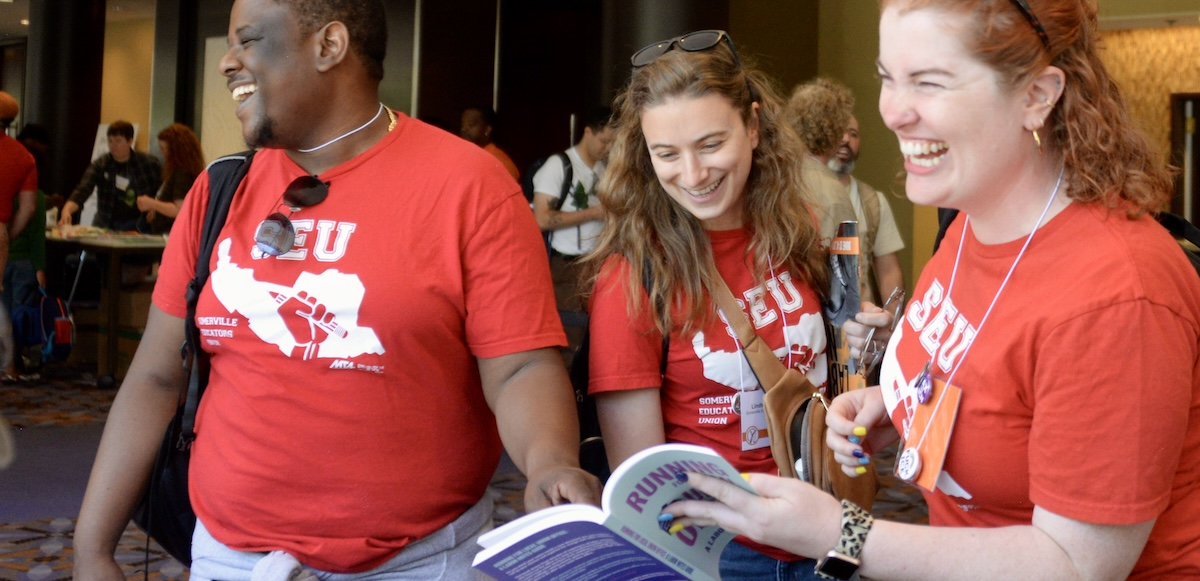
Somerville Educators at the Labor Notes Conference in Chicago in June found themselves mentioned in Labor Notes’ new book, Running for Local Union Office: A Labor Notes Guide. Photo: Jenny Brown
An excerpt from Running for Local Union Office: A Labor Notes Guide
As your union election approaches, you’re going to have a lot of work to do. Texting and phone banking. Campaigning. Getting all the last-minute details right.
Do you want to be doing all that work alone?
You can’t run a campaign by yourself, any more than you can run a local by yourself. Strong unions involve rank-and-file members. So do strong campaigns.
When most people think about their campaign team, they think, “Who can I get to run on my slate?”
That’s obviously important. But you should go broader. The more members doing something, the better, even if most only do a little.
You have to get comfortable asking for help, says Teamsters Local 135 organizer Vance Smith. “That four-letter word can do wonders for your campaign. If you can’t ask for help, you’re not going to win.”
“If you’re trying to build a democratic, transparent, member-driven union, you cannot do that by yourself,” says Rami Bridge, former president of the Somerville Education Association in Massachusetts. “If you don’t have a group, find that group first. Find people that want to see a change and are willing to do something about it.”
BIG AND SMALL ROLES
If you’re running for office, you probably know what a big commitment the union can be: all the meetings, the early mornings, the late-night phone calls.
Most members aren’t willing to be as committed as you are. That’s OK. Many are still willing to do something.
Your job is to bring together the people who are willing to do a lot, and work with them to organize and mobilize the members who are willing to do a little.
YOUR CORE TEAM
Your core team is made up of the people who will:
- Pass out campaign leaflets, shirts, and stickers
- Collect email addresses and phone numbers
- Endorse your slate and recruit other photo endorsements
- Talk to members and organize them to build support for the campaign
- Come to key campaign meetings and discuss strategy
- Build campaign events
- Text and phone bank to get out the vote
Ideally, your core team is bigger than the slate you’re running with. Without this inner circle, you’ll end up doing most of the campaign work yourself, and your campaign will suffer.
ACTIVE SUPPORTERS
Many members won’t come to a lot of meetings, but they will help out where they work. From the get-go, you want to recruit active supporters in key buildings and locations where you need votes.
Here are some of the things you can ask them to do:
- Identify issues where they work
- Confirm shift information and best times to campaign
- Tell you who supports you in their shop
- Pass out flyers
- Wear campaign buttons and shirts
- Identify leaders and influential people in their workplace
- Stand with you and introduce you to members when you campaign at their job
- Have their picture and a quote endorsing you in campaign literature
- Help with translation, if they speak another language
“When people decided to support us, we gave them tasks: talk to your co-workers and tell them what’s going on,” said Dwayne Johnson of Teamsters Local 322 in Richmond, Virginia. “A lot more people were leafleting and talking to members than were on the slate. That shows that you’re creating a movement.”
When the ballots are out, your active supporters can help get out the vote.

“We knew that to win our first election, it was going to take 1,200 votes. That meant we had to have at least 1,200 face-to-face conversations,” said Paul Santos, president of Rhode Island Teamsters Local 251. “Do the math. There’s two ways you can do that. You can have six people have 200 conversations each, or 40 volunteers can have 30 conversations.”
WILL THEY VOTE FOR YOU?
As you campaign, you’ll meet lots of people who say they’re going to vote for you. But not all of them will.
Why? Some people are well-meaning but forget to vote. Others are voting for the other team, but don’t want to hurt your feelings.
A smile and a handshake is not enough. If you get a potential voter to support you publicly, you’re much more likely to get them to vote for you. Public support can be as simple as wearing a campaign button or shirt.
Alano De La Rosa, now the president of Teamsters Local 90 in Des Moines, Iowa, said his campaign was constantly outside the workplace gates to meet members. “When people see you three, four times at their shop, they really get to know you and respect you.
“You need that one-on-one contact to get phone numbers and commitments. If a person won’t give you their phone number, they’re probably not going to vote for you.”
TIPS TO INVOLVE MEMBERS
- Hold regular meetings for your core group. Keep the meetings businesslike. Make room for discussion, but also make specific plans and assignments.
- Don’t confuse meetings with activity. Meetings aren’t campaign activity. They are to plan campaign activity.
- Make member-to-member contact the heart of your campaign. Talking one on one is the most powerful organizing tool. Petitions, social media, websites, and flyers are no substitute; they’re tools for getting people to talk.
- Map your local. Identify the key shops and potential leaders there, then make a plan for getting them involved. If you don’t know potential leaders in key workplaces, make a plan to get to know more members there by leafleting, asking supporters for contacts, or looking around at union meetings.
- Ask supporters to help you where they work. More people will do that than will come to your meetings.
- Start small and specific. Requests with a definite beginning and end are less intimidating. “Can you meet me from 7:30 to 9 a.m. next Wednesday to pass out leaflets?” is much better than “We need people to help us reach out to other members.”
- Ask people to do things they do well—especially at first. For some people this might be talking to their co-workers; for others, designing a logo or cooking for a fundraiser. As their confidence grows, so will their participation. Explain why you’re asking them. “You’re respected by the members in your building, that’s why I’m asking you to…”
- Tell each person how their job fits in with the rest. “Our goal is to reach members in every building with this leaflet. We have members covering A, B, and C locations. Can you cover D sometime next week? I’ll check in with you next Friday to see how it went.”
- Respect boundaries. Try to get people to take on more responsibility and get more involved—but also respect and appreciate what they’re willing to do. Not everyone will participate the same amount, or in the same way.
- Remember to say thank you.
- Don’t give up on people. If you think someone is a potential asset to your campaign, keep talking to them and asking them to get involved. But don’t badger or guilt-trip them. One “no” doesn’t mean “never.”
Your Slate Is Not Enough
Many union reformers’ default model is a hard-working slate that does everything. They rent a van and crisscross the local.
But if you want to win—and build a better union—you have to get a lot more members involved. Here’s why:
Incumbents can count on a ready-made network of stewards and other supporters who can turn out votes. You need to build your own network. You’ll have the best success in any worksite when respected people from that worksite are helping to campaign for you.
When you campaign, you will meet many people who want to help out. The traditional model does not put their support to good use.
Many locals are big, with numerous workplaces or units. Building support throughout the local will require more person-power than your slate alone can muster.
People who take active roles in the campaign will be primed to keep playing active roles in the union when you win.
Excerpted from Running for Local Union Office: A Labor Notes Guide available at the Labor Notes Store for $20.