Nurse Strike’s Focus Moves to Manhattan’s Richest Hospital Complex as Contracts Settle Elsewhere
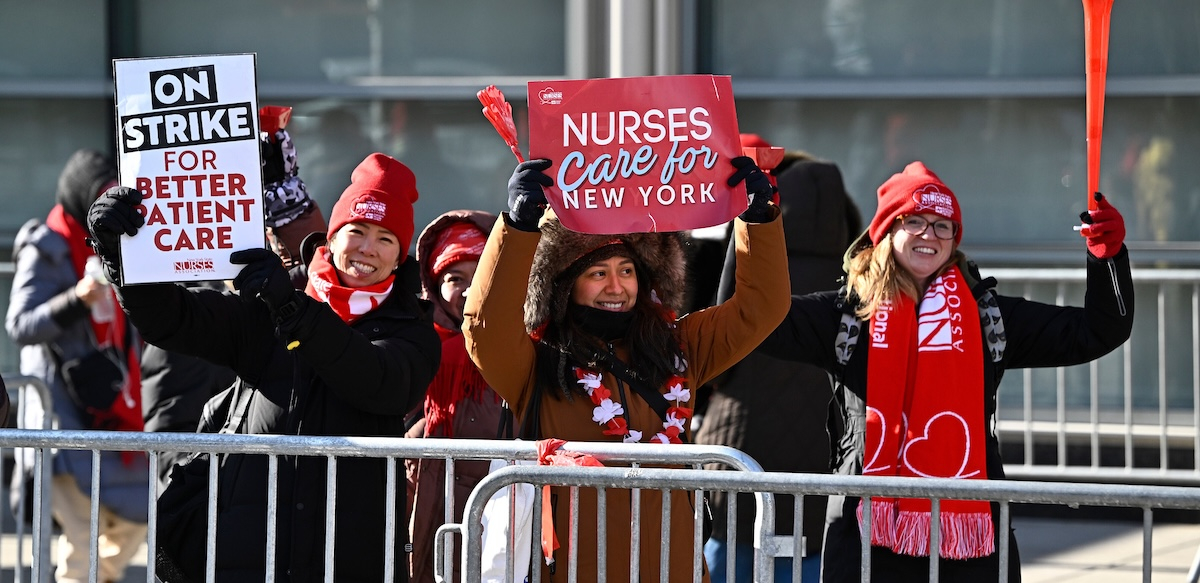
Nurses picketed outside NewYork-Presbyterian Columbia University Irving Medical Center in Manhattan. The NYP nurses will continue to strike after overwhelmingly voting down the company’s latest offer. (Photo by Anthony Behar/Sipa USA)(Sipa via AP Images)
The largest and longest nurses strike in the city’s history will continue at NewYork-Presbyterian Hospitals after nurses there decisively rejected the hospital chain’s contract offer 3,099 to 867.
About 10,500 other nurses will start returning to work Saturday, ending the strike at three Manhattan hospitals run by Mt. Sinai and at Montefiore Medical Center facilities in the Bronx. Those nurses overwhelmingly voted to approve contracts that maintained staffing ratio language, beat back additional health care costs, and added some protection from workplace violence and misuse of artificial intelligence.
At NYP, nurses expressed anger at the leadership of the New York State Nurses Association for pushing the contract vote over the objections of the negotiating team there.
Sophie Boland, a bargaining committee member, said the committee had just met with members when they heard they would be forced to vote on the deal to end the month-long strike. Members had agreed “this was going to be a dangerous contract to go back into the hospital with,” she said. “Because we still don’t have the staffing protections we need.”
The head of the negotiating committee got on Instagram live to say that the committee was still recommending a no vote on the deal, which came about through mediation between the hospital system and NYSNA leadership over the weekend. Members agreed, voting “no” by 73 percent.
“The proposal did not fix our core issues,” said another bargaining committee member, Tonya Fisher, an emergency department nurse at New York-Presbyterian Hospital, citing chronic short-staffing and protection against layoffs. “We have already seen what happens when protections are weak.”
The 4,200 NYP nurses are continuing to picket the hospitals in upper Manhattan, where they’ve been on strike since January 12. They are calling for support on the picket lines from other nurses, union members, and the public, in a showdown with NYP, the most fiercely anti-union of the city's hospital systems.
BACK TO WORK FOR SOME
At Mt. Sinai, nurses gained raises of 4 percent a year over the three-year contract. At Montefiore there will be a base wage increase of $15,000 over the life of the contract, and health care will continue without premiums.
The hospitals have cumulatively spent $100 million on traveling nurses to staff the struck hospitals. The striking nurses have been without health insurance and struggling to pay bills, picking up odd jobs or setting up GoFundMe pages. Many strikers have applied for unemployment benefits, becoming eligible on January 26 after a two-week waiting period. State law changed last year to shorten the wait for striking workers from three weeks to two.
New York Governor Nancy Hochul outraged strikers by continuously renewing an executive order that allowed the hospitals to hire out-of-state travel nurses. Normally, travel nurses would need a New York State license to practice. On February 2, strikers marched on Hochul’s office. She has renewed the executive order eight times, most recently this week extending it until February 17.
NYP THE WORST
NYP is the richest of the struck hospitals; CEO Steve Corwin raked in $26.3 million in 2024. According to the union, 30 of NYP’s executives get over $1 million in compensation each.
The nurses say dangerous staffing levels continue at the NYP hospitals: Columbia University Irving Medical Center (Milstein), Morgan Stanley Children’s Hospital, and Allen Hospital.
NYP has held out against staffing ratio language the union won at the other hospitals. When nurses do take unsafe staffing levels to arbitration, NYP has taken the unheard-of step of suing to avoid paying when arbitrators found it was understaffing. Some cases have been dragged through the federal courts for years.

SUPPORT LABOR NOTES
BECOME A MONTHLY DONOR
Give $10 a month or more and get our "Fight the Boss, Build the Union" T-shirt.
“Even if we do get a decision that results in a monetary compensation for short-staffing, they don’t agree to it, they won’t pay it,” said Boland, who works at Morgan Stanley Children’s Hospital at the pediatric intensive care unit.
In one case, the union said, nurses recorded that a high-acuity step-down unit was understaffed between 33 and 70 percent of the time during an eight-month period. A federal judge charged NYP with engaging in “gamesmanship” to avoid paying fines or resolving the disputes.
Boland said that at times the Emergency Department has up to 15 patients per nurse. “It’s totally unacceptable,” she said. “There’s absolutely no way that a nurse can take care of 15 ED patients at one time.”
NYSNA won expedited arbitration language at other hospitals after a three-day strike in 2023. It requires the hospital to pay penalties to nurses working in understaffed units. Most cases are resolved within three months.
The language is designed to discourage the hospital from violating staffing ratios, and there are signs that it works. Mt. Sinai has been fined at least $2 million for understaffing its labor and delivery, oncology, and emergency departments. A similar contract provision at NYC Health + Hospitals, the city’s public system, caused that system to hire 600 more nurses.
UNDERMINING UNION JOBS
Another issue at NYP is job security. Last spring, the hospitals cut 2 percent of staff—1,000 health care workers—claiming the action was in anticipation of government cuts to Medicaid. “They closed the palliative care unit, because dying patients don’t make them that much money,” said Boland. “This was a unit of incredibly specialized palliative care nurses, who spent their careers caring for dying patients.”
A division of specialty nurse practitioners were also terminated, she said. The cuts hit union members hard, and in some cases they were replaced with non-union practitioners.
After the NYP nurses learned they would be forced to vote on Tuesday, they held an online meeting with 2,500 attending. They maintained picket lines even though the union leadership had called them off. Then on Wednesday, 50 nurses marched to NYSNA headquarters, with a letter signed by 1,500, demanding disciplinary investigation of NYSNA’s executive director and president over their actions overriding the NYP nurses negotiating committee.
“Nurses feel deeply betrayed by the way this was pushed through,” said Fisher.
The strike is entering a bitter phase, and will need support. With other hospitals back to work, NYP management will have its pick of travel nurses to replace the strikers. And while NYP was not allowing any union members to work during the strike, management has said it will soon allow scabs to cross the picket lines.
“We could not allow our 30 days on strike to end without resolving one of the main reasons we went out in the first place: safe staffing and enforceable protections for our patients and our profession,” said Fisher. “NYP nurses are prepared to hold the line until hospital management returns to the table with a proposal that truly addresses these critical issues.”
The nurses are having a Valentine’s Day virtual rally from 2 to 4 p.m. on Saturday, February 14, and are asking for donations via Paypal to @NYPNurses.
Sindhu Sundar and Sarah Hughes contributed reporting.